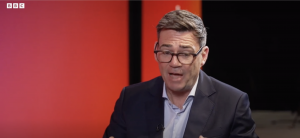
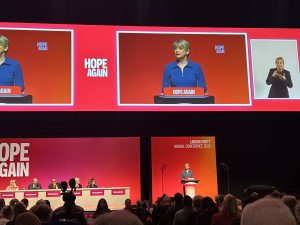
What two words sum up the 2026 Labour Party conference?
If you were to sum up the 2026 Labour Party conference in just two words, what would they be?
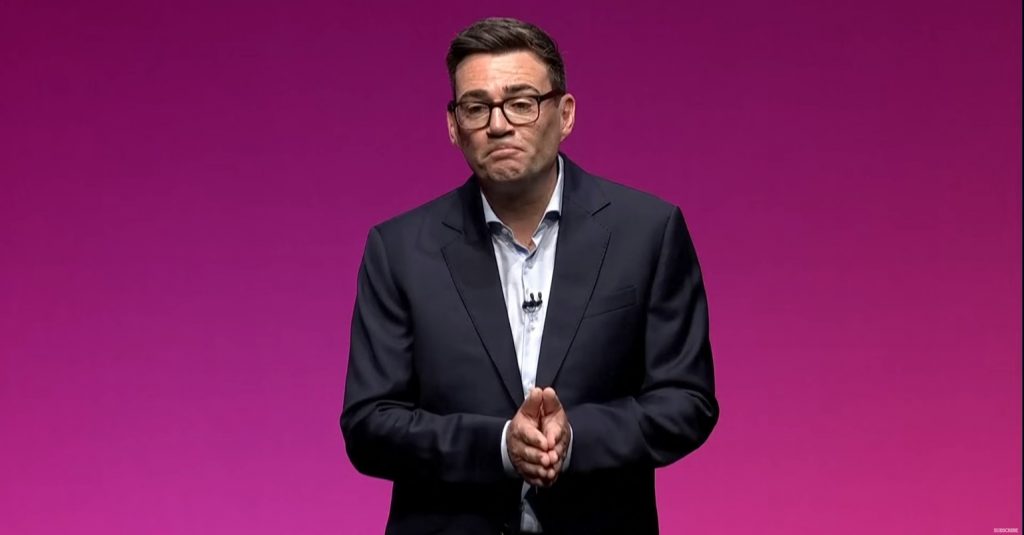
If you were to sum up the 2026 Labour Party conference in just two words, what would they be?
Those in Labour’s comms team would likely hope you’d say “hope again” – the slogan emblazoned throughout the conference centre.
Andy Burnham might hope you’d say “social care”, given his promise of major reforms to the system was one of the major announcements in his conference speech.
Democracy campaigners might go for “electoral reform”, what with Burnham committing Labour to fight the next election with that as a plank of its manifesto.
But what about “triple lock”? That’s the big political risk that Burnham has taken this year, with changes to it meaning that the state pension will likely rise more slowly in order to help fund the free social care service he hopes to provide.
Or how about “welfare reform”? That’s been an elephant in the room throughout the conference, with chancellor John Healey making a strong case for it in his speech, and the work and pensions secretary Pat McFadden arguing that it is a “moral crusade”.
Whichever words you chose, this conference has no doubt been a good one for Burnham. The mood throughout the event has been extremely positive, with delegates, MPs, councillors, mayors, trade unionists all exuding a sense of relief that the bleak tail-end of Keir Starmer’s premiership is over and that a reinvigorated party seems to have emerged. There’s been a spring in their step and a clear sense that the party has turned a corner.
Despite this, in the early days of the conference there were hints that the party faithful was itching for Burnham to move beyond vibes and to begin to put flesh on the bones of what his administration will deliver.
Some of that came on Tuesday, when Burnham gave his first Labour conference speech as prime minister. Changes to social care, electoral reform and council house building all featured heavily.
It’s safe to say it went down a storm in the room. That’s in part because of some of the key policy announcements that came within it. But again, it’s also quite a bit to do with the vibes, and the narrative Burnham gave around his vision for the future of the country.
In terms of the reaction, the speech was warmly received by the trade union movement. It also went down well among campaigners pushing for democratic reform. And on the big announcement around the triple lock, a rapid-fire poll suggests that the public are with him too.
More of that policy detail came elsewhere in the event too. While Burnham’s speech was obviously the main event, the rest of the Labour frontbench also addressed delegates in the main hall. With those speeches came a litany of policy announcements, including a commitment to plant half a million trees in England, new safe and legal routes for refugees from Afghanistan and Palestine, and a move to explore publicly owned trains.
One of the most significant of the speeches came from the chancellor John Healey, who used it to argue that a growing welfare bill is “not progressive”.
Given the scale of the rebellion against Keir Starmer’s attempts to make significant cuts to disability benefits last year, this priming of the party about forthcoming welfare reform has raised a few eyebrows. But the broad consensus among MPs appears to be that they’re not opposed to welfare reform per se – it all depends on what form it takes.
That’s the impression we got from speaking to Labour MPs – including Neil Duncan-Jordan and Rachael Maskell, both of whom had the Labour whip suspended under the Starmer regime due to their involvement in the rebellion against his benefit cuts. The devil – as they say – will be in the detail, and the view from MPs appears very much to be that they would be willing to back reform which seeks to get people into well paid work, but won’t be up for voting for significant cuts that sees the support that people who need it receive diminish. Watch this space for how this unfolds and whether this becomes a sticky problem for Burnham in the future.
While the conference generally had the feel of Burnham love-fest, there were indications that there could be dissent around the corner – and not just on welfare reform. The Socialist Campaign Group (the grouping of left wing Labour MPs) held a rally on the Tuesday of conference, during which speaker after speaker made clear that their support for Burnham was not unconditional and vowed to push for a more radical policy agenda. But even these notorious trouble-makers said they were content to give him the benefit of the doubt – at least for now.
But what of one of the big questions that was bubbling away in media circles prior to this conference? When will the next general election be?
Burnham was adamant before the event that he has no intention of calling an early election. He’s not deviated from that during his time at the conference, and it seems the party membership is with him. At one packed conference fringe meeting, attendees were asked to raise their hand if they thought he should call an early election. Not a single hand was raised.
And listening to the psephologists, you’d understand why. The polling expert Sir John Curtice spoke at a different fringe and was pretty frank. He said that Labour’s current standing in the polls was ‘not enough for anybody to contemplate’ holding an early general election.
Still – things can change. If the mood of optimism about the Burnham government migrates out of the conference hall and into the wider public, triggering a substantial shift in the polls, who knows whether the Labour leadership could resist going to the polls to try to secure more time in office…
That’s the narrative out the way. Here’s the full run down of all our coverage of what went on in Liverpool.
The interviews
- Jon Trickett MP: The existence of the Labour Party is in jeopardy if Burnham doesn’t deliver – Chris Jarvis
- Patrick Hurley MP interview: Welfare system needs ‘fundamental reform’ – Chris Jarvis
- Rachael Maskell MP: Starmer’s welfare reforms were ‘reprehensible’. Any changes Burnham makes must ‘lead with our values’.- Chris Jarvis
- Last year’s Labour conference was ‘like somebody had died’. This year’s is ‘much more positive’. – interview with Neil Duncan-Jordan MP – Chris Jarvis
- Don’t cut benefits to fund defence spending, PCS general secretary tells Andy Burnham in interview at Labour conference – Chris Jarvis
- Kerry McCarthy MP on Andy Burnham, supporting the hospitality sector, and how to fight off the Greens – Chris Jarvis
- John McDonnell interview: ‘The only way to balance the books is through wealth taxes not welfare cuts’ – Basit Mahmood
The speeches
- Yvette Cooper tells Labour conference ‘Sure Start’s back’ – Basit Mahmood
- Labour pledges £79 million fund to plant half a million trees – Chris Jarvis
- ‘He’s shown whose side he’s on’ – Angela Rayner slams Nigel Farage in conference speech – Chris Jarvis
- How trade unions have responded to Andy Burnham’s conference speech – Chris Jarvis
- 5 key takeaway’s from Andy Burnham’s speech – Basit Mahmood
- Campaigners hail ‘historic moment’ as Andy Burnham announces national commission on electoral reform – Olivia Barber
- Shabana Mahmood announces UK will be opening ‘safe and legal’ routes for Afghan women fleeing persecution and ‘Palestinians who have fled the horrors of Gaza’ – Basit Mahmood
- Rail unions and campaigners welcome Heidi Alexander’s move to look at publicly owned trains – Chris Jarvis
- How trade unions have responded to John Healey’s speech at Labour conference – Chris Jarvis
- John Healey tells Labour conference “bigger and bigger” welfare bill is “not progressive” – Chris Jarvis
- ‘You were right’: Ed Miliband tells Labour conference ‘we hear you on Gaza’ – Chris Jarvis
- Pat McFadden primes Labour members for major welfare reform in conference speech – Chris Jarvis
- Lucy Powell says Labour is party of hope, optimism and change in conference speech – Chris Jarvis
- Steve Rotherham opens Labour conference making the case that devolution can dismantle Thatcherism – Chris Jarvis
The fringes
- Labour left vows to fight for more radical policy platform from Andy Burnham – Chris Jarvis
- Emily Thornberry calls for the introduction of rent controls in ‘housing crisis zones’ – Chris Jarvis
- UK is closer than ever to getting proportional representation, Labour MP claims – Chris Jarvis
- Labour’s poll lead ‘not enough for anybody to contemplate’ an early election, Sir John Curtice tells party conference – Chris Jarvis
The rest
- ‘Tax the rich’ – Zack Polanski criticises Burnham’s triple lock plans – Chris Jarvis
- Snap poll suggests public supports scrapping triple lock to fund national care service – Chris Jarvis
- Labour Party conference supports wealth tax to help workers – Basit Mahmood
- 99% of Labour conference attendees back public ownership of Thames Water in straw poll – Chris Jarvis
- Unison general secretary to urge Andy Burnham to ‘do the right thing’ and drop immigration reforms at Labour conference protest – Olivia Barber
- Sharon Graham tells Andy Burnham to reduce tax burden on working class – Basit Mahmood
- Andy Burnham confirms he is boycotting The Sun over Hillsborough – Basit Mahmood
The stuff that’s still to come
We’re not quite done yet! We’ve still got five more interviews to publish from this week. Keep an eye out for our conversations with FBU general secretary Steve Wright, Unite general secretary Sharon Graham, BFAWU general secretary Sarah Woolley, Labour for a New Democracy’s Laura Parker, and Labour MP Luke Akehurst.
Can you help?
Labour Party conference was the second in our calendar of coverage for this season. Next up, we’ll be in Brighton covering the Green Party’s conference. We’re proud to have provided some of the most comprehensive coverage of TUC Congress of any media outlet in the UK, as well as detailed coverage of Labour conference. But this reporting doesn’t come cheap.
If you haven’t already done so, please consider chipping in and donating today to help fund our conference season coverage.
Chris Jarvis is head of strategy and development at Left Foot Forward
Left Foot Forward doesn't have the backing of big business or billionaires. We rely on the kind and generous support of ordinary people like you.
You can support hard-hitting journalism that holds the right to account, provides a forum for debate among progressives, and covers the stories the rest of the media ignore. Donate today.
Donate today