Farage reminded of some basic Brexit facts after claims it has done the UK no economic damage
"Meanwhile back on planet earth by almost every economic & financial measure Brexit has been disastrous for the UK."
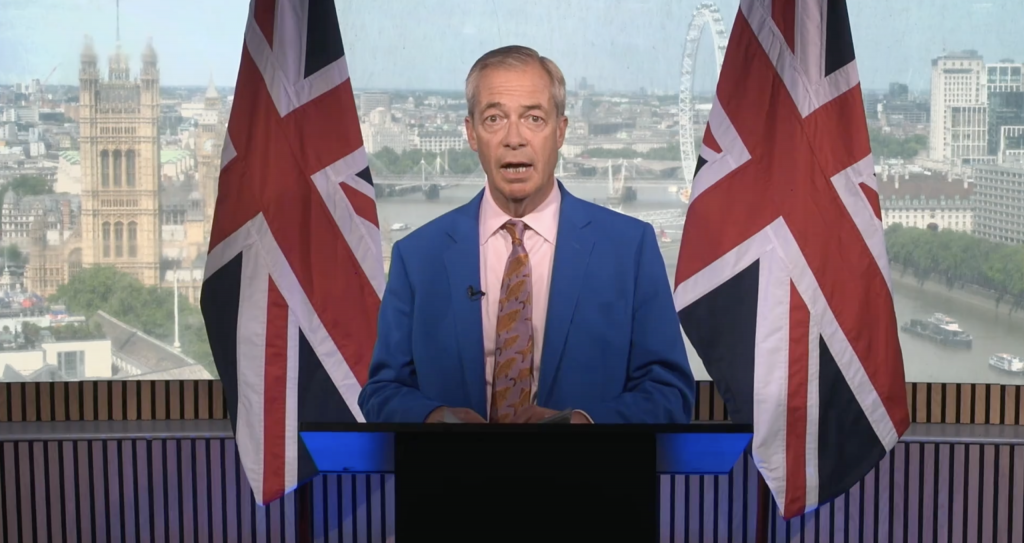
Nigel Farage has been ridiculed after claiming there is “not a single sign of any overall economic damage done by Brexit.”
Speaking on GB News in response to Andy Burnham’s suggestion that the UK could go “all the way” by rejoining the EU, the Reform UK leader dismissed the idea that Brexit had harmed the economy.
Lawyer and campaigner Peter Stefanovic was quick to challenge him, sharing a clip of Farage’s comments on X alongside a damning assessment:
“Meanwhile back on planet earth by almost every economic & financial measure Brexit has been disastrous for the UK. Is anyone seriously buying his bull****?”
Stefanovic then set out a series of economic indicators that undermine Farage’s sweeping claim.
The Office for Budget Responsibility (OBR) estimates that Brexit will ultimately leave UK productivity around 4 percent lower than it would otherwise have been.
Research published by the National Bureau of Economic Research in 2025 put the estimated hit to UK GDP at between 6 and 8 percent, equivalent to a loss of roughly £189 billion to £240 billion a year in economic output, according to the figures cited by Stefanovic.
The Resolution Foundation has also identified Brexit as one factor holding back wage growth, with weaker productivity and investment contributing to lower wages and squeezed living standards.
As Stefanovic argues, “The harm to the UK economy caused by Brexit has been entirely self-inflicted.”
Farage’s latest claim is also at odds with his own admission on BBC Newsnight in May 2023 that “Brexit has failed,” a remark that resurfaced in the mocking responses to his latest comments.
Farage has also claimed that British trade has increased “even with Europe.”
Stefanovic points out that the EU accounted for 48 percent of the UK’s total trade in 2016, compared with 46 percent in 2024. Those figures alone might not establish Brexit’s full economic impact, but they hardly suggest that leaving the EU has transformed Britain’s trading relationship with its largest nearby market for the better.
Nor have the much-trumpeted post-Brexit trade deals provided a convincing answer to the economic challenges of leaving the EU.
The UK-Australia trade agreement, for example, attracted criticism from within the Conservative government that negotiated it. In 2022, former environment secretary George Eustice admitted in the House of Commons that free from the constraints of collective responsibility, he no longer needed to put a “positive gloss” on the agreement.
He went on to declare “the Australia trade deal is not actually a very good deal for the UK” and that Britain had “given away far too much for far too little in return”.
That wasn’t a Remainer attacking Brexit, but a senior Conservative acknowledging the shortcomings of a deal negotiated by his own government.
According to official Department for International Trade estimates cited by Stefanovic, post-Brexit trade agreements were expected to add just 0.6 percent to GDP in the long run, a modest gain compared with the economic costs attributed to leaving the EU.
Investment provides further cause for concern. UK business investment stagnated in the years following the 2016 referendum, amid prolonged uncertainty over Britain’s future relationship with Europe. Its subsequent recovery doesn’t erase those lost years or prove the economy has returned to the growth path it might otherwise have followed.
Farage promised Brexit would deliver economic freedom and prosperity. Now, faced with mounting evidence of its costs, he insists there has been no damage. Denying the damage won’t undo it, or make the broken promises disappear.
As one commenter wrote in response to Stefanovic’s post:
“The damage done is so bloody obvious, look at skills shortage hospitality, farming and fishing sectors who mainly voted Brexit have been shafted. Business of all sizes affected.”
Left Foot Forward doesn't have the backing of big business or billionaires. We rely on the kind and generous support of ordinary people like you.
You can support hard-hitting journalism that holds the right to account, provides a forum for debate among progressives, and covers the stories the rest of the media ignore. Donate today.
Donate today