



Dave Calfe speaks with Left Foot Forward about fully nationalising the railway, the Employment Rights Act and the Birmingham bin strikes
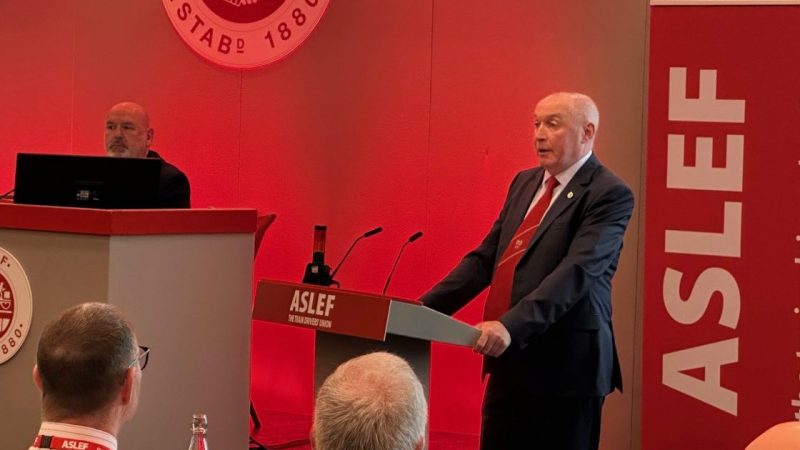
Forty-one years ago last week, Dave Calfe started out as a British Rail trainee train driver. On his first morning at the Carlow Street training school in Camden, he joined ASLEF union. The new intake, which was overwhelmingly male back in the 1980s, filled out their membership forms together and then listened to an initiation speech from the branch secretary.
Joining ASLEF was the done thing then, and apparently still is now. Today, ASLEF represents 96% of train drivers in England, Scotland and Wales. Meanwhile, Calfe is its newly elected general secretary, but insists this was not part of his grand plan when he joined the union as a shy 17-year-old.
Minimum age for train drivers
Calfe says ASLEF’s high uptake is down to the wins it delivers for workers. “We’re most definitely doing a lot right,” he says. Recent successes include resolving ASLEF’s two-year pay dispute when Labour was elected in 2024. The deal secured a 5% pay rise for train drivers in 2022-23, 4.75% for 2023-24 and 4.5% for 2024-25.
Since taking over from Mick Whelan on 5 January, Calfe has already secured an early win: the lowering of the age at which people can train to be a driver. After a seven year campaign by the union, the government will lower the age from 20 to 18 in July 2026, so that young people can enter the profession straight after leaving school. With around 40% of train drivers set to reach retirement age in the next five years, the change is hugely welcome.
Nationalising the railway
Over lunch with Left Foot Forward and a couple of other reporters, Calfe outlined his demands for this government. He wants to see a fully nationalised railway.
“We believe that all train services, freight and passenger should be nationalised in Great Britain, for the benefit of the taxpayer because money is leaking out of the system left, right and centre and it’s quite a bizarre way to run the railways,” he says.
Calfe says Labour should also bring the trains back into public ownership.
The three main Rolling Stock Companies (ROSCOs), Eversholt Rail, Porterbrook and Angel, lease out trains out to operators. In 2022/23, the companies, which are owned by investment management firms, paid out over £400 million in dividends to shareholders.
Calfe said the ROSCO system is “bizarre” not just because of the “onerous costs”, but because when operators want to make changes to a train, “you have to go back to the ROSCO and renegotiate with them to make a change to a train you’re paying for”.
In the Scottish Parliament last year, ASLEF urged the government not to use ROSCOs when replacing old ScotRail trains.
“Instead of governments going to ROSCOs and sort of mortgaging the rolling stock, they should raise the money through green bonds,” he says.
Calfe pointed to Merseyside as a successful example of direct ownership, where Labour Mayor Steve Rotheram has bought the Merseyrail trains outright. “They pay for themselves in a very short space of time,” Calfe says.
An Employment Rights Act “part two”
Asked about the Employment Rights Act, Calfe would be supportive of building on it with a “part two”. Though Calfe acknowledges that some parts of the act were dropped following lobbying from employers and the legislation going back and forth between the Lords and the Commons, he still describes it as the most “major change to employment legislation in a long time”.
One compromise watered down unfair dismissal rights from day one to a six-month qualifying period. “We could have perhaps waited longer for perfect, or we accept good. I think for the people it’s going to make a difference to, good is a good place to be,” Calfe says, adding that ASLEF will lobby Labour “to bring further improvements that got dropped off the bill for whatever reason and go in a future act.”
ASLEF’s relationship with Labour
Calfe recently signed the Restore Labour Democracy letter along with other trade union leaders and left-wing Labour MPs calling for an end to the factionalism under Keir Starmer’s leadership.
The general secretaries of Unite and Unison, Sharon Graham and Andrea Egan also signed the letter, as well as the Communication Workers’ Union and Fire Brigades Union.
Graham and Egan have already indicated that their unions could reconsider their affiliation to Labour.
However, Calfe said that at ASLEF, which has been affiliated to Labour since 1903, “we will continue to work with the government and make improvements not only for our own industry but for working people across the board”.
Regardless of what he thinks, he made clear that members would have to vote on affiliation at ASLEF’s conference.
When we spoke about the letter, Calfe seemed less concerned about the issues outlined in it. He said that the Labour movement “can get really wrapped up in a lot of things that working people don’t care about,” including who leads the party.
He said that Labour instead needs to focus on what people care about, including tackling insecure work and rebalancing the economy.
Reform
While most politicians and union leaders are alarmed by Reform’s lead in the polls, Calfe offers a more measured perspective.
He says that “Where Reform are is more a reflection of how disaffected people are with politics in this country. I don’t think it’s because they see Reform as some sort of saviour.”
Calfe seems optimistic that Labour can turn things around. “Three and a half years is a long time before the next election,” he says. He thinks that if Labour focuses on making working people better off, Reform may not maintain the lead it has now.
Birmingham bin strikes
There are some issues Calfe disagrees with Labour on. Much like Whelan, his predecessor, Calfe sees workers’ struggles as struggles that are shared across the union movement. Whelan was vocal about how doctors deserve to be paid more. Calfe, who has been to Birmingham to join workers on the picket line, said the bin strikes “have been made difficult when they don’t need to be difficult”.
Last week, the chancellor Rachel Reeves said the bin workers should get back to work. Labour-run Birmingham City Council got a court injunction banning people from protesting outside bin depots. Calfe has called on the government to step in and get Birmingham City Council back round the table with Unite.
“What you need to do is sit round a table and reach a resolution. Going to the courts does not resolve disputes,” Calfe warns.
The bin workers are being threatened with significant cuts to their pay. “None of us would accept it, would we, if someone came in and just said we’re going to take £8,000 a year off you,” he says.
“If we live in a democracy, the right to withdraw your labour is a fundamental part of living in a democracy and those workers have been balloted more than once, have returned to strike action in the same way that we went on strike to resolve our national dispute,” he says.
Olivia Barber is a reporter at Left Foot Forward
Left Foot Forward doesn't have the backing of big business or billionaires. We rely on the kind and generous support of ordinary people like you.
You can support hard-hitting journalism that holds the right to account, provides a forum for debate among progressives, and covers the stories the rest of the media ignore. Donate today.