Farage’s propaganda machine sets its sight on 15 million homes
Reform’s media empire and vast war chest raise urgent questions about political propaganda and independent scrutiny.
Imagine ‘The Reformer’ landing on your doorstep: an eight-page newspaper bearing Nigel Farage’s beaming face, loaded with anti-immigration messaging, and giving Reform UK another platform to tell voters why they should support them.
It may sound like political propaganda delivered free to your door. That, in essence, is the plan.
According to The Spectator, Reform UK is preparing to distribute The Reformer to 15 million households nationwide, a potential reach exceeding that of Metro, Britain’s most widely distributed free newspaper. Former Spiked editor Mick Hume is expected to play a leading role, with the publication featuring Reform policies, party announcements and comment pieces by Farage.
The party’s stated ambition is to bypass the traditional press and online gatekeepers. But this is about more than getting its message out. Reform is building a media operation capable of putting its own narrative directly in front of millions of voters, with little of the scrutiny that independent journalism is supposed to provide.

From Mussolini to Trump: the politics of controlling the message
Reform’s plans might be dismissed as an expensive propaganda exercise, but the wider implications deserve serious attention.
There are troubling parallels with the media strategies of other populist and authoritarian leaders.
Benito Mussolini founded Il Popolo d’Italia in 1914, initially as a pro-war newspaper. It later became a key instrument of fascist propaganda and political mobilisation. Donald Trump, meanwhile, has used his Truth Social platform to communicate directly with supporters, bypassing conventional press channels and issuing announcements that are quickly amplified across the wider media. As News24 has reported, Truth Social helps sustain a right-wing media ecosystem in which Trump’s posts are repeatedly circulated and echoed by sympathetic outlets.

Hungary offers another warning. Over 16 years in power, Viktor Orbán’s government and its allies consolidated much of the country’s media landscape through regulatory changes, financial pressure and takeovers. Pro-government outlets benefited from state advertising, while public service media increasingly served the government’s interests.
These examples demonstrate how political power can be strengthened when leaders don’t simply seek favourable coverage but build systems designed to control the flow of information itself.
Reform is not operating in the same circumstances as Mussolini’s Italy or Orbán’s Hungary, but its ambition to combine direct-to-voter publishing, digital journalism, video broadcasting and an enormous financial war chest raises legitimate questions about the balance between political communication and independent scrutiny.
A £72m war chest and a newsroom of its own
The Reformer freebie newspaper is only one part of the operation.
Reform has announced plans for a national publishing operation, including an expanded digital newsroom and a video channel, Reform TV, on YouTube.
Press Gazette reports that the party has built a video studio in Westminster and intends to recruit around 25 staff, including editors, multimedia reporters, social media specialists and a data and analytics lead. The aim is to turn its website into a national publishing operation ahead of the next general election and beyond.
The scale of the financial backing is terrifying. Reform is reportedly seeking to raise £100 million for the next election, with £72 million already raised. Two £36 million donations from cryptocurrency billionaires Ben Delo and Christopher Harborne have provided colossal firepower.
That level of funding could give Reform a communications operation with a reach few political parties could hope to match.
The concern is what happens when a political organisation with such resources builds an integrated media operation designed to dominate the conversation, while simultaneously attacking the credibility of independent outlets that scrutinise it.
GB News: Farage’s awkward double act
Yet, ironically, Reform TV could also create an awkward problem for GB News, where Farage has presented a prime-time programme for five years.
After a break of more than six months for campaigning, the Reform leader recently returned to his three-evenings-a-week presenting schedule. But how will the channel respond when its star presenter becomes the face of a rival operation with its own studio, newsroom and substantial funding?
Writing in the i, broadcaster Michael Crick has suggested Reform’s financial resources could threaten GB News, potentially setting up a battle between two right-wing channels built around the same political figure.

Farage’s media ambitions could undermine one of his most prominent platforms. But the more consequential issue perhaps, is the role political figures play in broadcasting, and the rules designed to prevent news coverage from becoming an extension of party campaigning.
Unlike newspapers, broadcasters in the UK are subject to statutory requirements for due accuracy and impartiality. Those safeguards are intended to protect audiences from the unchecked political influence that can accompany broadcast power.
Yet GB News has repeatedly attracted complaints and regulatory scrutiny. Between its launch in 2021 and March 2024, Ofcom received 21,671 complaints about the channel, according to figures previously reported by Left Foot Forward.
In March 2025, following a High Court ruling overturning earlier findings against Jacob Rees-Mogg’s GB News programme, Ofcom discontinued six remaining investigations into politicians presenting news programmes, including those involving Farage. The case intensified debate about whether the regulatory framework is adequate for a broadcasting landscape in which politicians can combine presenting roles with direct party leadership.
Former Guardian editor Alan Rusbridger has warned that Britain has, almost by stealth, allowed one political party to acquire what amounts to its own television station. The concern isn’t just that a broadcaster has right-wing views, but that political campaigning and news presentation can become increasingly difficult to distinguish.
Former prime minister Gordon Brown has also called for stronger media regulation, and for Ofcom to “be given more teeth.”
“I think we’ve got to look very carefully at GB News and all these broadcast companies that are emerging, because we’ve got a far wider range of broadcasters and the system of regulation is not good enough to cope with it,” he told Sky News.
Attack the watchdog, discredit the press
Farage’s ambitions extend beyond building his own platforms. He has repeatedly attacked the BBC, accusing it of left-wing bias, election interference and double standards, with Reform pledging to scrap the TV licence.
His response to critical reporting has followed a familiar pattern.
During the 2024 general election campaign, Channel 4’s undercover investigation captured a Reform canvasser making racist remarks about then-prime minister Rishi Sunak and saying the army should “just shoot” asylum seekers crossing the Channel.
Farage dismissed the investigation as a stitch-up, alleging that the canvasser was a paid actor. After facing criticism on Question Time, he accused the BBC of rigging its audience and attacked both broadcasters as partisan institutions.
Repeatedly portraying critical journalism as a conspiracy, risks eroding public trust in the very institutions responsible for holding politicians to account. And that is particularly concerning when the same politician is expanding his own media platforms and seeking to discredit the outlets that might scrutinise them.
Observer editor-in-chief James Harding has warned against assuming Trump-style attacks on the media could never happen in Britain. He argues the BBC’s independence was at stake and called for reforms to strengthen its protection from political interference, including removing the prime minister’s power to appoint its chair and board.
The question isn’t whether the BBC or other broadcasters should be immune from criticism. It’s whether independent journalism can survive if political leaders systematically undermine its credibility while building alternative channels over which they exercise far greater control.
The right-wing press: Farage or Badenoch?
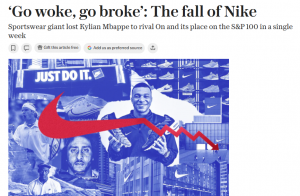
Farage’s relationship with the established right-wing press seems to be a bit more complicated. The Daily Mail, Telegraph and Express have often amplified Reform’s agenda, but their loyalties can shift between Farage and Kemi Badenoch.
Following the Conservatives’ recent party conference, the Mail enthusiastically declared “Kemi’s the new Thatcher,” embracing Badenoch’s promise to return the party to old-school values.
That enthusiasm coincided with polling suggesting the Conservatives had overtaken Reform to take second place nationally.
The Times reported that the figures would worry Farage’s strategists as the party struggled to halt its decline in support.
But when the Conservatives suffer setbacks or prominent figures defect, the same newspapers can quickly return to treating
Farage as the dominant force on the right. In January, the Telegraph gave former Conservative leadership contender Robert Jenrick a platform to declare: “I’ve joined Reform, and you should too.”
Brexbox TV – who?
Yet there is, perhaps, one tangible reason not to assume Reform’s media ambitions will succeed.
Farage has been there before. In 2019, his Brexit Party launched Brexbox, a short-lived YouTube and social media venture intended to bypass traditional journalists and deliver political commentary directly to voters.
“We thought we’d take matters into our own hands,” said Brexit Party MEP Belinda De Lucy at the launch.
But rather than being a broadcasting revolution, the show produced just 13 episodes before fading away into oblivion.
Its surviving broadcasts, which you can still watch on YouTube – if you dare – provide a glimpse of a predictable format: Brexit triumphalism, attacks on the press and theatrical denunciations of the EU. In one episode, presenting from the European
Parliament in Brussels, host David Bull announced, “the big bananas are in town,” as the UK and EU approached a Brexit deal.
Nigel Farage propped up the panel, decrying the deal as a dark chapter in what he’d spent 25 years of his life fighting for.
Brexbox’s demise is no guarantee that Reform TV will meet the same fate. The party now has vastly greater financial resources, an even more prominent leader and a more robust media strategy.

But it does illustrate that bypassing journalists doesn’t automatically create an audience or a lasting media operation.
The stakes are nevertheless considerably higher this time. Reform is not merely launching a newspaper or a YouTube channel, it’s attempting to build an interconnected political media machine, backed by extraordinary sums of money and fronted by a
leader who already enjoys extensive exposure in the legacy media.
Independent journalism isn’t perfect, and broadcasters and newspapers should always be held to account. But a democracy cannot function properly if political parties become their own newsrooms, their leaders their own broadcasters, and criticism is routinely dismissed as bias.
So, if The Reformer lands on your doorstep, you’ll know exactly where to shove it.
Gabrielle Pickard-Whitehead is author of Right-Wing Watch
Left Foot Forward doesn't have the backing of big business or billionaires. We rely on the kind and generous support of ordinary people like you.
You can support hard-hitting journalism that holds the right to account, provides a forum for debate among progressives, and covers the stories the rest of the media ignore. Donate today.
Donate today