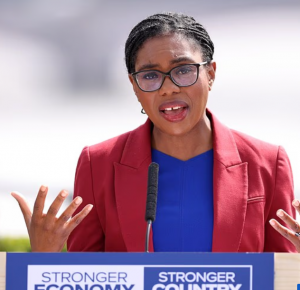
Kemi’s Thatcher tribute act has a Truss-shaped problem
If this is the Tories’ economic reset, the Truss-shaped elephant in the room is hard to miss.

If anyone thought the Conservatives might use their time in opposition to reflect on why they lost power after 14 years, Kemi Badenoch’s conference blitz offers a pretty emphatic answer – apparently, they think they simply weren’t right-wing enough.
At this week’s Conservative Party conference in Birmingham, Badenoch unveiled a raft of policies that would take the party further to the right, promising tax cuts, deregulation, a smaller state and a series of measures that would disproportionately benefit wealthier households.
In the process, the Tories aren’t only abandoning the centre ground. They are also junking, attacking or attempting to rewrite policies introduced by their own governments.
And then there is Andrew Griffith, Badenoch’s newly appointed shadow chancellor, a former Liz Truss minister who backed her leadership bid and was heavily involved in her disastrous economic strategy.
If this is the Tories’ economic reset, the Truss-shaped elephant in the room is hard to miss.
Kemi’s Thatcher tribute act
In her essay The Right Way, a 100-page statement on her guiding principles and a deliberate echo of Margaret Thatcher’s 1976 essay The Right Approach, Badenoch argues that the last Conservative government failed because it didn’t know what it stood for.
“The next Conservative government will have one central principle: business, not government, creates growth,” she writes, promising to deliver it through tax cuts, cutting red tape and reducing the civil service to pre-pandemic levels.
She also says politicians need to have “the stomach to say no to good causes when the resources simply are not there to do everything”.
The Tory press, unsurprisingly, lapped it up.
“Kemi’s the new Thatcher,” declared the Daily Mail, praising Badenoch’s pledge to remake the party in the Iron Lady’s image and return it to “old-school” values.

But beneath the Thatcherite rhetoric is a familiar political choice: shrinking the state while finding ways to make life easier for those at the wealthier end of the income scale. In the words of the old music hall song, as ever ‘it’s the tich wot gets the pleasure, it’s the poor wot gets the blame.’
A policy blitz for the better-off
Take childcare. Badenoch wants to abolish the £100,000 household income cut-off for free childcare, allowing all parents working 16 or more hours a week to claim the support.
On the face of it, extending childcare provision sounds like a welcome policy. The Tories acknowledge that the measure would cost around £700m a year, money they propose to find partly by cutting jobs at organisations including Arts Council England and the Environment Agency.
In other words, more state support for higher earners, paid for by shrinking public bodies and cutting elsewhere.
Then there is stamp duty.
Badenoch wants to abolish most stamp duty, presenting it as a measure that would help homeowners. But the distributional impact tells a rather different story.
Many first-time buyers already pay no stamp duty on properties worth up to £300,000, meaning the biggest gains from abolition would go to those buying more expensive homes. And because 60 percent of stamp duty is paid in southern England, according to Zoopla, the benefits would be concentrated disproportionately in London and the South.
In other words, scrapping the tax rather than reforming it would do little for many first-time buyers while handing a much bigger benefit to wealthier homeowners and those purchasing more expensive properties.
As would the abolishing of inheritance tax on a family home, another old-school Tory manoeuvre that would shovel £6bn of taxpayer money to the already-wealthy.
The proposal prompted accusations that the Tories were prioritising wealthy families over those struggling to make ends meet.
Tax Justice UK condemned it as a massive giveaway to some of Britain’s richest people, warning that it would deprive public services of vital funding at a time when they are already under pressure.
The Institute for Fiscal Studies (IFS) also warned it would disproportionately benefit people who already have substantial property wealth.
“The biggest beneficiaries would be those with the highest wealth and the most valuable homes – and their descendants. This is a very well-off group, mainly living in London and the South-East of England.”
Let’s not forget, it was George Osborne’s headline-grabbing promise to “take the family home out of inheritance tax” in 2007 that put Gordon Brown off calling a snap general election.
While Andy Burnham talks about levelling up the country and taking power and wealth away from London, Badenoch’s economic agenda promises the opposite, concentrating more of the gains in the wealthiest parts of the country.
More prisons, less overseas aid
The policy blitz doesn’t stop there.
Badenoch has promised 50,000 new prison spaces in England and Wales, a 50 percent expansion in capacity, partly funded by slashing overseas aid to £1bn a year, around a 90 percent cut from current plans.
That echoes a proposal previously made by Reform UK, which prompted warnings from aid organisations that such a cut would not even cover Britain’s existing contributions to international institutions such as the UN and World Bank, thereby shredding Britain’s influence in these spaces.
“UK aid is an investment in a safer, healthier and more resilient world. Protecting the UK aid budget protects us all,” said Gideon Rabinowitz, director of policy and advocacy at Bond, the UK network of NGOs.
And then came the high-profile pledge of an ‘Iron Dome’ for Britain. £10bn for an Israeli-style missile defence system to protect the country from missile and drone threats of Russian and Iranian aggression, paid for by welfare reform and reprioritisation of
other spending.
It’s quite a pitch from a party whose 14 years in government cut defence spending to the bone.
Yet the Tory press loved it.
“Britain needs an ‘Iron Dome’ to keep us safe,” screamed the Daily Express’s front page.
“Iron Dome lady,” announced the Sun.

The headlines may have been loud but the argument behind them is rather less convincing.
Enter the Truss connection
Perhaps the most ironic part of the Conservative conference was not Badenoch’s Thatcher-harpooning rhetoric but the man standing beside her economic agenda: Andrew Griffith, the party’s newly appointed shadow chancellor.
Griffith backed Liz Truss for prime minister in 2022 and served as her financial secretary to the Treasury, where he was closely involved in her disastrous mini budget, which led to a surge in gilt yields triggering her abrupt exit from Downing Street.
When Griffith was appointed shadow chancellor in August, Truss herself took to X to congratulate him.
“Congratulations to Andrew Griffith on becoming Shadow Chancellor,” she wrote. “The economic establishment of the last three decades has failed Britain. They must be taken on.”
In his keynote conference speech, the shadow chancellor promised to follow in the footsteps of Thatcher’s chancellor Nigel Lawson by cutting at least one tax at every budget under a future Conservative government. This rather ignores the fact that the famous Lawson 1987 budget restoked the flames of inflation which the Thatcher government and even more the British people, had worked so hard to bring under control.

Griffith’s Lawson re-tread includes scrapping Labour’s so-called “mansion tax,” the additional council tax levy on properties worth more than £2m due to come into effect in 2028.
Griffith called it a “vindictive levy,” claiming it would hit people living in “ordinary homes”.
An ordinary home worth more than £2m? I’m not sure I know many people who live in one.
He also pledged to scrap the net-zero-related “grocery tax,” which is actually the extended producer responsibility levy that charges businesses for the packaging they use and is intended to encourage less environmentally damaging packaging.
Yet another policy developed under the Conservatives, during Michael Gove’s time as environment secretary no less, before being implemented by Labour.
Yet Griffith now wants to axe it in the name of cutting red tape.
The Truss lesson – apparently learned, but not quite
And here the Tories’ economic argument becomes particularly interesting.
Griffith has criticised Andy Burnham for failing to explain how his policy commitments will be funded, warning that the Labour government risks making the same mistake as Liz Truss’s 2022 mini budget.
This is a particularly bold criticism coming from someone who backed Truss.
Griffith has continued to defend the underlying tax-cutting ambitions of the mini-budget, while arguing that its fatal flaw was failing to set out clearly how the tax cuts would be paid for.
As he himself put it, that was the “mistake of Liz Truss’ mini budget”.
Quite.
Because the problem with the Conservatives’ latest blitz is not simply that it contains lots of tax cuts and spending commitments. It’s that the party appears to be repeating the same ideological impulse that helped produce the Truss experiment in the first place: slash taxes, shrink the state, deregulate and hope growth follows.
The difference, apparently, is that this time they promise to explain how they will pay for it.
Hard choices – after 14 years of avoiding them
Griffith also accused previous Conservative leaders of failing to govern as genuine free-market conservatives, attacking Burnham and John Healey for supposedly wanting to return Britain to a “socialist fever dream of the 1970s”. Of course, returning the country to the 1950s and ‘60s when levels of growth far exceeded anything achieved since is never mentioned. Strange that!
There is something rather extraordinary about hearing Conservatives who governed Britain for 14 years accuse others of avoiding hard choices.
As LabourList noted, one of the more tone-deaf moments in Griffith’s speech came when he claimed the Conservatives would be “the ones to make the hard choices”.
That is a curious boast from a party whose record in government included enormous increases in national debt, years of austerity and a mini budget that sent financial markets into turmoil.
And if Griffith’s conference speech was supposed to demonstrate the political force of this new Conservative economic agenda, it was not exactly an electrifying display.
The Guardian’s John Grace described it as the “worst speech ever heard”, noting the empty seats and lacklustre response that was “like watching a less sentient version of the PG Tips monkey.”
It’s a world apart from the Thatcher-Lawson supposedly glory days the Conservatives appear so desperate to recreate.
The same old Tory economics, just further right
Strip away the Thatcher references and Iron Dome Lady headlines and Badenoch’s vision looks remarkably familiar: more tax cuts, less regulation, a smaller state and policies tilted towards the better-off.
The Conservatives appear to believe they lost power because they were not right-wing enough. But with a former Truss minister now sitting in the shadow chancellor’s chair, their supposed fresh start looks less like a reset than a rerun – only further to the right.
Gabrielle Pickard-Whitehead is author of Right-Wing Watch
Left Foot Forward doesn't have the backing of big business or billionaires. We rely on the kind and generous support of ordinary people like you.
You can support hard-hitting journalism that holds the right to account, provides a forum for debate among progressives, and covers the stories the rest of the media ignore. Donate today.
Donate today