Telegraph criticised for blaming Suffolk wildfires on ‘rewilding’
“Some of the oldest surviving heathland in the UK burns in unprecedented temperatures and Telegraph headline says “rewilding” is to blame.”
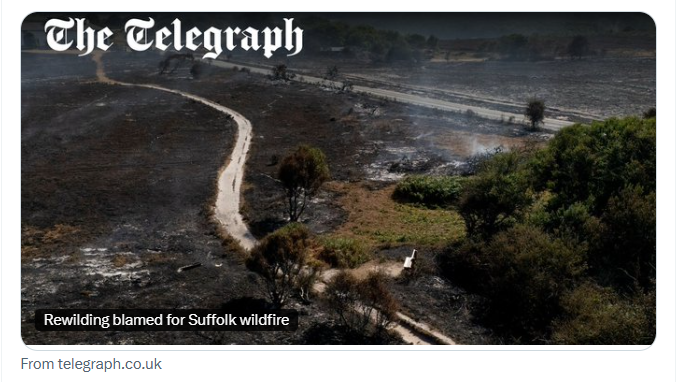
The Telegraph has been criticised after attempting to link the devastating Suffolk wildfires to ‘rewilding’ rather than the extreme weather conditions that experts say have dramatically increased fire risk.
Rewilding, alongside organisations such as the National Trust and the RSPB, has long been a favourite target of the right. Few episodes illustrate that better than the controversy surrounding Sir David Attenborough’s series on wildlife in 2023, when the BBC chose not to broadcast an episode examining the destruction of nature on its main channels amid concerns about a political backlash.
Senior BBC sources told the Guardian that the decision was taken partly to avoid criticism from Conservative politicians and the right-wing press. At the time, the Telegraph had attacked the BBC for creating the series and for taking funding from “two charities previously criticised for their political lobbying” – the WWF and RSPB.
It was hardly surprising therefore to see the newspaper publish the headline this week entitled: “Rewilding blamed for Suffolk wildfire.”
The article is focused on the 371-acre blaze that began on the RSPB’s Minsmere reserve before spreading to the National Trust-owned Dunwich Heath. It claims residents and experts believe the area had become a “tinderbox” because of the RSPB’s “rewilding agenda.”
One of the principal opponents cited is an anonymous local resident who criticised the RSPB’s land management and alleged its “green projects” had put nearby communities at risk. The piece also quotes Tim Bonner, chief executive of the Countryside Alliance, an organisation that has consistently opposed rewilding, who said the RSPB should “follow the evidence.”
“Refusing to manage upland vegetation because of political ideology or an obsession with rewilding is completely irresponsible,” Bonner added.
“As the Countryside Alliance has pointed out repeatedly, organisations that manage land should listen to science and evidence, and put landscapes, nature and livelihoods first. The RSPB are playing with fire.”
Only towards the end of the article were readers presented with responses from the organisations responsible for managing the land.
The RSPB said this summer’s fires had been “unprecedented in scale, driven by drought and prolonged heat exacerbated by climate change”.
A spokesman said: “While we work hard to reduce risk, it is important to recognise that wildfires are indiscriminate; they can ignite and spread quickly across a range of landscapes – from heathlands, grasslands and peatlands, to farmland, woodlands and areas close to homes and communities – particularly in hot, dry and windy conditions.
“We carry out ongoing habitat management across our reserves to reduce fire risk, including cutting firebreaks, rewetting peatlands, restoring bogs and wetlands, and improving water retention across vulnerable areas.
“We also run public awareness campaigns urging people not to use disposable barbecues, light campfires, or leave litter that could spark a blaze.”
The National Trust confirmed that assessment, pointing instead to prolonged drought and exceptionally low rainfall across England and Wales.
A spokesperson said:
“Our Suffolk colleagues are part of the local community and care deeply for Dunwich Heath and have long worked to reduce fire risk – maintaining fire breaks and regularly cutting heather.
“When the fire broke out, our team, neighbours, local agencies and the wider community rallied immediately, working alongside emergency services to cut additional breaks and help contain the blaze.
“Evidence shows healthier, wetter landscapes are more resilient to fire, which is why we prioritise nature restoration over routine burning.
“The wider issue is clear: climate change is accelerating, and we urgently need national leadership to help protect people, places and nature as we face a long recovery together.”
While the Telegraph’s headline suggested rewilding itself was responsible for the blaze, both conservation organisations pointed to the growing scientific consensus that hotter, drier conditions driven by climate change are creating unprecedented wildfire risks across many different landscapes.
The article prompted a backlash online. Celia Richardson, the National Trust’s director of communications, wrote on X:
“Some of the oldest surviving heathland in the UK burns in unprecedented temperatures and Telegraph headline says “rewilding” is to blame.”
Many readers accused the newspaper of using an environmental disaster to advance an ideological argument. One commenter wrote: “Who would want to advertise or buy this out-of-date, once-quality newspaper?”
Another said: “The truly jaw-dropping fact is that the Telegraph is still regarded as a serious newspaper.”
Others noted that catastrophic wildfires have also occurred on intensively managed land, including Scotland’s first recorded “megafire” at Dava, a managed grouse moor, last year. Critics argued that presenting rewilding as the primary cause of wildfire ignores both the wider evidence and the increasingly central role that climate change is playing in driving extreme fire conditions.
Left Foot Forward doesn't have the backing of big business or billionaires. We rely on the kind and generous support of ordinary people like you.
You can support hard-hitting journalism that holds the right to account, provides a forum for debate among progressives, and covers the stories the rest of the media ignore. Donate today.
Donate today