Nigel Farage wants us to think Clacton is a victory. Here’s why it’s not.
Farage may have won the Clacton by-election on paper, but the contest’s “vibes” told a very different story, argues Best for Britain’s Cary Mitchell
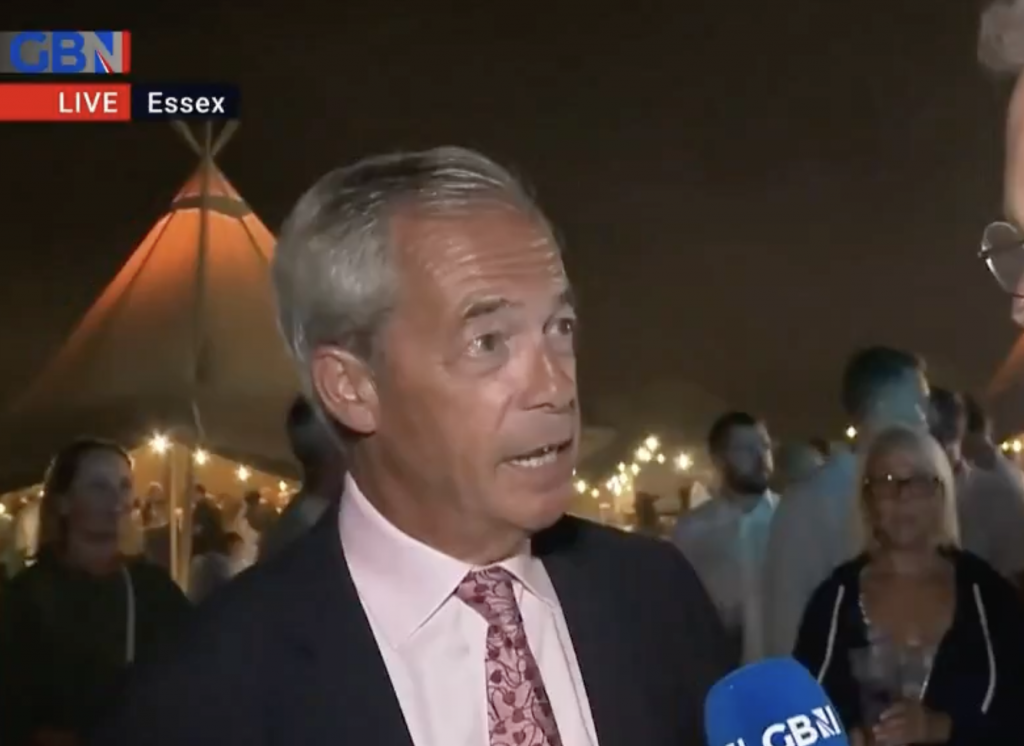
Cary Mitchell is the Executive Director of Strategy at Best for Britain, a group that campaigns against the radical right.
In the end, he didn’t even show up to the count. At a cost of some £250,000 to the taxpayer, Nigel Farage’s re-election in Clacton – at a by-election he called by resigning as the area’s MP in a rambling televised address railing against journalistic scrutiny – might just prove to be the most expensive bin day in history.
The Reform UK leader appears keen to claim the result (of one of the most surreal exercises in democracy of recent times) as an uncontestable triumph; a resounding victory of the supposed will of the ‘people’ over the nebulous ‘establishment’.
Speaking overnight, at an event dubbed ‘Farage Fest’, he thanked the supporters he termed “my beloved people’s army” and declared that the voters of Clacton had “stuck two fingers up to the entire political establishment”.
On paper and in numerical terms, Farage is irrefutably the winner of this by-election. With 22,239 votes to the 9,455 secured by his only real challenger, the self-styled intergalactic space warrior Count Binface, portrayed by comedian Jon Harvey, his majority is now more than 12,700 votes. A vote share of some 62.8%, to Binface’s 26.9%, and an increase on 2024’s 46.2%. The 32 remaining candidates (of the record 34, who lined up in a somewhat hallucinogenic array of costumes) did not hit the threshold to avoid losing their deposit money.
But those are the numbers. The vibes? Those were entirely different. The way the contest played out suggests something else is going on here; a changing narrative emerging, blinking into the daylight over Clacton Pier.
Ultimately, with all mainstream parties – as well as Rupert Lowe’s far-right Restore Britain – declining to field candidates, Farage may have fought the election on his turf – but in no sense on his terms.
Rather than operating squarely within his comfort zone, denouncing what he so often dubs “the uniparty”, Farage was forced, as former Chancellor Rachel Reeves memorably put it “to spend the summer arguing with a bin”. His critique of this monolithic blend of progressive and centrist parties, politicians and voters, alongside a slippery sense of establishment stitch-up – a liberal-woke-BBC-academia smoothie of grievance – was so much harder to land.
It’s tough to look or sound dignified under these circumstances, as any seagull could confirm, while wrestling fish and chip wrappers out of a dustbin. But Farage may face deeper trouble yet.
Clacton, when viewed through the lens of politics as two competing blocs, is an overwhelmingly right-leaning constituency; a faded seaside resort on the Essex Sunshine Coast, and home to some of the most deprived corners of modern Britain. And the voters of this bloc, as expected, came out to back him.
What today’s result also reinforces, is that dynamic operates – equally strongly – in the other direction. As we saw in Makerfield, at the Senedd, in Gorton and Denton, centrist and left-leaning voters will coalesce – eagerly – around the candidate most likely to stop Reform UK – and Farage.
Even, and national polls suggest perhaps especially, when that candidate is dressed as a waste receptacle. With some 1 in 4 voters opting to cast their ballots for Binface, the strength of opposition, even in his own backyard, is palpable…
Then, there was Farage’s mysterious absence from the declaration stage. His lack of attendance meant he avoided – as so many political figures before him have politely endured – the mild indignity of standing on stage and exchanging pleasantries with his array of cartoonish opponents. In a peevish show of less-than-geniality, he even derided them as “nobodies”.
In the wake of former Conservative MP turned Reform UK spokesperson Anne Widdecombe’s murder and the very real prospect of threats to politicians – on all sides – Farage’s claim of safety concerns cannot and should not be entirely dismissed. All such risks must be taken seriously. But the statement from Essex Police that no candidates had been advised not to attend prompts obvious question marks.
What’s more, looking beyond Clacton, as Reform UK will, or should, doubtless be doing today, the picture for Farage – long viewed as the Teflon man of British politics, is shifting. As expected, the Parliamentary standards investigation into whether Farage should have declared the £5m gift he received from the crypto-billionaire Reform UK donor Christopher Harborne, has been swiftly reopened.
The resumed investigation, the prospect of a recall petition, and the potential for a second by-election. Far from a clear path across the chessboard, Farage’s way remains littered with pitfalls, and hamstrung with tripwires. He is no longer facing an unpopular, even resented, Prime Ministerial opponent in a scolding, head-masterly Sir Keir Starmer.
Instead, Andy Burnham’s honeymoon period, his easy manner, positive and relaxed communication style and the ‘Burnham bounce’ in the polls, which has seen Labour overtake Reform UK, pose a very different and substantial set of challenges, as reflected in the party’s teetering performance.
Farage’s anti-immigration narrative has long proved divisive. His financial scandals, the conduct of those around him, and the profound and instinctive questions of fairness, for his carefully construed man-down-the-pub persona, could be destructive.
Left Foot Forward doesn't have the backing of big business or billionaires. We rely on the kind and generous support of ordinary people like you.
You can support hard-hitting journalism that holds the right to account, provides a forum for debate among progressives, and covers the stories the rest of the media ignore. Donate today.
Donate today