Woke-Bashing of the Week: Right mock museum’s decision to remove Egyptian mummies
“If the ancient Egyptians took great pains to mummify the body so that it might rise again, why are we figuratively spitting on their belief systems under the guise of ‘education’?”
The right-wing press has found another target in the so-called culture wars: Egyptian mummies.
As first reported by the Daily Mail, Kelvingrove Art Gallery and Museum in Glasgow has removed several ancient Egyptian human remains from display, citing a desire to treat the deceased with respect. Visitors are informed of the decision by a sign reading: “We have removed human remains from this display as a mark of respect.”
The decision reflects growing recognition within the museum sector that displaying human remains raises ethical questions, particularly when there is no evidence that the deceased consented to their bodies being exhibited.
But for the woke-bashing media, the move was an opportunity to wheel out a familiar culture-war bogeyman.
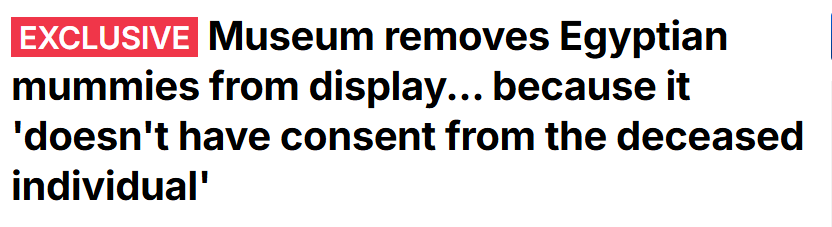
“Woke’ museum slammed after removing mummies due to ‘lack of consent’,” the Express’s headline declared.
The article explains that the exhibits removed include a mummified male head and right foot, a mummified right hand recovered from the Valley of the Kings in Luxor, and a painted coffin containing the remains of a priest.
It also reports Glasgow Life, the charity that runs the museum with funding from Glasgow City Council, says the decision reflects contemporary museum practice.
Nevertheless, the article gives prominent space to critics eager to portray the move as absurd.
Scottish Conservative MSP Murdo Fraser branded it “woke madness at its most ridiculous.”
“Even Egyptian mummies are now being cancelled by a society so obsessed with modern sensibilities that it has lost all sense of perspective,” he said.
Chris McGovern, chairman of the Campaign for Real Education and a former adviser to the Policy Unit at 10 Downing Street, similarly dismissed the decision as “more virtue-signalling, woke nonsense.”
He argued that it was impossible to seek permission from people who died thousands of years ago.
Yet this misses the point. The absence of consent is precisely the ethical dilemma, not a reason to dismiss it. The question is whether the fact that human remains can be displayed means they necessarily should be.
Glasgow Life has offered a clear explanation for its decision, pointing to the International Council of Museums’ revised Code of Ethics, published in June 2026, which states that museums should uphold the inherent dignity of human remains and respect their significance.
The charity also cited the All-Party Parliamentary Group on Afrikan Reparations’ 2025 report, Laying Ancestors to Rest, which raises concerns about displaying ancient Egyptian remains without sufficient regard for the wishes of the deceased or the communities that laid them to rest.
Glasgow Life’s draft Human Remains Policy proposes that such remains should only be displayed where documented, informed consent exists from the deceased or, where appropriate, their descendants.
“In the absence of such consent, we believe removing ancient Egyptian human remains from display is more respectful to the deceased individuals,” a spokesperson said.
That’s a considered ethical position, not an attempt to erase history. The remains have not ceased to exist, nor has the history of ancient Egypt been rewritten. The museum has simply decided that displaying human bodies is not the only way to educate visitors about the past.
Of course, museums must balance educational value, historical preservation and public access with respect for the dead.
Reasonable people can disagree about where that balance should lie. But dismissing the issue as ‘woke’ does little to engage with those competing responsibilities.
The Express and other critics also give little attention to those who welcome the decision.
Writing for Vice in an article entitled Why This Museum Is Removing Egyptian Mummies From Its Exhibits, journalist Jillian Drachman argues the move was entirely sensible, questioning why the remains of people who had been carefully mummified in accordance with their beliefs should be displayed for public consumption.
“If the ancient Egyptians took great pains to mummify the body so that it might rise again,” the writer asks, “why are we figuratively spitting on their belief systems under the guise of ‘education’?”
It’s a question worth considering.
But reducing that debate to a sneering headline and predictable denunciations of ‘wokeness’ is not an argument; it’s a way of avoiding one.
Left Foot Forward doesn't have the backing of big business or billionaires. We rely on the kind and generous support of ordinary people like you.
You can support hard-hitting journalism that holds the right to account, provides a forum for debate among progressives, and covers the stories the rest of the media ignore. Donate today.
Donate today