How the Right are trying to take over the Church of England
Can religious institutions retain their moral independence when political movements seek to define faith on their own terms?

It’s been almost impossible to escape coverage of the court poceedings involving Russell Brand and allegations of rape. Amid the endless headlines, one detail has emerged: Brand and his wife pray together before he heads to court.
Once an anti-capitalist, anti-establishment comedian who urged people not to vote, Brand has reinvented himself as a Christian influencer, aligning himself with populist, conspiracy-theorists and right-wing circles.
His X account, followed by more than 10 million people, now features regular broadcasts about his faith, alongside videos of him baptising people in a river, in his underpants.
While Christianity is built around the possibility of redemption, Brand’s newfound faith sits within a broader trend that deserves scrutiny: the growing convergence of far-right politics, manosphere culture and traditional Christianity.
Tommy Robinson has also embraced Christian imagery and rhetoric, with his rallies featuring Bible verses and crosses amid a sea of St George’s flags. He has even proclaimed a revival of “masculine Christianity” will replace what he dismisses as the established church’s “weak drivel.”
When Dame Sarah Mullally was named the next Archbishop of Canterbury, Robinson pointed to an earlier statement she had made in support of Black Lives Matter, declaring that “masculine Christianity” was coming to replace such supposedly weak expressions of faith.
“Their churches will stay empty, a Christian revival will grow on the streets. Masculine Christianity [sic] is coming not this weak drivel,” he wrote.
Christianity as a weapon in the culture wars
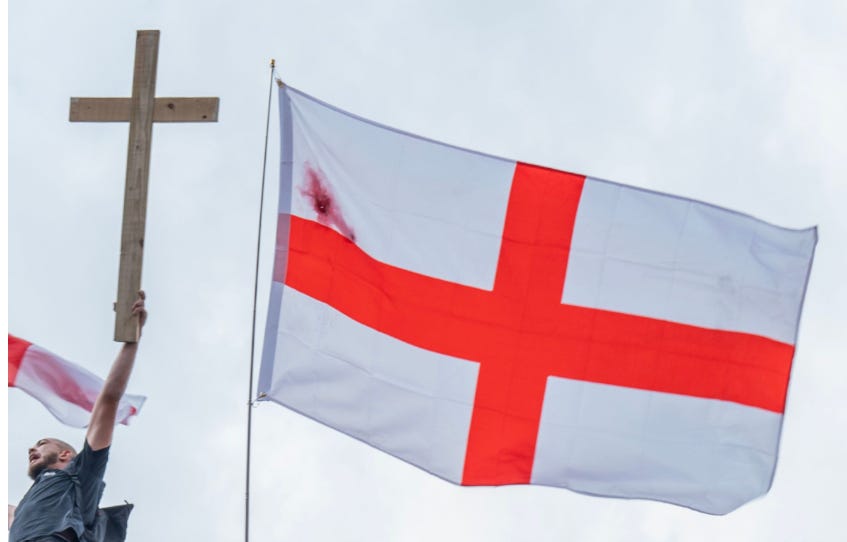
Research suggests this political appropriation of Christianity, in which central teachings of compassion, humility and care for the vulnerable are being repurposed as a political weapon against immigrants, Muslims and those deemed insufficiently patriotic, has little to do with regular religious practice.
A recent report by the think tank Theos, Beyond ‘Christian nationalism’: Measuring attitudes to Christianity and Britishness today, identified a group it calls “identity integrationists,” accounting for 11 percent of respondents. They see Christianity as fundamental to British identity and believe its heritage must be defended against threatening outside influences.
Yet just 13 percent of this group regularly attended church. Its members were also strongly hostile to immigration and Islam, while only 19 percent agreed that Christian values required welcoming and supporting asylum seekers.
For many, Christianity, it seems, appears to function less as a faith to practise than an identity to defend.
One Tommy Robinson supporter told the BBC he didn’t necessarily believe in God but felt compelled to attend church because he feared Christianity was being replaced.
This is religion shaped less by spiritual conviction than by cultural anxiety: an attempt to reclaim a supposedly lost national identity, with Muslims and immigrants cast as threats.
And church leaders have pushed back. In September 2025, Church of England bishops joined other Christian leaders in condemning the “co-opting of the cross” at Robinson’s Unite the Kingdom rally to divide people and exclude others.
Their message was that the cross represents sacrifice for others, while Jesus called on people to love their neighbours. Former Archbishop of Canterbury Rowan Williams similarly urged people to recognise migrants as vulnerable human beings.
But conservative figures have challenged the Church’s authority to speak on these issues. Ceirion Dewar, a bishop in the traditionalist Confessing Anglican Church, led a prayer at Robinson’s rally, describing his participation as a Christian duty. He argued that people there sincerely believed Britain’s Christian foundations were being eroded.
From the clergy to the courtroom
The battle is not confined to rallies and online influencers. It’s playing out within the Church of England itself.
Project Spire, a £100 million initiative addressing the Church’s historical links to transatlantic slavery, has become a target for Conservative politicians and religious traditionalists.
After 24 Conservative MPs and four peers criticised the project, Dame Sarah Mullally defended the Church’s “calling to confront historic injustice.”
Critics argued that spending the money was wrong when churches across the country were struggling to keep their doors open.
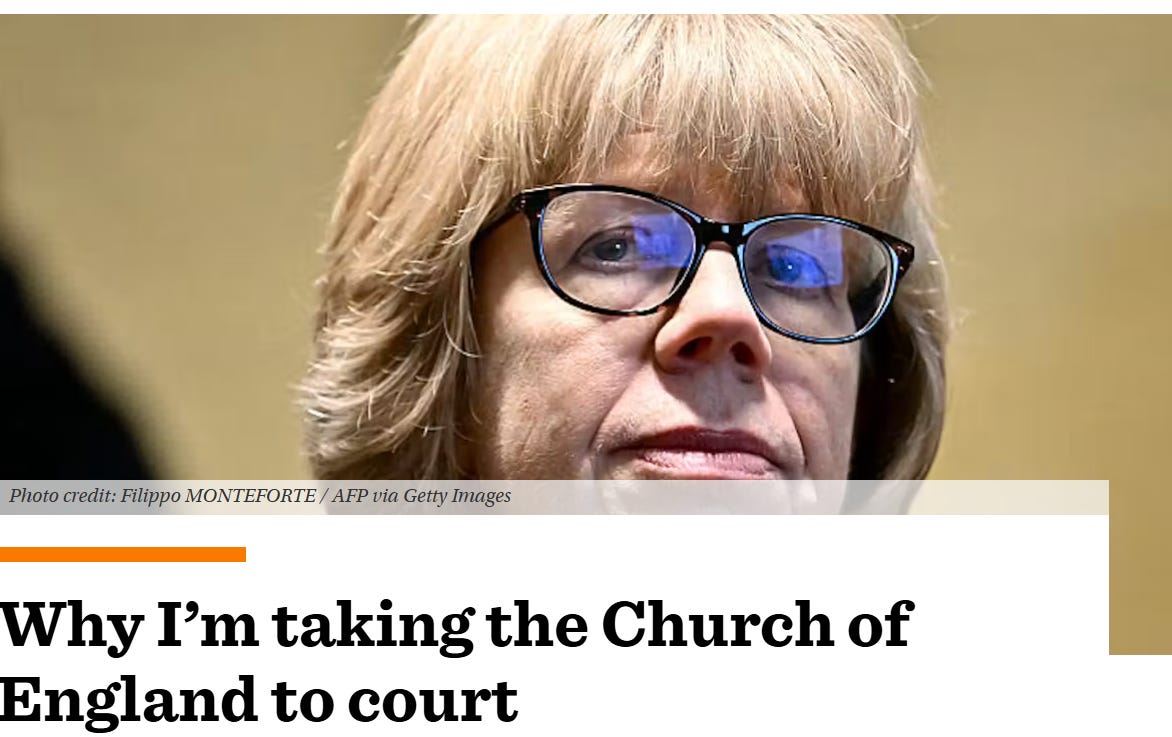
Jamie Franklin, a Church of England priest, went even further, taking legal action against the Church over the project. Writing in the right-wing magazine The Critic, he described it as legally, historically and morally dubious.
Thanks for reading Right-Wing Watch! Subscribe for free to receive new posts and support my work.
While the dispute might raise legitimate questions about how the Church should allocate its resources, it also illustrates how efforts to confront Britain’s historical injustices have become another front in the culture wars, with critics framing attempts at restitution as an attack on the institution itself.
Franklin’s claim to be defending the Church sits uneasily with his decision to take it to court. If the aim is to protect the institution, the question is whether this approach strengthens it or deepens its divisions.
A familiar right-wing playbook
Sadly, the fight over the Church of England fits a wider pattern. Institutions that embody aspects of Britain’s social and cultural life have repeatedly found themselves targeted by right-wing campaigns against so-called ‘wokeness.’
The National Trust has faced years of attacks from campaigners who object to its treatment of colonialism, slavery and Britain’s past. The NHS, meanwhile, remains a source of national pride, yet chronic underfunding under consecutive Tory governments has helped undermine public confidence and create opportunities for greater private-sector involvement.
The BBC has also long been a target. In November 2025, following controversy over its clumsy editing of a Donald Trump speech, Boris Johnson demanded that director-general Tim Davie either explain the changes or resign, declaring he would not pay his licence fee. Within days, Davie and the corporation’s news chief, Deborah Turness, had announced their resignations.

The recurring pattern is notable; institutions are portrayed as corrupted by progressive values, their authority undermined, and their defenders cast as enemies of the nation.
The Church of England is now caught in the same struggle, with its commitment to confronting historical injustice and welcoming vulnerable people increasingly at odds with a political movement that claims Christianity as its own. It does seem though that the far right’s capacity to co-opt fundamental values as exclusively their own – see patriotism, free speech, democracy itself – is meeting real resistance from Christians and their churches.
A global struggle for Christianity – ‘Judeo-Christian’ values
This battle is not uniquely British.
Across Europe, far-right parties increasingly invoke ‘Judeo-Christian values’ not as a commitment to religious principles, but as a cultural identity marker, defining a supposedly shared European civilisation against an imagined Islamic threat.
Research by Dr Toby Greene, a lecturer at Bar-Ilan University, found widespread references to Europe’s ‘Judeo-Christian’ roots among radical-right parties. The Alternative for Germany (AfD), for example, declares it:
“Opposes Islamic practice which is directed against our liberal-democratic constitutional order, our laws, and the Judeo-Christian and humanist foundations of our culture.”
Greene identifies comparable rhetoric from Marine Le Pen in France and Nigel Farage. Italy’s Giorgia Meloni has similarly cultivated an image of herself as a Christian mother, using religious identity as a political badge rather than advocating a consistent commitment to Christian doctrine.
The Catholic Church has also faced fierce opposition from conservative and traditionalist factions over its direction.
Pope Francis, who led the Church from 2013 to 2025, angered right-wing critics through his outreach to LGBTQ+ Catholics, his support for blessings for same-sex couples and his emphasis on climate change and economic inequality.
His successor, Pope Leo XIV, has likewise attracted attacks from MAGA-aligned figures in the United States. Steve Bannon and Laura Loomer have criticised Leo over his support for migrants and opposition to nationalist rhetoric, branding him “anti-MAGA,” “pro-open borders” and a “globalist.”
Such hostility exposes the political fault line running through Christianity: between a faith that calls for solidarity across borders, and one increasingly harnessed to nationalism, exclusion and cultural grievance.
The question is not whether Christians should engage in politics, nor whether churches should be immune from criticism. It’s whether religious institutions can retain their moral independence when political movements seek to define faith on their own terms.
If the right truly wants to defend the Christian tradition, it might start by taking its central teachings on compassion, humility and care for the vulnerable seriously.
Gabrielle Pickard-Whitehead is author of Right-Wing Watch
Left Foot Forward doesn't have the backing of big business or billionaires. We rely on the kind and generous support of ordinary people like you.
You can support hard-hitting journalism that holds the right to account, provides a forum for debate among progressives, and covers the stories the rest of the media ignore. Donate today.
Donate today