Andy Burnham ‘gets it’ on challenges facing musicians – interview with Musicians’ Union general secretary Naomi Pohl
Naomi Pohl spoke to LFF at TUC Congress
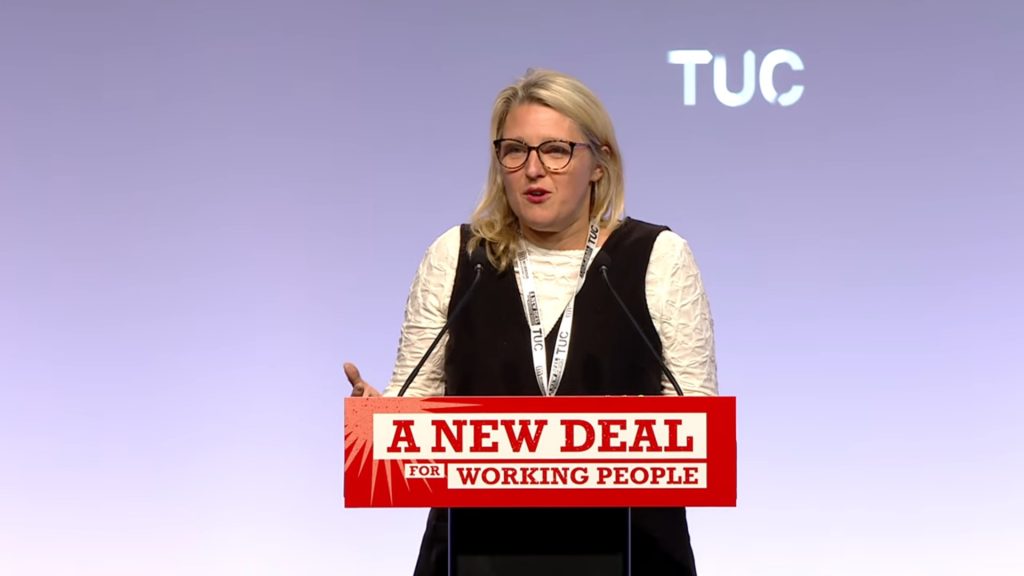
Naomi Pohl has been general secretary of the Musicians’ Union (MU) since 2022. In those four years, the music industry has faced major challenges, from the aftermath of Brexit to the rise of Artificial Intelligence (AI).
At this year’s TUC Congress in Brighton, LFF spoke to Pohl about these issues and what she wants to see Andy Burnham’s government do to address them.
Pohl began by telling LFF that Burnham “gets a lot of the issues” in the music sector and that he “understands the issues with generative AI and EU touring”.
She then went on to explain what the big issues facing her members around AI are. “Well, the problem that we’ve got at the moment is that to start with it was AI developers training on mass catalogues of works, but without any permissions in place”, Pohl said, adding: “But now the problem is that we’ve got licensing deals actually happening. So, for example, major record labels like Warner will go and license the catalogue to an AI developer.”
She continued by setting out what this means for musicians themselves, telling LFF: “Most artists are going to have contracts that predated generative AI and so there’s nothing in contracts that says if work is licensed for training purposes, what the royalty rate should be.
“So, what happened with music streaming is they went for the lowest possible royalty rate in the contract. And we think it should be a 50/50 split with the artist. But there’s no transparency around these deals – and session musicians, the backing musicians, get absolutely nothing just like [with] music streaming.”
What should the government be doing to address this? Pohl told LFF that it’s a combination of new regulation, strengthening existing laws around copyright, and establishing new rights for musicians in relation to AI.
She said: “We want regulation from the government. We want copyright laws to be strengthened. And ideally we want our members to have new rights that relate to AI so that anyone like a record label or an AI developer would need to come and seek permission from the musician and actually pay them something if they wanted those rights.
Pohl continued: “So if it’s just left to the market like it is at the moment, then we’ll end up with all these licensing deals done behind closed doors and there’ll be no transparency around how artists are being paid if at all.”
How confident is the MU that Burnham will deliver on this? Pohl told LFF: “I think that the word on the street is that Andy is maybe a bit more friendly to the creative industries. I think there was a bit of a concern that Keir Starmer’s administration maybe were more pro [the] AI sector and what growth that could deliver to the economy.
“But of course, the creative industries also deliver growth, and I actually think it’s not a binary choice. It’s not a case of the government can back AI or back music. Potentially, there could be licensing deals that are done that are fair if the government actually supports us.”
Aside from AI, one of the most pressing issues the MU is seeking to address is the impact Brexit has had on the ability for musicians to tour within the EU, and the consequences this has had for their income.
New research has estimated that between 2022 and 2024, the UK touring sector lost £208 million and 2,490 jobs due to reduced touring activity across Europe. The research also suggested that reduced touring by UK musicians resulted in estimated losses of more than £1 billion to EU member state economies.
Pohl told LFF: “I think in the previous set of negotiations with the EU, really the EU touring issue [was] seen as being a UK problem – like it affects our members more than it affects the EU. But I think the importance of this research is that it shows there is an economic impact on both sides of the border, and that there’s an advantage to us allowing touring and facilitating touring.
“So we want to see issues addressed like the cost of Carnets, which are the equipment passports that our members have to get, which can be minimum £300 or £400, but they can be thousands of pounds.
“We also want to see some sort of solution to the 90 day issue, where we’ve got at the moment our members are restricted to working or 90 days in a 180 day period. So if you’re on a long running show that’s touring in Europe, you have to come back after 90 days. Robbie Williams actually had to send back his whole crew tot he UK and bring out an entire different crew, which is just complete madness.”
Pohl continued: “We’ve got at the moment different rules in different territories, where we just need to have ideally one EU wide visa waiver agreement which would mean it would facilitate our members touring between territories without having to get visas and work permits for each individual territory.”
As with other unions that represent workers in the creative and arts sectors – such as Equity – the MU has another big concern at present: the ongoing BBC charter renewal process. The current charter expires at the end of 2027, and the government is therefore in the process of renewing and reviewing it, which will steer the future of the broadcaster for the next decade.
“We also want to see a decent license fee settlement for the BBC charter renewal, we want to make sure that they’ve got stable, secure funding”, Pohl told LFF, adding: “We want it to be a universal BBC, we don’t support the idea of having a two -tier system for people who pay a subscription and get better content or better access. For me, that’s not a message that this government wants to send to people – that you have to pay to get increased access. It should be the BBC should be for everyone.”
She went on to say: “The BBC‘s already made some commitments around use of AI. We’d like to see them go further. We’d like to have a firm commitment that they won’t use AI generated music and other creative content. We want to make sure that they’re still paying good salaries. I know that at the moment because of the state of the BBC and the fact that less people are paying the license fee, we’re not getting RPI pay rises.”
Chris Jarvis is head of strategy and development at Left Foot Forward
Left Foot Forward doesn't have the backing of big business or billionaires. We rely on the kind and generous support of ordinary people like you.
You can support hard-hitting journalism that holds the right to account, provides a forum for debate among progressives, and covers the stories the rest of the media ignore. Donate today.
Donate today