Andy Burnham’s government ‘markedly more competent’ than Keir Starmer’s – Equity general secretary
Paul W Fleming spoke to Left Foot Forward at this year's TUC Congress
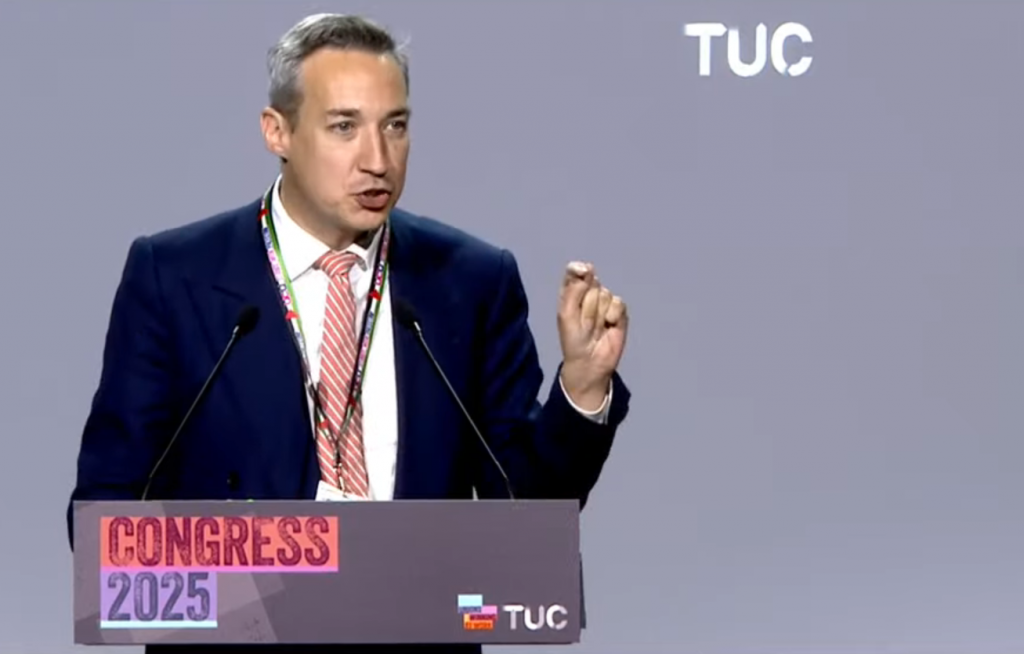
Paul W Fleming is general secretary of the creative workers’ union Equity. In an interview with LFF at last year’s TUC Congress, he gave a damning verdict on the Labour government under the then prime minister Keir Starmer, saying “they’re deeply unpopular, they’re broadly incompetent and nobody likes them”.
12 months on, there’s been a change of prime minister and a clear shift in the trade union movement’s attitude to Labour in power. When Fleming spoke to LFF at the 2026 TUC Congress, that shift was clear.
“I would say they are markedly more competent”, Fleming told LFF, adding: “I think there’s a a real reason for hope.”
He would go on to say: “I think a lot of the politics of the last two months has been very good – not responding to reform on a daily basis, setting the government’s own agenda, some good bold positions on devolution and on on on the economy and rebalancing people’s rights.”
While Fleming is positive about the initial signs from the new government, he’s clear that he feels there needs to be a big economic offer in the upcoming budget. Referring to Burnham’s promise to ‘end 40 years of neoliberalism’, Fleming said: “You can’t promise the biggest economic transformation in 40 years and have basically less than half of a parliamentary term to go and not make this budget a big one”, later adding: “there has to be something in there that’s a big ticket item about rebalancing the economy”.
Pressed on what he would like to see the government introduce in the budget, Fleming was clear that there needs to be significant announcements in areas beyond increased defence spending. He told LFF: “If the top line is defence and defence alone, we know that a defence program that is at the expense of everything else will cost jobs, not create them.
“Whilst defence spending is important, it cannot come at the cost of anything else. And I should like to see the reason as to why that’s the top of the list versus social security, arts and culture, education, the health service, all areas in which our members really do need to see some movement.”
Turning to the areas of economic policy that have a big impact on Equity members, Fleming said: “obviously there’s a million one things that I could point to in our industry, whether it be capital funding for RAAC or some restoration in arts funding or frankly meaningful reforms to social security to support the out of work artistic workforce.”
Beyond the budget, Fleming raised a number of other big things he wants the Labour government to tackle, including elements of Labour’s 2024 election manifesto that are yet to be delivered. While the trade union movement has generally welcomed the Employment Rights Act, Fleming argues that the government needs to go further and fulfil its manifesto commitment to introduce a single status of worker.
He told LFF: “There is plenty within the manifesto that the government was elected on that they really need to follow through on – the first being the Employment Rights Act being completed. So, when is the single status of worker happening?”
Prior to the 2024 election, Labour also pledged the ‘biggest wave of insourcing in a generation’, promising to bring public services back in house and end reduce the level of outsourcing in the public sector.
Fleming flagged this as an area he also wants to see movement on – specifically at the BBC, where Equity has many members. The BBC is at a critical moment at present, with its current charter expiring at the end of 2027. The government is therefore in the process of renewing and reviewing it, which will steer the future of the broadcaster for the next decade.
Equity has said that the charter renewal “is an exceptional opportunity to refound the BBC as an arm of the welfare state, in which arts and culture are enshrined as an essential public service”.
Fleming told LFF that insourcing should be a part of this. He said: “At the minute the BBC is obliged to tender 30% of their of their content and it can’t be produced by the BBC in-house. Because of restrictions around the news agenda that disproportionately falls on scripted work, which is where our members are.
“That is not a requirement that’s placed on any streamer or any other commercial body, which means that there’s a lot of chatter about how the BBC should should behave more like Netflix or Amazon, but they are cut off at the knees at the start because they’re told you can’t retain your intellectual property, you can’t create new stuff.”
He went on to add: “And because of the nature of where the charter is, that that is something that the government really could look to change.”
According to Fleming, the current setup undermines both the financial sustainability of the BBC and the dignity and safety of workers. He argued that such an insourcing project would help address the fact that the licence fee doesn’t bring in enough money.
He told LFF: “When we talk about [how] it’s not bringing in enough money, there’s not enough conversation about how much money is creamed off the top of the BBC through the fictitious internal market.
“So, you look at products like MasterChef, which was developed within the public sector and is now produced by an independent producer. It not only leads to profits being creamed off the top, but also when a single independent producer, in the case of MasterChef or in the case of a wide variety of personality driven content, you’re in a position where individuals hold massive control. That is a dignity at work issue.”
He went on to add: “It’s the structures within which people are allowed to operate which means that abuse in the workplace or inappropriate behaviour in the workplace – whether or not it reaches a criminal bar – can thrive. So, again, dealing with that kind of internal market competition thing is a dignity at work issue as well as a sustainability issue.”
Chris Jarvis is head of strategy and development at Left Foot Forward
Left Foot Forward doesn't have the backing of big business or billionaires. We rely on the kind and generous support of ordinary people like you.
You can support hard-hitting journalism that holds the right to account, provides a forum for debate among progressives, and covers the stories the rest of the media ignore. Donate today.
Donate today