‘He could have made a lot more of it’: An analysis of Andy Burnham’s cabinet picks
Did Burnham use his cabinet-picking powers wisely?
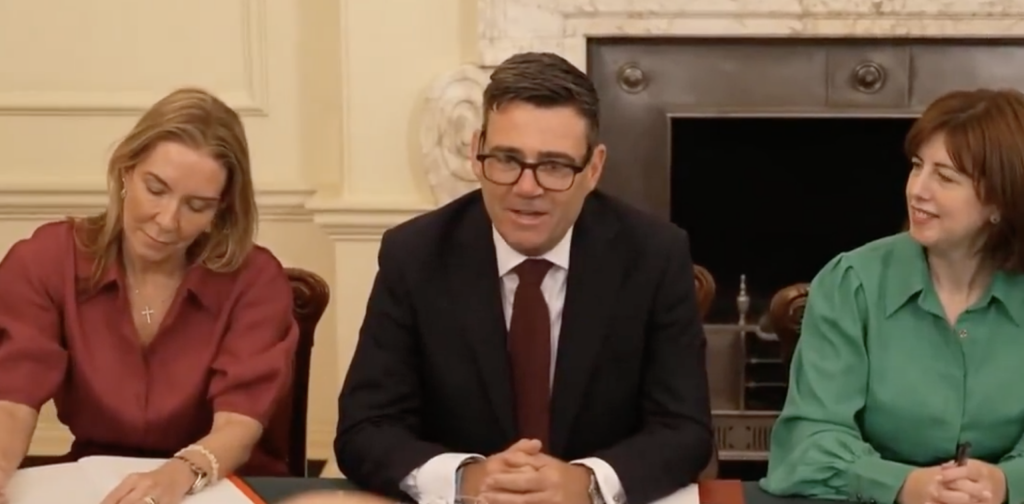
By 11pm on Monday evening, Andy Burnham had put the finishing touches to his cabinet team. Into the night and following morning, searing opinion pieces and Bluesky posts flooded in. “Starmerism without Starmer”, said Adam Bienkov of Byline Times. “Utterly bizarre” and “Starmerism: with rizz!”, was the verdict of the Financial Times’ Stephen Bush.
While many of the same MPs remained at the top table, Burnham also brought back his allies Lucy Powell, as well as Louise Haigh and Angela Rayner, both of whom had been forced to resign from Keir Starmer’s government. Haigh over a historic fraud conviction and Rayner over the underpayment of stamp duty.
Burnham ejected the obvious Starmer loyalists, such as Rachel Reeves – although he did still offer her defence secretary, which she declined – Steve Reed, Darren Jones, Liz Kendall, Peter Kyle. Aside from that, the overall composition of the cabinet looked reasonably similar to Starmer’s.
Was Burnham overly cautious with his appointments?
“Andy Burnham won’t be as powerful ever again as he was yesterday [on Monday], so he had a real opportunity to remake the government,” Tim Oliver, a lecturer in British politics and public policy at the University of Manchester told Left Foot Forward.
Oliver doesn’t think Burnham “wasted” the opportunity, but adds, “he could have made a lot more of it”. He also stated that while he can understand some of Burnham’s individual appointments, “in terms of coherence as a political project, it’s a mixed bag”.
Labour’s hardline immigration policies.. To be continued
One area where Burnham could have been bolder was with his decision to keep Shabana Mahmood as Home Secretary. The move indicates that his government will continue to pursue the controversial immigration policies associated with Starmer’s government. There had been hope among Labour MPs that if Burnham had made Mahmood chancellor, they might have been able to scrap her stricter rules on indefinite leave to remain. Now, it’s not clear how backbench opposition to her reforms will play out.
In addition, analysis by political scientists indicates that Labour’s anti-immigration stance doesn’t help them either maintain support among their progressive base or win over anti-migration voters.
In the 2024 general election, Labour’s voter coalition was “broadly, softly, pro-migration”, Oliver adds.
He argues that instead of keeping Mahmood, Burnham could have put in a home secretary “who’s going to spend all their time talking about crime”, while vowing to focus on issues such as phone scammers and reforming the police.
Bridget Phillipson’s promotion from women and equalities minister to Secretary of State also sends a message that Burnham’s government will continue to pursue its previous policies on single-sex spaces. As women and equalities minister under Starmer, Phillipson drafted the code on making use of single-sex spaces based on biological sex, a policy that risks discriminating against trans people.
The government decided to create the code in light of the Supreme Court’s ruling in April 2025 that the legal definition of a woman is based on biological sex.
Less good appointments
Burnham’s decision to keep Lisa Nandy as culture secretary has also raised eyebrows. Oliver says “One joke I saw on Blue Sky was ‘Does Lisa Nandy know she is secretary for culture, media and sport?’”. He equally questioned the rationale for Burnham appointing Yvette Cooper as health and social care secretary.
“I’m not aware of a lot of people going ‘she was a really effective home secretary and then a really effective foreign secretary’,” Oliver said.
“Especially if you want to make fixing social care one of your topline priorities,” he added.
Appointments that ‘make sense’
In what was something of a surprise appointment, Burnham made John Healey chancellor. Oliver argued that there was “too much huffing and puffing” about how the bond markets would react if Ed Miliband had got the job, adding “what the bond markets don’t like is that the UK has a very high debt to GDP ratio”.
Nonetheless, he says that his appointment of Healey makes sense, as Burnham “wanted a safe pair of hands to run the treasury” and “leeway to have more say over economic policy”.
Another appointment that made sense was Miliband being made foreign secretary. “Burnham says he wants to spend less time on foreign policy, so you need someone who carries a lot of weight”, which Miliband does as he is like “an elder statesman”, Oliver remarks.
Miliband is also aligned with Labour changing its policy on Israel’s war on Gaza, which Burnham alluded to when he recently apologised for Labour’s initial response to Israel’s military action in Gaza and said the party “didn’t get right”.
Good choice!
In terms of good appointments, Oliver said he viewed Angela Rayner being brought back as the Secretary of State for housing, communities and local government as a strong move, as she is “a political heavyweight”, she has experience and has got Burnham’s back. Rayner’s brief also includes devolution, which Burnham has made a core focus of his government.
By appointing Miatta Fahnbulleh — who did a lot of work on shaping the government’s Warm Homes plan alongside Ed Miliband — as energy and net zero secretary, Burnham has signalled that his government intends to continue pursuing the net zero agenda.
Burnham’s appointment of Haigh could also be an effective one, Oliver argues. She is an ally of Burnham’s, and as Chancellor of the Duchy of Lancaster, will be Burnham’s “fixer” in government. She will also be able to go out and work on things that the prime minister doesn’t have time to focus on. As a former cabinet minister, Haigh has “got an idea of how the Whitehall machine works and could be quite an effective appointment”.
No wild cards
The new prime minister’s cabinet is a mixed bag. There aren’t many wild cards in it, which, in some ways, is a positive thing, and there’s a wealth of veteran experience across the team. However, the lack of new faces and MPs on the left of the party suggests Burnham’s Labour might not be heading in a radically different direction to Starmer’s.
On the other hand, Burnham may intend to drive change across all departments himself while keeping greater control over the government’s overall direction.
Olivia Barber is a reporter at Left Foot Forward
Left Foot Forward doesn't have the backing of big business or billionaires. We rely on the kind and generous support of ordinary people like you.
You can support hard-hitting journalism that holds the right to account, provides a forum for debate among progressives, and covers the stories the rest of the media ignore. Donate today.
Donate today