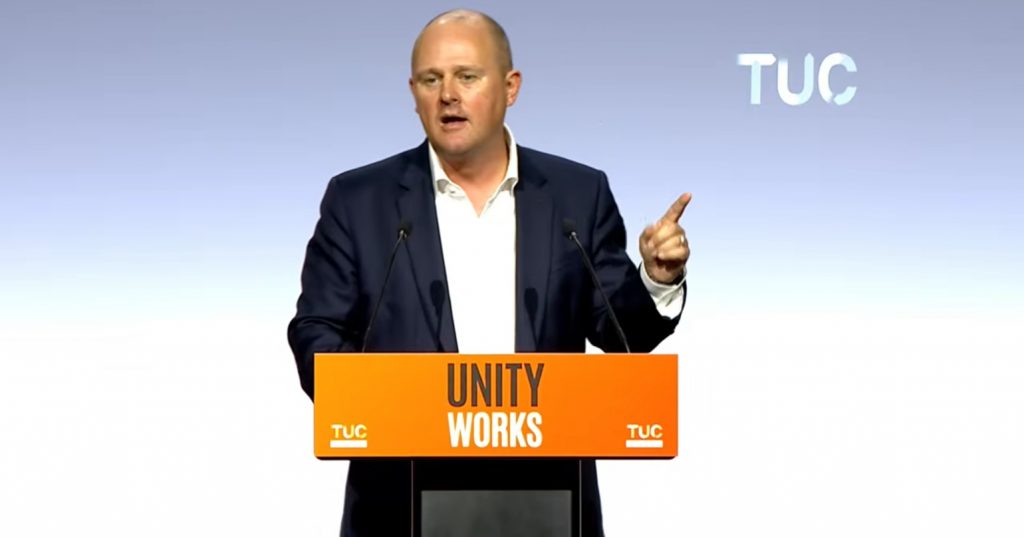
This week, Brighton once again played host to the annual gathering of trade unionists at the TUC Congress. While it was the third Congress since Labour returned to power, it was the first since Andy Burnham took over as prime minister.
Mr Burnham’s ascent to Number 10 loomed large over the event – and gave the whole thing a much more optimistic tone than it has had in recent years. Speaking to delegates, there was a palpable sense that Burnham offered hope for the movement and a real opportunity to prevent a Reform government.
Likewise, both the senior cabinet members who addressed the Congress were warmly received by delegates. Housing secretary Angela Rayner spoke at the event on Monday, in which she gave a stark warning of what a Reform government would mean for workers. On Tuesday, first secretary of state Louise Haigh spoke in place of the prime minister, who had cancelled all engagements following the death of his father. She used her speech to commit the government to “turn the page on four decades of lost opportunity, to deliver the change our country is crying out for, and to build a future that the people we represent expect and deserve.” Both speeches were met with a standing ovation from delegates.
Beyond the applause though, what do the leaders of some of the big unions think of the early days of the Burnham government?
Equity’s Paul W Fleming told LFF that it is ‘markedly more competent’ than Keir Starmer’s‘. Dave Ward from the CWU said Burnham is the ‘best chance for working people’. Unite’s Sharon Graham told LFF that his ‘analysis has been good’.
So far, so good. But the support from trade union general secretaries isn’t unconditional or without warnings.Graham said she wanted to see “meat on the bones” and that he needed to prove “the working class could feel that their better days are ahead of them”. ASLEF general secretary Dave Calfe told LFF that Burnham has to use the budget to “make life easier for working people”. And while Ward said he was the best chance for working people, he also said he was the ‘last chance’ to prevent Reform from coming to power and seeing Labour out office for a long time.
The prospect of Reform coming to power, and the threat of the far-right, were threads that ran throughout much of this year’s Congress. The TUC general secretary Paul Nowak used his keynote speech at the event to lay into Nigel Farage’s party, saying: “Reform do not, never have, and never will represent the interests of working people”, and calling for a ban crypto donations. Delegates also agreed to set up a task-force to combat the far-right online. They also voted for a motion which saw the TUC commit to take steps to tackle the far-right’s “weaponisation of women’s and girls’ safety”.
On the topic of motions – what were the big debates at this year’s Congress? Ultimately, there was very little disagreement within the movement this year, with most motions passing unanimously. Compared to Congresses over recent years, this one was much more cordial.
The main disagreement came on Wednesday morning, over a UCU motion on the ‘Wages Not Weapons’ campaign, which calls for investment in public services, rather than defence spending. The motion called for the TUC to “build on the Wages Not Weapons campaign by advancing a trade union vision of security based on decent work, quality public services, equality, climate action, democracy and peace”. Although it passed, it proved divisive, with Unite and GMB among those to speak against it.
Despite not causing disagreement in the hall, this year’s Congress did pass a number of other significant motions. Delegates voted to oppose the EHRC code of practice and support self-ID for trans people, to call a national demonstration this autumn calling for investment in public services, and to push the UK government to end all military cooperation with Israel.
With the storytelling done, here’s the full line-by-line rundown of everything that happened:
The interviews
- Sharon Graham: A just transition could be as transformational as the 1945 Labour government
- Andy Burnham must ‘make life easier for working people’ – interview with ASLEF general secretary Dave Calfe
- Andy Burnham is ‘best chance for working people’ – CWU general secretary Dave Ward
- Zack Polanski will be sixth Green MP after Holborn and St Pancras by-election, Rachel Millward claims
- Andy Burnham’s government ‘markedly more competent’ than Keir Starmer’s – Equity general secretary
The speeches
- Louise Haigh tells TUC Congress Labour government is ‘proudly on the side of working people’
- Angela Rayner gives stark warning of impact of Reform government on workers in TUC Congress speech
- TUC general secretary slams Tory and Reform ‘flat-earthers’ over climate policy
- Paul Nowak calls for ban on crypto donations in damning attack on Reform UK
- TUC general secretary celebrates ‘biggest increase’ in trade union membership ‘since records began’
- TUC president blasts ‘vindictive and pernicious’ legislation that blocks trade unionists’ ‘fundamental human rights’
- TUC president perfectly sums up why trade unionism matters
The motions
- TUC calls for end to all UK military cooperation with Israel in wide-ranging BDS policy
- TUC votes to build on ‘Wages Not Weapons’ campaign and advance an alternative vision for security
- TUC passes motion condemning ‘institutional racist targeting, harassment and humiliation’ of Professor Jason Arday
- TUC backs motion calling for investment in climate resilience
- TUC backs ASLEF campaign for publicly owned trains to end railway profiteering
- TUC calls on Labour to make good on its promise to deliver ‘biggest wave of insourcing in a generation’
- TUC agrees to call national demonstration to demand investment in public services
- TUC votes to condemn EHRC code of practice and back self-ID for trans people
- TUC issues call for radical shift in British economic policy
- TUC agrees to launch social media taskforce to take on far-right online
- TUC commits to ‘defend’ teachers from ‘attacks’ by Reform-controlled councils
The rest
- Privatised water firms acting “like a criminal racket”, Apsana Begum MP claims
- Labour Party’s record on trans rights ‘absolutely disgraceful’, Nadia Whittome tells TUC fringe
- Sharon Graham explains why workers not bosses are what keeps the country going in just 29 words
- Government must ‘face up to reality’ on climate crisis, Fire Brigades Union leader says
- Union leader destroys far-right’s claims to care about women’s safety
The stuff that’s still to come
We’re not quite done yet! We’ve still got two more interviews to get out from this week. Watch this space for our conversation with the Musicians’ Union’s Naomi Pohl and USDAW’s Joanne Thomas.
TUC was the first conference in our calendar of coverage for this season (as Reform refused to let us in!) Next up, in just over a week’s time, we’ll be in Liverpool covering Labour Conference. We’re proud to have provided some of the most comprehensive coverage of TUC Congress of any media outlet in the UK. But this reporting doesn’t come cheap.
If you haven’t already done so, please consider chipping in and donating today to help fund our conference season coverage.
Chris Jarvis is head of strategy and development at Left Foot Forward
Left Foot Forward doesn't have the backing of big business or billionaires. We rely on the kind and generous support of ordinary people like you.
You can support hard-hitting journalism that holds the right to account, provides a forum for debate among progressives, and covers the stories the rest of the media ignore. Donate today.
Donate today