



If Labour blunders on, it will lose the next election.

The challenge of delivering national renewal
We know what people want.
Voters’ top issue is the economy and the cost-of living crisis. As Hannah Spencer, the new MP for Gorton and Denton said: “[T]hings have changed a lot over the last few decades. Because working hard used to get you something. It got you a house. A nice life. Holidays. It got you somewhere.
“But now – working hard? What does that get you? Because talk to anyone here and they’ll tell you. The people who work hard but can’t put food on the table. Can’t get their kids school uniforms. Can’t put their heating on. Can’t live off the pension they worked hard to save for. Can’t even begin to dream about ever having a holiday. Ever. Because life has changed. Instead of working for a nice life, we’re working to line the pockets of billionaires. We are being bled dry.
“I don’t think its extreme or radical to think working hard should get you a nice life. And if you’re not able to work, that you should still have a nice life.”
She is right. And Labour must change track to be able to claim at the next general election that it is delivering the national renewal it promised voters.
The list of concerns is long. The economy is not yet on the path to recovery and, without a change in policy, the IMF’s forecast that we are heading for the worst decade in 100 years will come true and the cost-of-living crisis will worsen. The UK’s public services will be further harmed by repeating the errors of the last government on privatisation and PFI. And reducing immigration to the extent that is planned will cause damaging staffing shortages in the NHS and Care sectors.
The next general election is not far away – in order not to lose, Labour need voters to feel the benefits of having given Labour a chance at power.
The question of how to reinvent is urgent.
Rising to the challenge
The book 99%: Mass Impoverishment and How We Can End It sets out five steps the UK should take to return to the path of progress:
Step 1: Democratic Reset – Constitutional Reform. Work by the 99% Organisation and others on Defensive Constitutional Reform explains what the government should do now to safeguard UK democracy and prevent the UK going the way of the US.
Step 2: Fact-based policy-making. Rewiring our economic institutions to enable economic renewal is vital. Without that, policy making for renewal is impossible.
Those two steps are an essential precursor to Step 3.
Step 3: Policies for solidarity and prosperity – growing the pie and sharing it fairly. On the solid foundation of the constitutional reform and rewiring for fact-based policy, the government can build a policy portfolio that will tackle and reverse mass impoverishment.
Policy formulation is complex, but there are only fundamentally four types of policy. Each policy either grows the pie or it doesn’t; and it either shares the benefits of that growth fairly or it doesn’t. That gives us four types of policy:
I. Captured growth policies;
II. Shared growth policies;
III. Vulture policies; and
IV. Balancing policies.
The chart below helps understand both how we got into our current mess, and how we can get out.
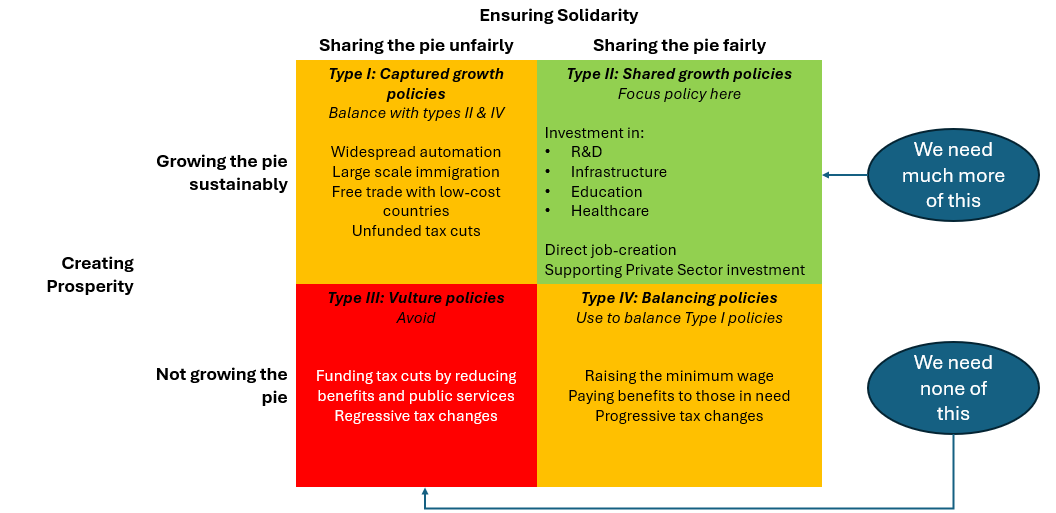
We got into this mess because in recent decades, we have had far too many captured growth policies and vulture policies and far too few shared growth policies and balancing policies.
Step 4: Investing in the Future. It is clear, and generally accepted, that investment in the UK has long been far too low. Underinvestment causes low economic growth and struggling public services. Now is the time to reverse it, as Roosevelt did with his New Deal.
Step 5: Clean-up Capitalism by tackling externalisation. In a growing market, the best way to grow profits is to grow the top line, and businesses can do that. In a stagnant market, it is impossible for most businesses to grow, so they focus on reducing their costs. And too often they do that by ‘externalising’ (off-loading) costs to the rest of society. When a business externalises its costs, it gets us to pay for its pollution, for its underpayment of staff, and for its tax avoidance.
And because it externalises its costs, it can outcompete more ethical businesses, it becomes an engine for mass impoverishment, and it gets rewarded for destroying the environment.
But if it could no longer externalise all these costs, it would cease to have an advantage over more ethical businesses. It would not grow. And it would not contribute to mass impoverishment or environmental destruction.
Those five steps would put the UK back onto a path of progress.
But before Labour can take them, it needs to be clear what kind of country wants to build and what kind of party it wants to be: a centre-right party with a tolerance for racism or a dynamic progressive party? And it needs to be able to communicate its vision and values in a way that appeals to voters. That requires clarity, courage, leadership, and communication skills.
Putting the picture together, here is a blueprint for what Labour (or any other progressive party) must do.
It is not easy. But it can and must be done.
Conclusion
The stakes for Labour are high. As Clive Lewis MP put it “If we carry on like this, we won’t just lose by-elections. We’ll lose the country for a generation.”
Equally high are the stakes for citizens. If Labour blunders on, it will lose the next election. If it loses to Reform (as Electoral Calculus suggests), the UK is likely to experience in 2029 what the US is experiencing today.
Neither UK citizens nor Labour itself can afford the government to fail so dismally. Now is the time to act.
Mark E Thomas is founder of the 99% Organisation
Image credit: Lauren Hurley / Number 10 – Creative Commons
Left Foot Forward doesn't have the backing of big business or billionaires. We rely on the kind and generous support of ordinary people like you.
You can support hard-hitting journalism that holds the right to account, provides a forum for debate among progressives, and covers the stories the rest of the media ignore. Donate today.