



Labour's child poverty strategy offers some welcome measures, but it won't address the factors keeping families trapped in poverty
Prem Sikka is an Emeritus Professor of Accounting at the University of Essex and the University of Sheffield, a Labour member of the House of Lords, and Contributing Editor at Left Foot Forward.
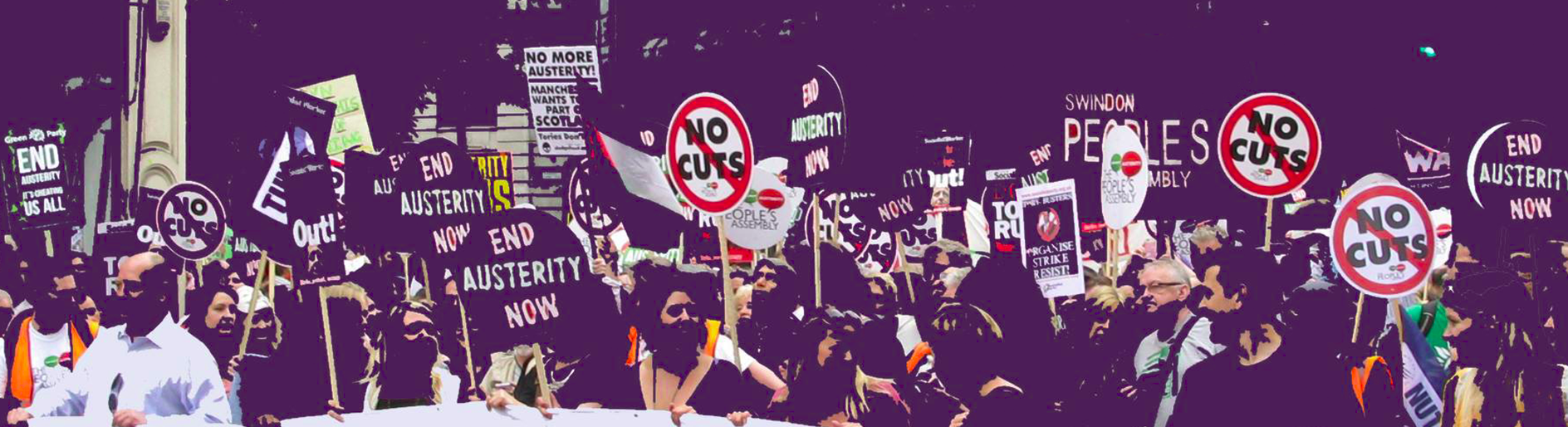
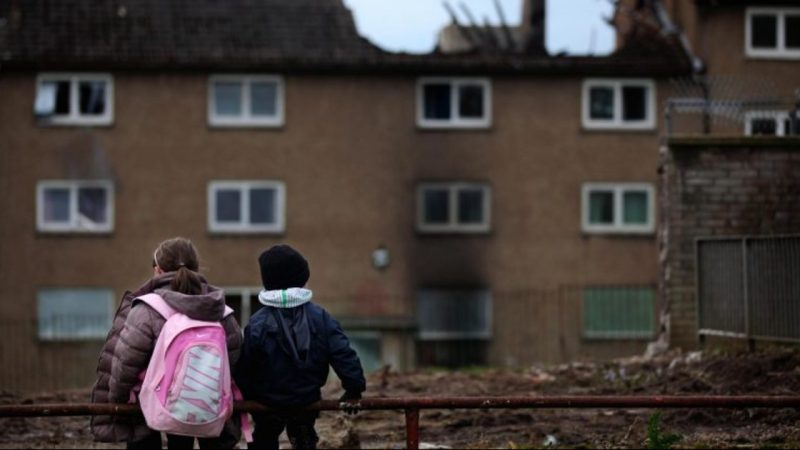
The UK government has published its long-awaited strategy on reducing child poverty. After 14 years of Conservative obsession with austerity, it is a welcome development but child poverty can’t be eradicated without dealing with parental poverty, which in return requires equitable distribution of income and wealth and universal free basic services.
Background
A major crusade of the 1979 Conservative government was to appease capital and boost rates of profitability by weakening trade union and worker rights. In 1979, some 13.2m workers were members of trade unions and by 1997 the membership declined to around 7.8m. This enabled employers to increase profits by cutting real wages. Public services and benefits were cut. There were no restraints on profiteering which reduced household disposable incomes. The government cut public spending, real wages and benefits. By 1997, some 4.5m children (34%) were living in poverty.
The Labour’s administration of 1997 promised to abolish child poverty over the next 20 years. It sought to increase greater participation in labour markets by introducing the National Minimum Wage and Working Tax Credits to ‘make work pay’. It did not reverse any of the anti-union laws and by 2010 union membership declined to 6.6m. The government wanted more parents to participate in labour markets but this was not accompanied by affordable childcare. The government had no effective programme for redistribution of income and wealth and the then Business Secretary Peter Mandelson said that he was “intensely relaxed about people getting filthy rich”. The poverty reduction project suffered a setback from the 2007-08 financial crash as the government embarked on a programme of spending cuts and wage restraints. By the time Labour left office in 2010, almost 3.6m children were living in relative poverty.
Despite some high sounding policies, the incoming coalition government (Conservatives and Liberal Democrats) in 2010 was relaxed about insecure work as the use of zero-hour contracts and fire and rehire practices expanded. The government introduced austerity, real wage and benefit cuts. To this day, the average real wage has barely moved from the 2008 level. In 2017 the government, introduced the two-child benefit cap and limit the child element of Universal Credit and Tax Credits to the first two children in a family. Due to austerity and failure to plan for the pandemic, the number of unfilled hospital appointments in England increased from 2.5m in 2010 to 4.5m in February 2020 and hit 7.62m in June 2024. Finding a dentist or a timely appointment with a family doctor became a struggle. By 2024, some 4.5m (31%) children were officially living in poverty though others estimate it to be around 5.2m children.
Government Strategy
The above brief background shows that child poverty is an outcome of policies affecting work, household incomes, workers’ bargaining power, profiteering, benefits and taxation. Household poverty is exasperated by dwindling incomes and a rising cost of living. People live in poor housing and lack nutritious food. Poor healthcare reduces parental ability to work. A lethal combination of factors manufactures higher infant mortality, child poverty, higher rates of illness, shorter life expectancy, and education and employment attainment.
A comprehensive programme of poverty reduction is needed. The government’s child poverty strategy has good elements but lacks crucial elements. Besides, policies can’t be judged by good reports they need to deliver outcomes.
Key elements of the government strategy are removal of the two-child benefit cap from April 2026. The government claims that this will lift around 450,000 children out of poverty by 2030.
From September 2026, the government will expand free school meals in England to all children in households in receipt of Universal Credit. This will lift 100,000 children out of relative low income by the end of parliament. However, free meals won’t be universal and cliff-edge means that free meals will be lost if parental income exceeds the Universal Credit limit. The free breakfast clubs for primary schoolchildren in England are already under way. The government will invest in Healthy Star programme, helping low-income families afford nutritious food and supporting breastfeeding. The number of children living in temporary accommodation will be reduced. Local councils will be required to inform schools, GPs and health visitors when a child is put in temporary accommodation with his/her family. A large number of children are in poverty because absence parent, often fathers, do not make the agreed child maintenance payments. The government has promised to overhaul the system and further details are awaited.
Need to restructure society
The above proposals are welcome but they are undermined by government policies. Child poverty is linked to parental and household poverty which can’t be tackled without redistribution of income and wealth. It is hard to discern any effective policies.
On the one-hand the government wants to reduce child poverty whilst simultaneously it is planning to plunge more into poverty through its immigration policies. To appease its right-wing, the government is planning to make legal migrants wait up to 20 years before they can settle permanently. The government is considering limiting benefits to those “making an economic contribution”. Such a policy would deny benefits to children of immigrants, UK born or otherwise, if their parents face financial hardships due to illness, disability or unemployment.
Other than the mantra of ‘growth’ there is no strategy for increasing household incomes. Trickle-down economics has failed and average real wage hasn’t moved since 2008 as workers lack bargaining power. Last month the government extended the freeze on income tax thresholds to 2030/31. As a direct result, 780,000 additional people, the poorest, will be required to pay income tax at the basic rate for the first time. Another 920,000 would be pushed into paying income tax at the higher marginal rate of 40%. Successive governments have taxed labour at a higher rate than wealth and return on wealth. Wages are taxed at marginal rates of 20% to 45%; compared to capital gains at marginal rates of 18% to 32%, and dividends at the rates of 8.75% to 39.35%. Such regressive policies hurt the poorest. The poorest 20% pay a higher proportion of income in taxes than the richest 20%. The bottom 50% of the population owns less than 5% of wealth, bottom 20% has 0.5%, and the top 10% a staggering 57%. None of this can be changed without a radical engagement with corporations and the super-rich.
The government has announced plans to force people to work or lose benefits. There is some childcare support but it is inadequate. What are lone or disabled parents to do? Despite recent rises in the minimum wage, work doesn’t pay enough to make ends meet. Some 34% of the people on Universal Credit are in employment. Around 1.17m workers are on zero-hour contracts, which is particularly prevalent in accommodation and food, transport, arts, health and social work sectors. Some 4.5m jobs in the UK pay less than the real Living Wage. Around 24m people, 36% of the population, live below socially acceptable living standards. Despite earlier promises, the Employment Rights Bill will not end zero-hour contracts, fire and rehire policies which enable employers to fire workers and rehire them on inferior pay and working conditions. Employers can shift production to secondary sites but secondary picketing by workers will remain banned.
Poverty is deepened by a poor healthcare system. In October 2025 some 6.24m individuals were waiting form 7.3m hospital appointments in England alone. Instead of expanding the NHS, the government is committed to privatising further parts of it. The NHS dentists are scarce and private equity controlled organisations such as My Dentist, PortmanDentex, Rodericks Dental, and Bupa Dental Services, dominate the private provision of dentistry. Their prices are around 3.5 times higher than the NHS dental charges, enabling them to make £1.2bn gross profit over the past two years. Parents are paying around £350 for one tooth extraction for a child.
Indeed, there is no government plan to curb profiteering. Water, energy, rail, mail and grocery prices are rising at rates faster than inflation and plunging millions into poverty. There is huge lack of social housing. The city of Liverpool has 12,764 households on its social housing waiting list. It has just five “additional social rent dwellings”, as local authorities have been starved of resources. Poverty can’t be eradicated without affordable housing.
Poverty in one of the richest countries is made by political choices. The government must chart a new course. Universal basic income and services would be a good start towards eradication of poverty. Well paid work is an essential element for reducing poverty, but not all parents are able to work or find work. Therefore, support is needed through the tax and benefit system. The government can help through scheme of apprenticeships, job training, abolition of university fees and investment in new and emerging technologies. There must be universal access to free school meals, sports and playgrounds. Improvements in healthcare and public services are needed. Workers’ rights and bargaining power must be improved by strengthening trade unions. No doubt, neoliberals would object to emancipatory change even though child poverty costs the UK economy around £40bn a year. We can and must do better.
Left Foot Forward doesn't have the backing of big business or billionaires. We rely on the kind and generous support of ordinary people like you.
You can support hard-hitting journalism that holds the right to account, provides a forum for debate among progressives, and covers the stories the rest of the media ignore. Donate today.