EU court makes landmark ruling protecting workers’ rights – but you won’t have seen it
Brexiteers are keen to scrap the role of the ECJ after Brexit. No surprise, given a spate of recent pro-worker rulings...

A new ruling from the European Court of Justice has dealt a blow to unscrupulous bosses who force workers to do excessive overtime.
A little-reported decision this week says member states must ensure that employers have systems to keep track of working hours, in order to protect workers’ rights.
The EU’s Working Time Directive stipulates that workers cannot be made to work more than 48 hours a week on average, unless they specifically opt out of the protections.
But without systems in place to monitor hours, unions feared workers are being exploited.
That may now change, after the Spanish union Federación de Servicios de Comisiones Obreras (CCOO) brought a case over working hours at Deutsche Bank. The union argued that over half of overtime hours aren’t recorded in Spain, putting workers at greater risk of exploitation. It is likely to be a picture reflected across the EU, with this ruling having effect across all member states.
Deutsche Bank argued that Spanish law didn’t require systems to monitor working hours. But the court found that for the Charter of Fundamental Rights of the European Union (‘the Charter’) and the Working Time Directive to have effect, member states must actively enforce them.
The ECJ summary stated: “Member States are required to ensure that workers actually benefit from the rights that are conferred on them.” In other words, without action, such rights aren’t worth the paper they’re written on.
It will now be up to member states to respond to the ECJ ruling, with unions across the bloc likely to bring legal cases forward with the aim of bringing the decision into national law.
However, the draft Withdrawal Agreement proposes that UK courts ‘need not [but may where appropriate] have regard to’ any ruling of the ECJ on a point of EU law, once the UK leaves the EU – potentially leaving UK workers unprotected when it comes to this latest ruling.
Speaking to Left Foot Forward, Alan Bogg, Professor of Labour Law at the University of Bristol Law School said: “Without having an accurate measure of working time, it’s very difficult to enforce working time limits.”
He noted that the ECJ has been active in actively promoting workers’ rights – in contrast to UK courts: “The Court of Justice tends to think about working time rights from a fundamental rights perspective, which has supported an expansive approach to workers’ rights.
“It’s very difficult to see that will be the case when UK courts use a common law frame of reference which historically hasn’t been worker-friendly, but has [instead] been friendly to employer property rights.”
While the UK is likely to follow the (non-EU) European Convention on Human Rights after Brexit, through the Human Rights Act, the ECHR has no article protecting working time rights.. “From the perspective of labour rights, the ECHR isn’t adequate substitute for the EU Charter, especially in the working time context,” Professor Bogg said.
However, he added a note of caution, arguing that placing an obligation on employers to record working time accurately “could justify more intensive forms of surveillance” where there was little trade union representation.
Stephen Doughty MP, leading supporter of the People’s Vote campaign, told LFF:
“Now we know any Brexit deal will strip away hard-won protections for workers and begins a race-to-the-bottom on standards, as that’s the path leading Brexiters are desperate to pursue.
“Whilst the EU is implementing new standards and rights for workers, Brexiters are instead trying to team up with the likes of Donald Trump and begin a bonfire of workers’ rights and environmental standards.
“The Brexit being delivered is a million miles away from what was promised during the referendum. That’s why, in order to deliver a stable and lasting settlement for our country, the public must be given the final say through a People’s Vote.”
Michael Chessum, national organiser for Another Europe is Possible, said the ruling reflects the fact that the EU is ‘open to the demands of workers and ordinary people fighting for better rights and conditions.’ He added:
“We are all beneficiaries of the collective struggle of workers all over Europe. In this case, workers from the UK to Ukraine will benefit from the work of Spanish trade unionists, adjudicated in a court in Luxembourg.
“The way forward is to transform these institutions and build a proper pan-European left, not to cheer the fragmentation of the continent at the hands of nationalists and fascists.”
The German Trade Union Confederation (DGB) welcomed the ruling, saying overtime hours has been “at an unacceptably high level for years,”
the newspaper Deutsche Welt reported.
“That is not just wage and time theft — within a year, employers line their pockets with approximately €18 billion,” said a member of the union body’s executive committee.
But representatives of German employees branded the court’s decision as “the reintroduction of a time clock in the 21st century.”
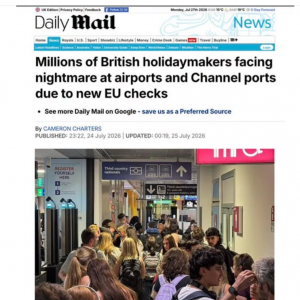
Very few outlets have reported the ruling in the UK – though the Daily Express did manage to rant against ‘red tape’.
Josiah Mortimer is Editor of Left Foot Forward. Follow him on Twitter.
Left Foot Forward doesn't have the backing of big business or billionaires. We rely on the kind and generous support of ordinary people like you.
You can support hard-hitting journalism that holds the right to account, provides a forum for debate among progressives, and covers the stories the rest of the media ignore. Donate today.
Donate today