Tom Brake is director of Unlock Democracy
From broadcast to broadsheet, podcast to print, an attempt is being made to convince you that the two-party system is coming back. Labour’s bump in the polls, at the expense of Reform, has led some commentators to announce the death of multi-party politics – at least in England.
These reports, as Mark Twain didn’t quite say, have been greatly exaggerated. It mistakes small movements in the polls for the reversal of a transformation decades in the making.
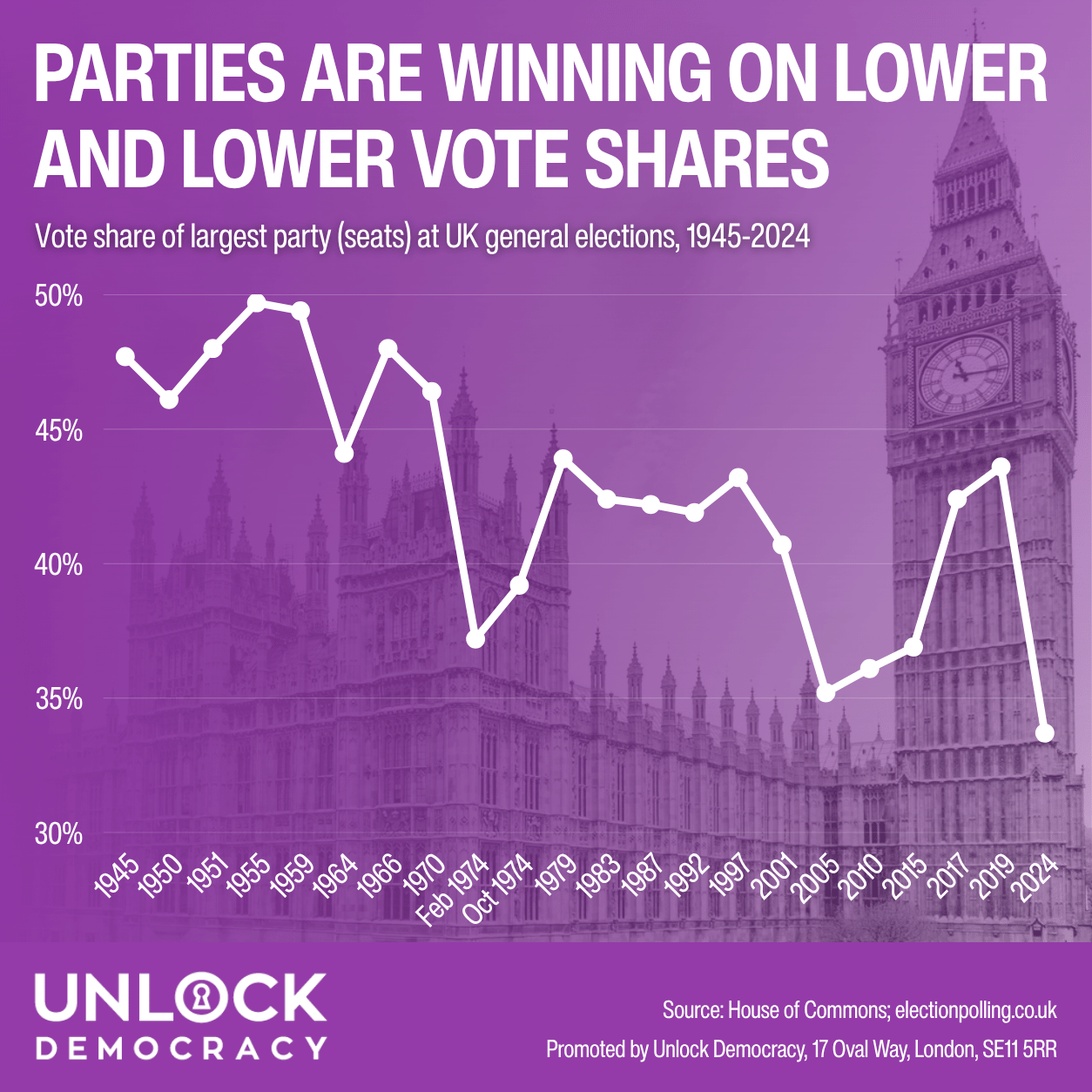
In the 1950s, Labour and the Conservatives between them won an average of 93% of the vote. By the 1970s, that had fallen to 80%. At the 2024 election, the two parties received just 57% between them – their lowest combined share on record.
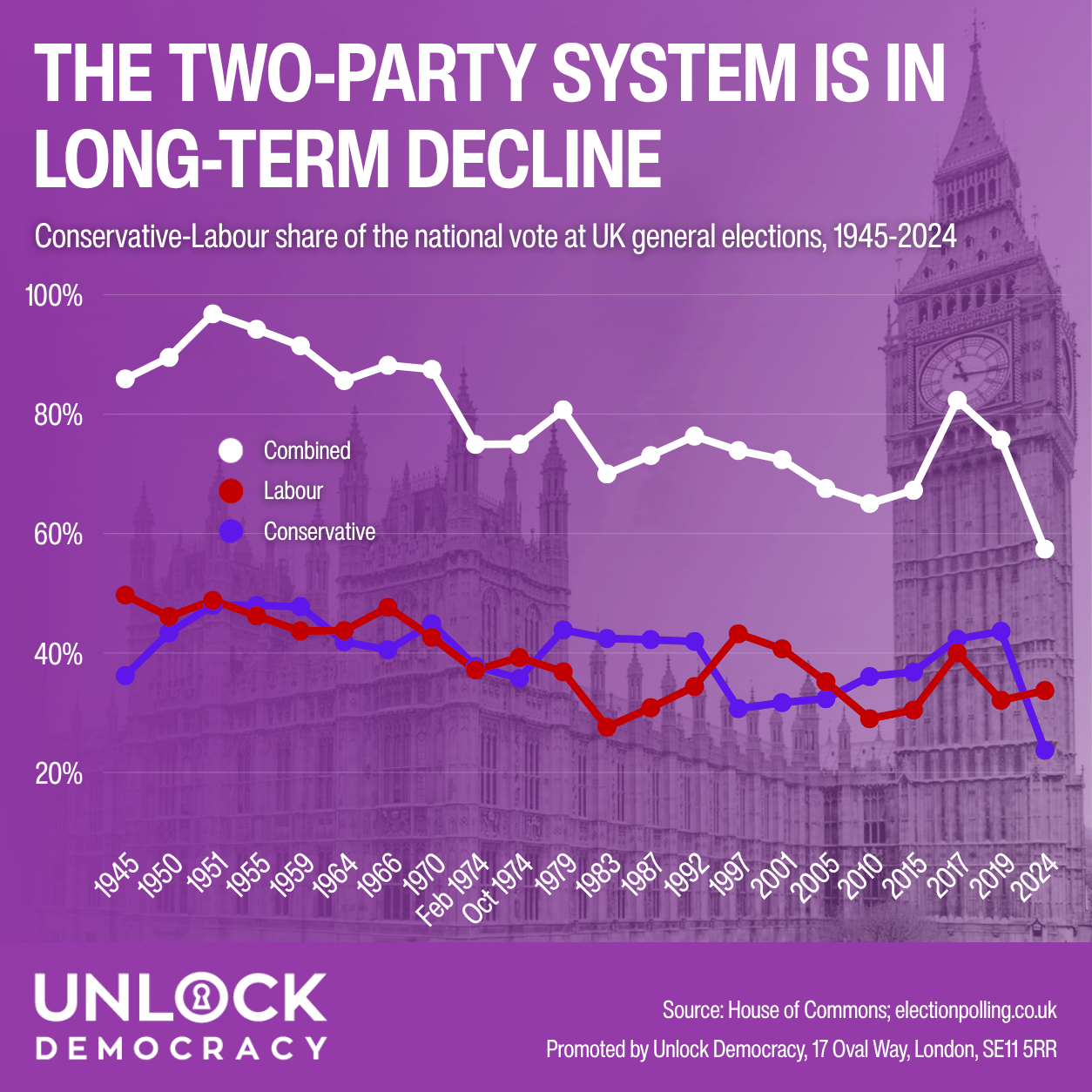
The same story can be seen in the share of the vote needed to win an election. Between 1945 and 1970, the party winning the most seats averaged 47% of the vote. From 1974 to 1997, that fell to 41%. Since 2001, it has fallen again to just 38%, and it’s hard to see the next election bucking that trend. Even the most favourable recent poll for Labour has them nowhere close to that figure.
Diminishing vote tallies reflect a deeper shift in voters’ relationship with the two main parties. In the 1950s heyday of the two-party system, party allegiance was closely bound up with class: Labour drew heavily on the working class, while the Conservatives dominated among the middle class. Both parties had distinct social roots, with voting often an expression of social identity, as much as a judgement on competing manifestos.
Those ties have steadily weakened. By the 2024 election, support for Labour and the Conservatives varied remarkably little by social class. Age and education were much stronger demographic dividing lines, while divisions over Brexit and cultural values continued to cut across the traditional left-right divide.
The old marriage of class and party has, in other words, given way to something resembling a ‘conscious uncoupling’. In 1987, 46% of people told British Social Attitudes (BSA) that their identification with a political party was very or fairly strong. Twenty-five years later, that had fallen to 31%. In 2020, BSA found that just 7% felt “very strongly” attached to a political party, a joint record-low.
The result is an electorate less firmly anchored to either of the two main parties, and more willing to move between a wider range of alternatives.
True, the process has not been linear. The 2017 election briefly looked like a return to the past, with Labour and the Conservatives taking 82% of the vote between them. But that revival proved short-lived. Their combined share fell to 76% in 2019, before collapsing in 2024.
That should caution against treating short-term poll improvements for the two traditional parties as evidence of a structural revival. The social foundations that underpinned two-party politics are no longer there.
First Past the Post will continue to obscure this fragmentation. By converting small changes in support into dramatic swings in seats, it may again hand a single party overwhelming parliamentary power without anything approaching majority public support.
But it’s an illusion. We saw, following the 2024 election, how quickly Labour’s parliamentary dominance ran up against lukewarm support among the public. The long-term trend towards multi-party politics is unmistakable.
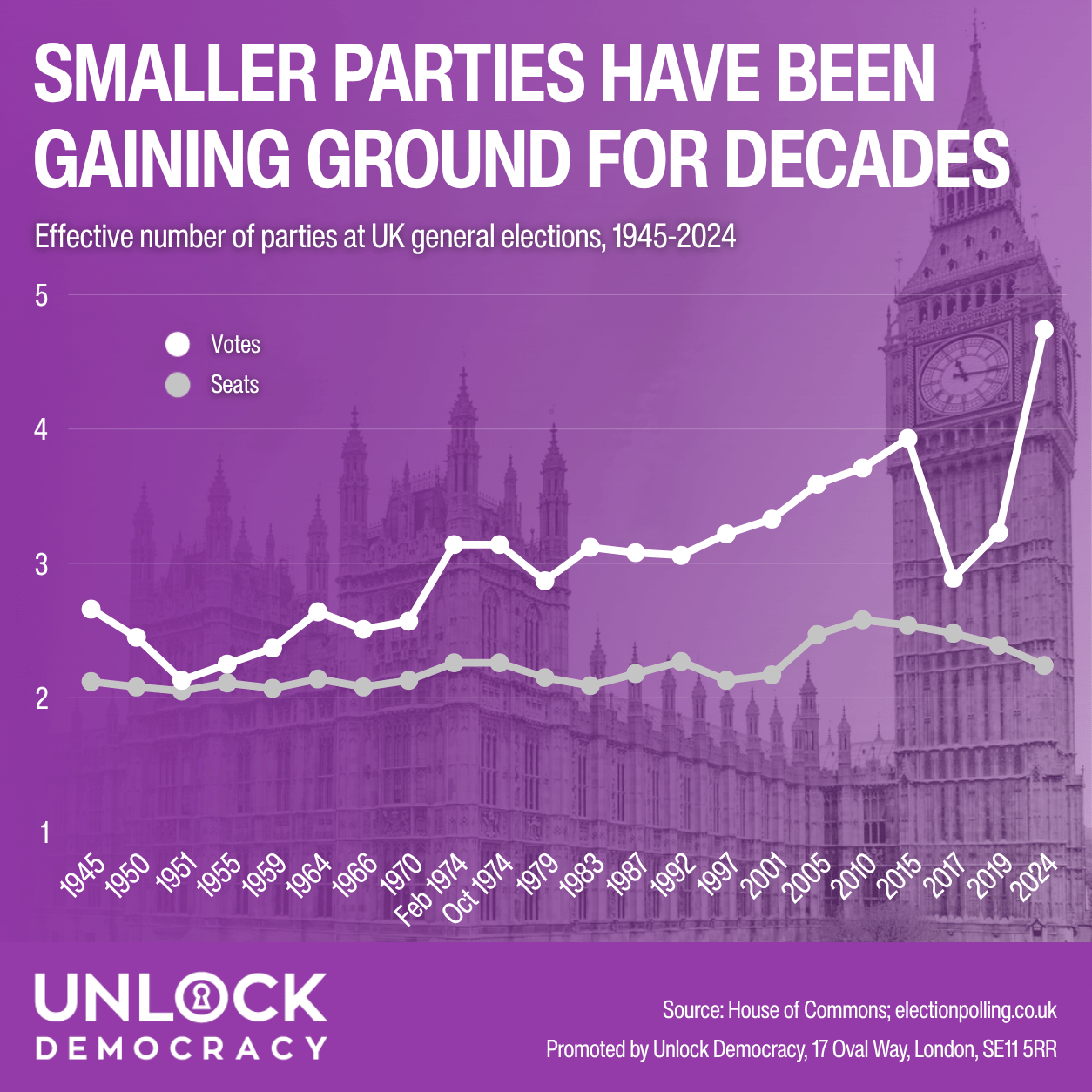
The two main parties once commanded support from almost the entire electorate, reinforced by social loyalties that made voting behaviour comparatively predictable. Both have eroded. The question is not whether the two-party system can briefly reassert itself in the polls. It is how long an electoral system built for that vanished political world can continue to survive without it.
Image credit: Oatsy40 – Creative Commons
Left Foot Forward doesn't have the backing of big business or billionaires. We rely on the kind and generous support of ordinary people like you.
You can support hard-hitting journalism that holds the right to account, provides a forum for debate among progressives, and covers the stories the rest of the media ignore. Donate today.
Donate today