Daily Mail’s lazy ‘back to the 1970s’ scare story ignores the decade’s real legacy
"Yes, drag us back to where one wage bought a home, fed a family of six, where mum could choose to stay at home before the children were school age. Foodbanks didn't exist... need I go on?"
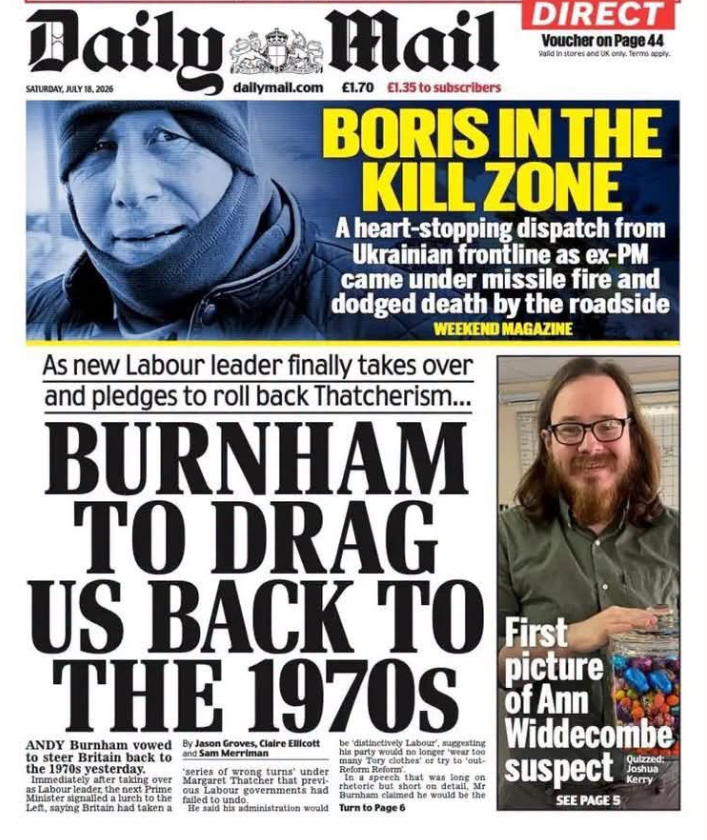
The Daily Mail has been mocked after splashing its front page with a familiar political bogeyman.
Beneath a separate story celebrating Boris Johnson and his “heart-stopping dispatch” from the Ukrainian frontline, the newspaper’s July 18 front page declared:
“As new Labour leader finally takes over and pledges to roll back Thatcherism… BURNHAM TO DRAG US BACK TO THE 1970S.”
The article claimed that, on becoming Labour leader, Andy Burnham had “signalled a lurch to the Left” by arguing that Britain had taken “a series of wrong turns” under Margaret Thatcher which previous Labour governments had failed to reverse. It added that his government would be “distinctively Labour,” no longer trying to “wear too many Tory clothes” or “out-Reform Reform”.
The Mail’s framing relies on a well-worn assumption: that “the 1970s” is shorthand for economic chaos, strikes and national decline. It is a trope that has been used for decades whenever politicians advocate reversing aspects of Thatcherism.
But history is rarely that simple.
As historian Dominic Sandbrook observed in a BBC article: “Of all post-war decades, the 1970s has undoubtedly had the worst press, but the truth is that most ordinary families in 1970s Britain were better off than ever.”
The decade undoubtedly experienced inflation, industrial conflict and economic turbulence, but reducing it to a national disaster ignores many of its lasting social achievements.
The era saw advances in equality and civil rights. Second-wave feminism secured major legal victories, including the Equal Pay Act 1970 and the Sex Discrimination Act 1975, strengthening workplace protections and expanding opportunities for women.
There was also the rapid growth of the modern gay liberation movement following the 1969 Stonewall uprising. Organisations such as the Gay Liberation Front campaigned openly for LGBT rights, helping lay the foundations for Pride marches and future legal reforms.
Disabled people’s rights also advanced. The Chronically Sick and Disabled Persons Act 1970 was pioneering legislation that established new rights to support, access and inclusion, helping shift disability policy away from charity towards equality.
Environmental awareness entered the political mainstream too. The first Earth Day in 1970 mobilised millions around pollution and conservation, while governments introduced stronger environmental protections that transformed public health and air quality in many cities.
For many, the decade also evokes memories of greater economic security than exists today, such as more affordable housing, stronger trade union protections, free higher education for many students, and an NHS that had yet to endure decades of austerity and privatisation debates. That does not mean the period was idyllic, but it explains why some reject the caricature presented by newspapers like the Mail.
Musician Paul Rooney captured such a feeling in a widely shared social media post, writing, alongside the Mail’s article:
“GREAT NEWS: Back to Glam Rock, Punk Rock, development of Electronic Music, no homelessness, fair rent in council houses, free dental care, nurses and matrons ran clean hospitals, a working NHS and welfare system. University Education was state funded for the poorest of kids. Working people had protection, unions and could strike for better pay. Affordable beer, lots of gigs, council estates, community spirit! YAYY Bring it on…”
And many agreed.
One response read: “1976 saw greater social equality in the UK than any other time in history. Bring it on.”
Another added: “Yes, drag us back to where one wage bought a home, fed a family of six, where mum could choose to stay at home before the children were school age. Foodbanks didn’t exist… need I go on?”
Others responded with political jibes, with one writing: “And Reform want to take us back to the 1930s.”
The 1970s was a complex decade of economic challenges alongside profound social progress.
Reducing the era to a scare headline may generate attention, but it says more about the newspaper’s editorial instincts than it does about the decade itself.
Left Foot Forward doesn't have the backing of big business or billionaires. We rely on the kind and generous support of ordinary people like you.
You can support hard-hitting journalism that holds the right to account, provides a forum for debate among progressives, and covers the stories the rest of the media ignore. Donate today.
Donate today