The King’s Speech wasn’t the transformative plan for the country we need
The government has some good policies, but not a transformative plan for society.
Prem Sikka is an Emeritus Professor of Accounting at the University of Essex and the University of Sheffield, a Labour member of the House of Lords, and Contributing Editor at Left Foot Forward.
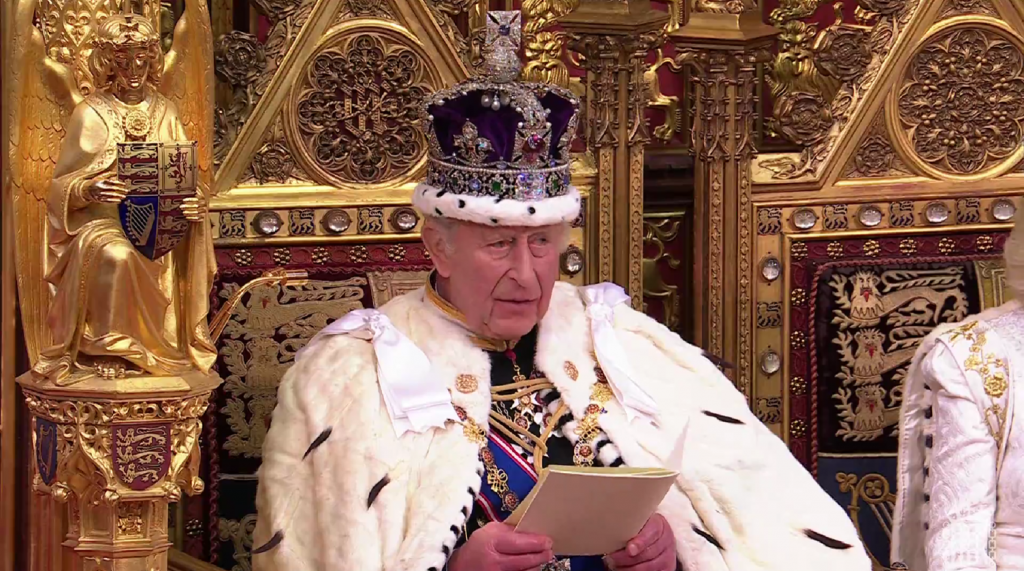
The King’s Speech has laid out the Labour government’s legislative agenda for the current session of parliament against the background political uncertainty. Following a poor showing of the government in local elections in England and parliamentary elections in Scotland and Wales, there is intense pressure on Prime Minister Sir Keir Starmer to resign. Depending on the outcome, the policies announced in the King’s speech may not survive.
It will take time for any government to undo the effects of 50 years of neoliberalism, but the King’s Speech shows that on too many fronts the government’s ambition is not matched by actions.
The King’s Speech outline thirty-seven new bills focusing on economic growth, energy independence, national security, housing, public services, and transport to build what the Prime Minister called “a stronger, fairer Britain.”
In an increasingly uncertain world, the proposed European Partnership Bill will seek to build a closer relationship with the European Union (EU) by eliminating barriers to trade. The UK will adopt EU rules in selected areas, such as food, drink, carbon emissions, and energy supply. This won’t fully undo the damage inflicted by Brexit but will improve the UK’s trade with one of the biggest trading blocks.
The Energy Independence Bill which seeks to accelerate investment in home-grown renewable energy and speed up infrastructure delivery is most welcome. The Electricity Generator Levy Bill increasing the windfall tax on generators from 45% to 55% is also welcome. However, there is no comprehensive attempt to curb profiteering by energy companies. Since 2020, their UK operations have made profits of £125bn. Over 120,000 Britons die in fuel poverty annually.
The disastrous Private Finance Initiative (PFI) is being promoted through the Highways (Financing) Bill to enable what the government calls “a new financing approach to fund large-scale road schemes.” Previous PFI schemes resulted in £6 repayment for every £1 of private investment. Though such schemes the state effectively guarantees corporate profits. Government borrowing is always cheaper than corporate borrowing. The government can also fund infrastructure by issuing public bonds, but such alternatives have been ignored.
The 129 pages of background notes make no mention of the word “manufacturing” even though every £1 of manufacturing activity supports a further £1.8 through indirect and induced multiplier effects. Despite the economic wars, the King’s Speech is silent on boosting manufacturing of semiconductors, rare earth minerals, bricks, cement, auto, medicines and other essential items to build a resilient economy.
The regulator consolidation offered by the Enhancing Financial Services Bill may save duplication and costs, we are being framed around phrases such as “competitiveness” and “regulatory simplification” They are code words for further deregulation. Between 1995 and 2015, the UK finance industry made a £4,500bn negative contribution to the UK economy. Despite that governments have abolished the post-2008 crash restraints. The regulator’s duties to protect customers have already been diluted. They have a secondary duty to promote growth and competitiveness of the industry. Conflict of interests abound. The government’s briefing notes make no mention of the social costs of deregulation. There is no attempt to regulate private equity which is devouring hospitals, care homes, veterinary services, supermarkets, water, energy, retail and more.
The so-called “industry friendly” reforms of the Financial Ombudsman Service are a cue for deregulation and dilution of consumer rights. There is silence on institutional cover-up of bank frauds. There is still no investigation of the 1991 closure of the Bank of Credit and Commerce (BCCI), the biggest banking fraud of the twentieth century. In the House of Lords, I have raised questions about the failure to tackle HSBC after it was fined $1.9bn in the US in 2012 for money laundering for criminals. The then Chancellor George Osborne and regulator secretly urged the US authorities to go easy on the bank as it was too big. The response to my questions has been ministerial silence.
On numerous occasions, I have asked questions about HBOS frauds (dating from 2002-2007) in the House of Lords. Regulators ape the three unwise monkeys, and Ministerial indifference means that the victims have not received compensation even after the courts have established criminality of managers at the bank. Again, all I get is excuses and ministerial indifference. What good is an Ombudsman system when Ministers and regulators ignore financial crimes?
There are mixed messages from the government about privatisation and nationalisation. For years, the steel industry has received public subsidies. Companies keep the resulting assets and income streams. In return for free money, Governments have not taken an equity stake or a seat on the boards of the entities. The free cash is not repayable. In April 2024, the government intervened to seize control of British Steel’s Scunthorpe plant to prevent its Chinese owners from closing its blast furnaces and damage UK steelmaking capacity. The Steel Industry (Nationalisation) Bill will renationalise British Steel to safeguard jobs and vital industry capacity. This begs the question why the entire steel industry has not been nationalised, especially as other operators, such as Tata Steel, also receive subsidies.
There are two major bills for transformation of railways. The Northern Powerhouse Rail Bill will provide investment of up to £45bn to deliver faster, more reliable and more frequent services between the North of England’s key cities. This is welcome and would help to boost jobs and the economy.
The Railways and Passenger Benefits Bill will establish Great British Railways (GBR) and unite track and train management under a single body. Passenger services are already being nationalised, as when the franchise contracts end. However, there is no attempt to bring lucrative freight and rolling stock companies (ROSCOs) into public ownership. For passenger services, GBR will rent carriages from three offshore-based companies. They have an average profit margin of up to 41.6% which is a huge burden on customers and the public purse.
We are told that that nationalisation of rail passenger services and British Steel is in the public interest. But so is nationalisation of water, energy, mail, social care, and other essential services. But they are ignored.
Sustained economic growth cannot be achieved unless people have good purchasing power. That can be achieved by curbs on profiteering. But that is missing from the King’s Speech. It can be achieved by improving workers’ share of the economy, but that receives little attention.
Some 25.3m people, including 14.9 working age adults and 7.7m children live in households below the minimum income standard. A major cause is the erosion of workers’ share of gross value added (GVA). In 1975, workers’ share of GVA was 71.9%. By 2025, it declined to 59.7%. This includes the remuneration of fat-cat executives. So, the share going to workers is much lower.
The huge transfer of wealth from labour to capital has coincided with lower rates of corporation tax. The headline corporation tax rate was 52% in 1974, compared to 25% now. The increase in capital’s share has not resulted in higher rate of investment in productive assets. In 2025, the UK invested 18.9% of GDP in productive assets, the lowest amongst G7 nations. For most of the last thirty years, the UK has been at or near the bottom of the OECD league of investment. Inevitably, productivity and economic growth is low. Yet there is no coherent strategy for increasing workers’ share of GVA. There is no reform of corporate governance or short-termism in the City of London. There is no plan to emulate EU countries and put worker-elected directors on the boards of large companies to ensure that they have a say in how the wealth is to be shared.
People’s purchasing power could be boosted by progressive taxation, but that is not on the agenda. The poorest 20% of the population pay a higher proportion of their income in direct and indirect taxes compared to the richest 20%. At the same time dividends and capital gains, mainly accruing to the well-off, are taxed at lower marginal rates than wages.
Problems are compounded by freeze on income tax personal allowance. In April 2021, the Conservative government froze the annual personal allowance at £12,570. Labour continued with it. If the personal allowance of £12,570 had increased in line with inflation, it would have been £16,048 for 2026/27. Due to the freeze, someone earning £20,000 a year will pay additional income tax of £696 in 2026/27 alone. None of this aids household resilience. Redistribution is not on the government’s agenda.
The government has some good policies, but it is hard to discern a transformative plan for society. The King’s Speech tinkers at the edges and is unlikely to deliver sustained economic growth or household resilience.
Left Foot Forward doesn't have the backing of big business or billionaires. We rely on the kind and generous support of ordinary people like you.
You can support hard-hitting journalism that holds the right to account, provides a forum for debate among progressives, and covers the stories the rest of the media ignore. Donate today.
Donate today