



If there are two things guaranteed to provoke outrage on the British right, they are Sadiq Khan and any attempt to regulate motorists. Bringing the two together is guaranteed to generate performative fury among our right-wing brethren.
If there are two things guaranteed to provoke outrage on the British right, they are Sadiq Khan and any attempt to regulate motorists. Bringing the two together is guaranteed to generate performative fury among our right-wing brethren.
This week’s reaction to proposed AI-powered traffic enforcement is a textbook example.
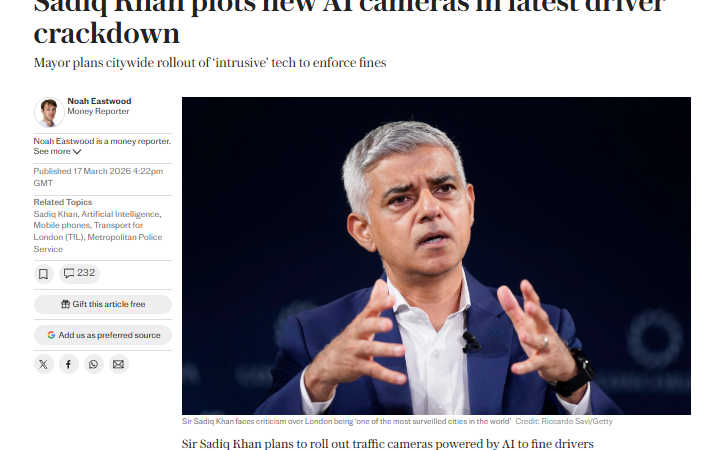
A headline in the Telegraph thundered: “Sadiq Khan plots new AI cameras in latest driver crackdown,” accompanied by warnings of “intrusive” technology and a looming “citywide rollout.”
The framing is breathless, but the underlying policy is rather more mundane: trialling camera systems, led by Transport for London and the Metropolitan Police, to enforce existing laws against dangerous driving.
The initiative forms part of London’s “Vision Zero” strategy, one of 43 proposals aimed at eliminating road deaths. The penalties cited are not new or extraordinary: £200 and six penalty points for using a mobile phone while driving, and fines of up to £500 for failing to wear a seatbelt. These are longstanding rules designed to prevent avoidable harm.
Evidence from elsewhere suggests enforcement works. After similar cameras were introduced in Devon and Cornwall, detections of drivers using phones or neglecting seatbelts rose sharply. Critics present this as evidence of overreach, while a more straightforward interpretation is that the technology is identifying behaviour that was already illegal, and dangerous.
Khan also noted how cities such as New York City and Paris have implemented comparable measures in efforts to reduce traffic fatalities, meaning London is playing catchup rather than taking an authoritarian leap.
But much of the backlash hinges on civil liberties concerns. The Telegraph cites warnings by campaign group Big Brother Watch that such systems risk turning London into a surveillance state, with a spokesperson arguing the technology treats “every driver as a potential suspect.”
While the expansion of surveillance does deserve scrutiny, particularly where biometric data may be involved, the politics behind the outrage are difficult to ignore. Big Brother Watch was founded by Mark Littlewood, former director of the Institute of Economic Affairs, and remains closely aligned with a libertarian, anti-regulatory worldview.
Littlewood himself has been associated with the deregulatory agenda that underpinned Liz Truss’s short-lived premiership, which, as we know, culminated in market turmoil and Truss to resign after 49 days in the job. Littlewood is now involved in efforts to push the Conservative Party further toward a “small state” agenda with his PopCon (Popular Conservatism) group.
Seen in that light, opposition to traffic enforcement technology is less surprising. It reflects a broader ideological resistance to state intervention, whether in markets, public health, or road safety.
Critics from City Hall Conservatives have accused Khan of being “anti-motorist.” His response is simple: he is not “anti-motorist,” but “anti-death.”
Left Foot Forward doesn't have the backing of big business or billionaires. We rely on the kind and generous support of ordinary people like you.
You can support hard-hitting journalism that holds the right to account, provides a forum for debate among progressives, and covers the stories the rest of the media ignore. Donate today.