


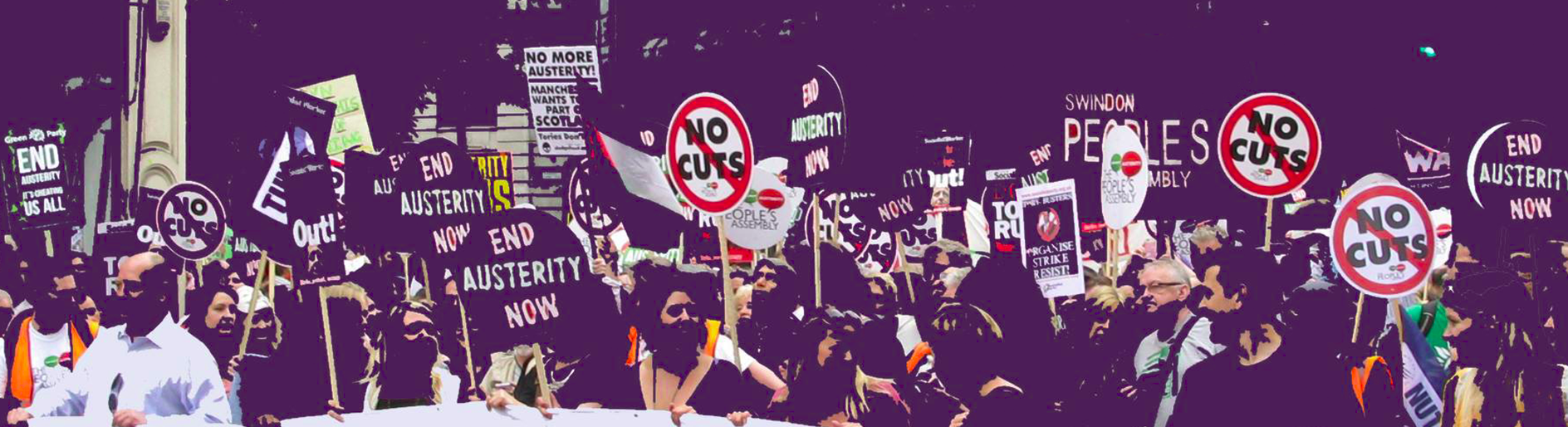

Dehumanisation of the people always unleashes personal and social tragedies

Prem Sikka is an Emeritus Professor of Accounting at the University of Essex and the University of Sheffield, a Labour member of the House of Lords, and Contributing Editor at Left Foot Forward.
History is littered with examples of powerful societies decaying from within, with tragic outcomes. How does that happen?
That question occupied Hannah Arendt, one of the Twentieth century’s leading thinkers, an escapee from Nazi Germany. How could Germany, an advanced society excelling in science, engineering, education and aesthetics give rise to the evil of Nazism? She concluded that “the death of human empathy is one of the earliest and most telling signs of a culture on the verge of descending into barbarism”.
Empathy is the glue that holds societies together. It enables us to be compassionate, caring, share feelings and see people’s predicament from a different viewpoint. It builds civilisations, trust and an environment of dignity and advancement. But it is slowly stripped away by populist dehumanising discourses orchestrated by charismatic figures hungering for power. With the aid of media and think-tanks they reconstruct people’s common-sense by creating folk-devils and moral panics. Minorities, the old, poor, sick, disabled and the unfortunate are scapegoated for social and economic problems and portrayed as undeserving. Dehumanisation of people occurs gradually and once people are dehumanised, their lives don’t matter to the system. Inhumane policies are portrayed as ‘toughness’ and financial discipline on the road to authoritarianism and decay.
They came for the minorities
The above isn’t something that happened in the past. It is happening now in the UK. Islamophobia, antisemitism and misogyny is on the rise. Minorities, rather than capitalism or inept government policies, are blamed for the housing and employment crisis. Racist discourses have been normalised.
Mass deprivation of citizenship, long abandoned after the Nazis stripped Jewish people of citizenship, is being touted as UK state policy. The presence of migrants is portrayed as an “invasion” by Reform UK. Its candidate in a recent by-election said: “It takes more than a piece of paper to make somebody ‘British’.” The implication is that people with black, Asian and other non-white backgrounds are not British. Reform would forcibly deport more than 600,000 people in its first year in office and this could include individuals holding indefinite leave to remain. A Conservative MP, touted as a future leader wants legally settled families to be deported, in order to ensure the UK is mostly “culturally coherent”. Up to nine million people are vulnerable to having their British citizenship stripped. The prospect of detention centres [concentration camps] looms. People of colour are twelve times as likely to be at risk as their white peers. Any person with dual nationality could be stripped of UK citizenship. The hard-right Restore Party appeals to Christian nationalism to marginalise others, paradoxically celebrating the life of a brown male refugee from Palestine.
The Nationality and Borders Act 2022 passed by the Conservative government empowers the Home Secretary to strip a person of citizenship without notifying them. Labour government’s Deprivation of Citizenship Orders (Effect during Appeal) Act 2025 means that even in cases where a court has found the Home Secretary to have acted unlawfully in stripping a British national of their citizenship, they do not get their citizenship back until all appeals by the government have been exhausted – a process that often takes many years. Further legislation to make it harder for migrants to get citizenship rights is on the way.
And… pensioners
The politics of indifference do not respect race, age or economic condition. People falling on hard times due to unemployment, sickness or disability are portrayed as scroungers. The elderly are targeted too. The UK state pension age is 66 and rising to 67 between 2026 and 2028, compared to 62 in France and rising to 64 in 2030. The UK state pension, as a percentage of average earnings, is one of the lowest in the advanced capitalist societies. The full post-2016 state pension, received by about 35% of pensioners, is less than 50% of the minimum wage. Around two million pensioners live in poverty. Some 110,000 pensioners a year die in poverty.
However, think-tanks funded by the super-rich describe the triple-lock on the state pension as a “clear financial burden on the state”, paving the way for “national bankruptcy”. They demand a three-year freeze on state pensions. Consequences for human life receive no attention.
And… children
There is no empathy for children. In 2017, the Conservative government introduced the two-child benefit cap, depriving poorest families of income and blighting the future of many children. Children in poverty have difficulties in realising their full education and employment potential, leading to lower earnings and contribution to the public purse. They are more likely to have healthcare problems and make greater demand for public and welfare services throughout their life and die younger compared to their peers. The Child Poverty Action Group estimates that keeping children in poverty costs the economy some £40bn a year.
Around 14.2m people, including 7.9m working-age adults and 4.5m children live in poverty. In opposition, Labour party described the two-child benefit cap as “obscene and inhumane” but upon taking office in July 2024 decided to continue with it as this somehow showed fiscal toughness. Prime Minister Keir Starmer withdrew the party whip from seven MPs for opposing the policy. Eventually, in March 2026 the Universal Credit (Removal of Two Child Limit) Bill abolished the cap. It will lift 450,000 children, and their families, out of poverty, and stimulate the local economy too. Abolition of the cap will increase government spending by £2.3bn in 2026-27, rising to about £2.9bn by 2029-30. In the overall scheme of things, this is not a huge sum. In 2025-26, the government is projected to spend around £1,370bn.
However, not all families with more than two children will receive additional financial support as there is an overall benefit limit of around £22,020 a year for families and £14,753 for single adult households (amounts are larger in London) without children though there are exceptions. In the interest of ‘toughness’ some 119,000 households had their benefit capped. Some 300,000 children won’t benefit from abolition of the benefit cap.
The Conservative party opposed the abolition and has promised to reimpose the two-child benefit cap. It claims that the abolition discourages work. The party does not oppose spending on corporate welfare. It wants to increase defence spending by confining children to poverty. Of course, defence spending can be increased by taxing the rich but that is not party policy. Reform UK has promised to reimpose the cap to buttress its pro-business credentials. It would use the £2.3bn/£2.9bn to cut beer duty and taxes on pubs and reduce the price of a pint of beer.
And… low-paid workers too
Minorities, unemployed, children and pensioners are increasingly portrayed as undeserving and a threat. That classification is applied to low-paid workers too. Without providing any evidence, the Conservative Party this year opposed the rise in minimum wage with the claim that the rise would somehow damage business profits and create unemployment. The legislation increases the hourly pay rate from £12.21 to £12.71. for workers over the age of 21 and from £10.00 to £10.85 per hour workers aged 18 to 21. A worker over the age of 21 will have gross earnings of around £25,000 a year for working 37.5 hours a week. This is well below the employee annual median wage of £31,056.
Tory opposition to the increase in minimum wage made no mention of the social condition of the masses. Average real wage has hardly moved since 2008. Some 25.3m Britons live below Minimum Income Standard i.e. lack incomes required to meet material needs and to enable participation in society. This comprises 48.6% of children and 35.0% of working-age adults. Low wages deprive people of good food, housing, education and life chances. The UK has a high rate of infant mortality compared with peer countries. Due to poor food and living conditions, British five-year-olds are up to 7cm shorter than children of the same age in Europe. One in four young people in England have mental health condition. Victorian illnesses like rickets and scurvy have returned. Altogether, some 7 million children are growing up in households lacking the income needed for a dignified standard of living. Some 3 million people are malnourished or at risk of malnutrition.
In sharp contrast to treatment of low-paid workers, nothing was said about soaring executive pay. A typical FTSE100 CEO collects average UK wage in two days, and the CEO-to-worker pay ratio is 141 times. Recently, the CEO of Shell got a pay rise of 60% to £13.8m. BP CEO’s pay has doubled to £11.7m. Her daily pay exceeds the annual median wage of a UK employee. At Melrose Industries, the CEO-to-worker ratio is over 1,110 times.
The above is a tiny glimpse of the systematic erosion of empathy. Minorities, pensioners, children and workers are confined to negative spaces and portrayed as burdens on society, often by wealthy people. Human rights are sneered at. People are being turned against each other by charismatic individuals. The UK may not be on the verge of descending into barbarism, but dehumanisation of the people always unleashes personal and social tragedies.
Left Foot Forward doesn't have the backing of big business or billionaires. We rely on the kind and generous support of ordinary people like you.
You can support hard-hitting journalism that holds the right to account, provides a forum for debate among progressives, and covers the stories the rest of the media ignore. Donate today.