




When you devote paragraphs to a writer’s body, clothes, and supposed visual offence, you forfeit the right to claim weight is beside the point.
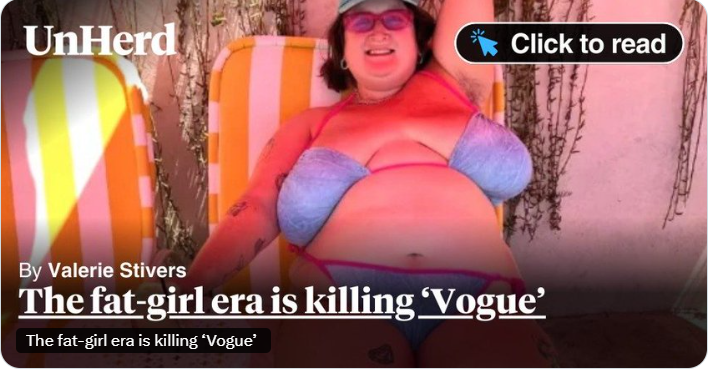
Another make-you-look-twice headline stopped me mid-scroll this week.
“The fat-girl era is killing Vogue,” it declared, followed by a subheading even more startling:
“I don’t care what the fat girl thinks of my opinions of her as long as I’m free to hold them and ignore her accordingly.”
The piece, written by Valeria Stivers, senior editor of UnHerd US, argued that Vogue, like other “beloved cultural institutions,” is hastening its own demise by betraying its audience through “woke decision-making.” Her proof is an obituary for Brigitte Bardot that dared to focus on Bardot’s politics rather than her style.
According to Stivers, Vogue has “long abandoned its mission of providing gorgeous, inspirational eye-candy for young women who were never going to be able to afford the clothes, in favour of the dreariest woke-ism.”
In her view, acknowledging that Bardot was a committed right-wing extremist somehow constitutes cultural vandalism.
So where does fat come into it?
This is where the article veers from culture-war cliché into something far more troubling.
Stivers reserves particular scorn for Emma Specter, the Vogue journalist who wrote the Bardot obituary, making a point of informing readers that Specter is “morbidly obese.” She goes on to critique Specter’s fashion choices, “sheer red lace over giant red undies,” outfits that allegedly emphasise what magazines once delicately called “problem areas,” as though this were remotely relevant to the quality or accuracy of her writing.
Stivers reminisces about her own time at Condé Nast, recalling an era when thinness was a professional prerequisite at Vogue, “let alone being photographed on its pages.” She admits she found the standard noxious at the time, but now, she says, she longs for its return.
She later insists that her real issue is not Specter’s weight, but her “joylessness.” Specter, she writes, offers only “predictable” insights, such as the fact that Bardot was right-wing and anti-immigration. Yet this disclaimer collapses under the weight of what precedes it. When you devote paragraphs to a writer’s body, clothes, and supposed visual offence, you forfeit the right to claim weight is beside the point.
Stivers concludes that Specter exists at Vogue not because of talent, but as “a political token for the magazine to display its conformity to the current body-positivity status quo.”
Oh dear.
As someone who grew up in the 1990s, when the waif look, Kate Moss, and “heroin chic,” dominated fashion media, there is something deeply ahistorical about this argument. That aesthetic did set an aspirational and often damaging standard for young women. It began to lose cultural dominance in the late 1990s, and by the early 2000s fashion had already started cycling toward curvier, more varied body types. While ultra-thinness still appears, it no longer reigns uncontested as it once did.
And let’s be honest, Vogue remains filled with thin models. The presence of a single larger-bodied writer is not a revolution, nor is it evidence of institutional collapse. If Vogue truly refused to reflect the diversity of bodies that exist in the world, surely that would be a death knell.
As for Brigitte Bardot, an obituary isn’t meant to flatter, nostalgia-polish, or conveniently forget. Bardot was repeatedly fined for inciting racial hatred over her denunciations of Muslim ritual slaughter during Eid, once declaring in court that Muslims were “obsessed with throat-cutting.” In 2006, she warned then-interior minister Nicolas Sarkozy that France was being “destroyed” by its Muslim population.
In 2018, she dismissed the #MeToo movement, suggesting women who spoke out about harassment were merely seeking attention. In 2022, she was fined again, this time for describing the people of Réunion as “degenerates” with “savage genes.” In total, Bardot accumulated five convictions for hate speech and thousands of euros in fines.
To mention these ‘facts’ is not “woke orthodoxy,” it’s basic journalistic honesty.
Unsurprisingly, readers online saw Stivers’ piece for what it was.
“I think most of Gen Z would disagree with you,” wrote one commenter.
“I don’t think she struggles with her weight. I think you struggle with her weight,” said another.
“1,000 wasted words trying to establish plausible deniability that you’re mad at a fat person for being fat, who fucking cares?”
Indeed.
Left Foot Forward doesn't have the backing of big business or billionaires. We rely on the kind and generous support of ordinary people like you.
You can support hard-hitting journalism that holds the right to account, provides a forum for debate among progressives, and covers the stories the rest of the media ignore. Donate today.