


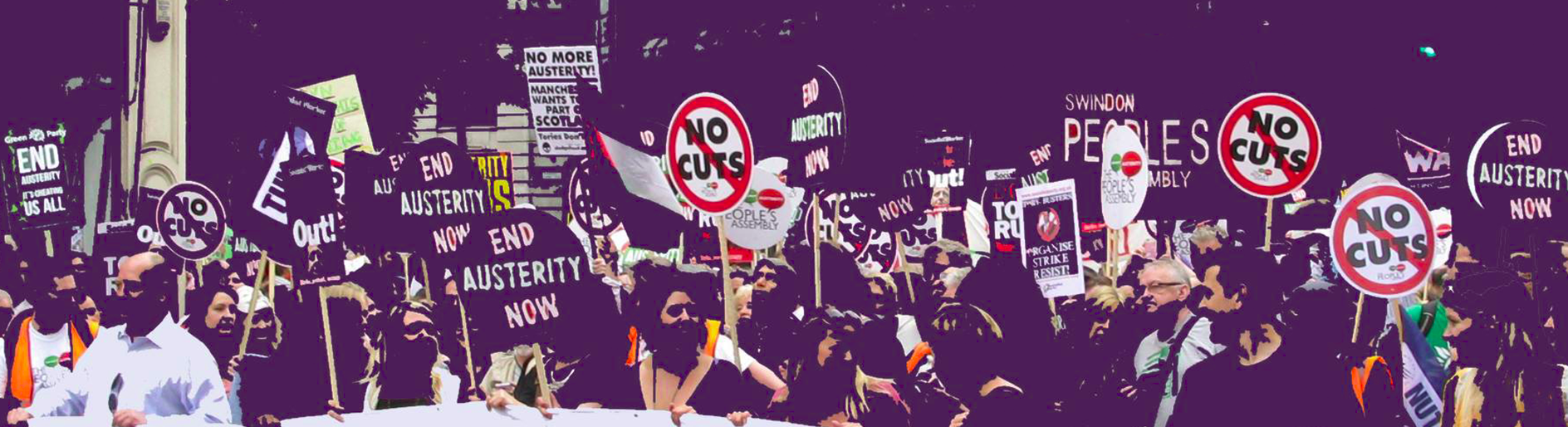

If you are simultaneously bashing the unions and slashing welfare, you're also not in the best position to accuse others of conducting class war.

If you are simultaneously bashing the unions and slashing welfare, you’re not in the best position to accuse others of conducting class war
On the Andrew Marr show this morning David Cameron confirmed that under a majority Conservative government a turnout threshold would be introduced for strike action. The PM said:
“I think in these essential services, like the London Underground, the pain caused to people trying to get to work and trying to help their families by these strikes, which are often supported by a relatively small percentage…I think it’s hugely damaging and so I think the time has come for setting thresholds in strike ballots in essential services. It’s not something I can achieve in a coalition government. It’s something that will be in our manifesto.”
The idea of 50 per cent turnout threshold is something which has previously been championed by London Mayor Boris Johnson. It also fits with the theme of recent Tory attacks on Ed Miliband for being “in the pocket” of the trade unions.
Indeed, for someone who was once believed by many to be a ‘no-content’ Conservative (for a long time it was said that Cameron didn’t believe in anything), proposals to introduce thresholds for industrial action are profoundly ideological. It’s also ironic that, during a week when the Tories have accused Labour of “class war”, they are indulging in pointless union-bashing in order to cheer up their grassroots supporters.
And that’s really what this proposal is about: appeasing right-wing Tories who may be attracted to UKIP.
It’s certainly hard to see any practical reason why Britain urgently needs new strike turnout threshold rules. Far fewer days are lost to industrial action in Britain today than in the past. The number of working days lost to industrial action hit an all-time-low in 2012, with just 250,300 days lost. This compares to an average of 12.9m working days a year lost in the 1970s.
The odds are also already stacked against trade unions, with many ballots invalidated by bureaucratic legal rulings even after a successful ballot. Since 1980 there has been the following blitz of legislation to curb strikes:
- the 1980 Employment Act;
- the 1982 Employment Act;
- the 1984 Trade Union Act;
- the 1988 Employment Act;
- the 1989 Employment Act;
- the 1990 Employment Act;
- the 1993 Employment Act.
As much as the recent tube strikes were an inconvenience to London’s commuters, the biggest issues facing ordinary people in Britain today are stagnant pay and inequality between the ‘squeezed middle’ and the so-called ‘1 per cent’. Wages are still lagging behind inflation for those who don’t receive bonuses, and notwithstanding a very slight narrowing of the gap between the rich and the poor during the downturn, the share of total UK income going to the richest 1 per cent increased from 6 per cent in 1979 to 14 per cent today.
These developments are arguably attributable to the declining power of the trade unions, and for obvious reasons: as union membership has fallen, bosses have had a much stronger hand when it has come to squeezing the pay of their employees and awarding themselves eye-watering sums in remuneration. No, not all employers are like that; but nor are all trade unionists communist troublemakers intent on walking out at the first opportunity. In fact, I’ve never met a trade unionist who actually enjoys going on strike and losing a day or more in pay.
Even Ukippers should welcome more active trade unions if they really care about British workers being undercut by migrants from Eastern Europe. The best way to ensure that migrant workers are paid properly is, after all, to get them unionised so that, alongside their British counterparts, they can push their employer for better pay and working conditions.
Making it more difficult to strike will do nothing to tackle the real issues facing British families, and as with so many policies emanating from Downing Street these days, this is yet another sop to a faction of the Tory party that is increasingly charmed by Ukip. If you are simultaneously bashing the unions and slashing welfare, you’re also not in the best position to accuse others of conducting class war.
James Bloodworth is the editor of Left Foot Forward
Left Foot Forward doesn't have the backing of big business or billionaires. We rely on the kind and generous support of ordinary people like you.
You can support hard-hitting journalism that holds the right to account, provides a forum for debate among progressives, and covers the stories the rest of the media ignore. Donate today.
54 Responses to “The Tories want to ban strikes without 50% turnout, yet they accuse others of class war”
PoundInYourPocket
Good point, in Geermany & Norway union reps sit on the board and take part in company decisions. This prospect has always caused fits of hysteria in the Telegraph but look at the success of German companies. They also have a better safety record, higher skills and greater employmee retention. The disease of british industry has always been its hereditary hatred of the very people it employs and its rejection of union cooperation.
LB
Well, the state has taken all the NI from the poor and spent it. Unfunded means no assets. Bernie Maddoff didn’t get that far. Ditto for the civil service pensions scheme. They’ve done a Maxwell in spades.
The biggest losers, percentage wise are the poor. With their NI gone, they need a pension. The problem is the state has promised 7.1 trillion of pensions, linked to inflation.
So you can demand all you want, the state is bankrupt. So why are you cheerleading for the impoverishment of the poor? Perhaps you make a living from their money.
LB
My cash is onshore. It’s not like I’m doing a Guardian. 300 million profit, not a penny in tax, and a 800,000 tax rebate. All in an offshore Cayman Island trust.
People have a right to the money they earn. People have a right to keep all the money they earn to get them out of poverty. Then they should pay a fair share of the common goods, so long as they aren’t over charged.
That’s not what’s going on now.
LB
Absolutely correct. He was. The reason is he won’t acknowledge, like Labour too, that people are owe a pension for their NI contributions (ditto, civil servants).
It’s net assets (or debts) that matter. The state is bankrupt.
LB
No. The number of foreign born residents of the UK is 7,354,000 [Latest estimate]
Some of those will be Brits.
Not all will be working, so even if 50% are, that’s enough to cover all of unemployment in the UK and still have jobs left over for the high skilled, high tax paying workers.
http://en.wikipedia.org/wiki/Foreign-born_population_of_the_United_Kingdom