


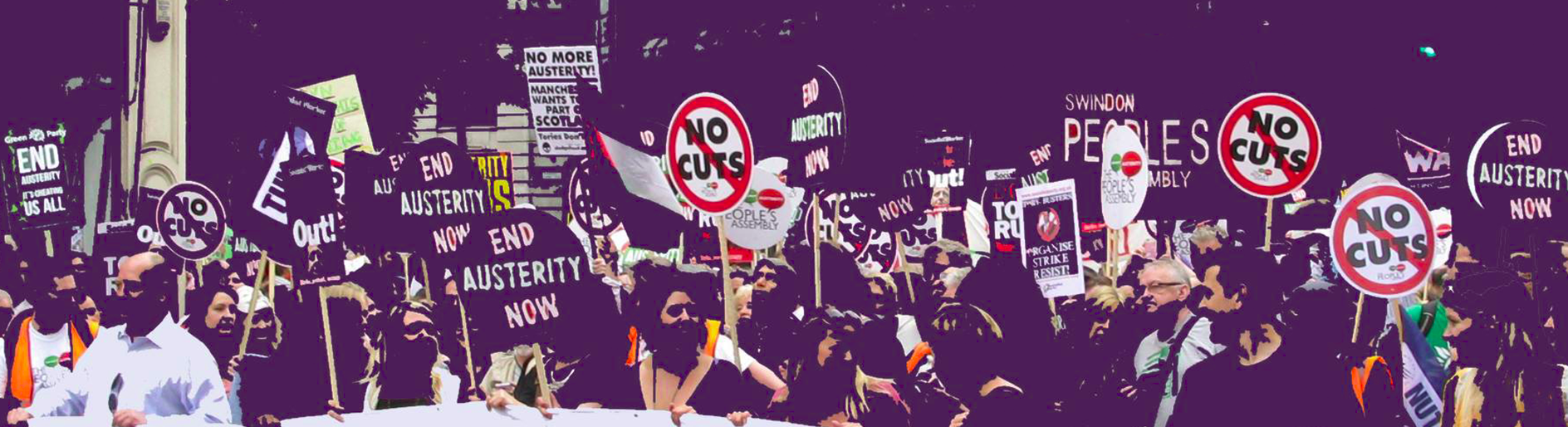

The Government claims that “We’re all in this together”. But even with Eric Pickles’ 'transition grant' into account, the poorest areas will do worse out of this settlement.

The Government is fond of claiming that “We’re all in this together”. But even taking Eric Pickles’ ‘transition grant‘ into account, it is abundantly clear that the poorest areas will do worse out of this settlement.
Left Foot Forward has carried out a simple econometric analysis of the local government cuts and compared the post-transition grant “change in estimated ‘revenue spending power’ 2011-12” with the 2007 index of multiple deprivation – the last analysis available. The figures speak for themselves.
In London, there is a strong correlation between the two variables. Poor areas like Hackney (-8.9%), Newham (-8.9%), Tower Hamlets (-8.9%), and Islington (-8.8%) find themselves with the deepest cuts while richer areas like Richmond (-0.61%), Havering (-1.71%), and Harrow (-1.9%) are best off.
The x-axis covers the index of multiple deprivation (50 is the most deprived area) while the y-axis covers the percentage fall in ‘revenue spending power’.

A similar pattern takes place in metropolitan areas. Here Manchester, Liverpool, South Tyneside, and Knowsley get take the maximum hit of -8.9% while less deprived areas like Solihull (-3.49%), Dudley, (-3.39%), and Trafford (-3.79%) do far better.

UPDATE 18.41:
It has been pointed out to me that the local government figures include NHS support for social care. If this were excluded the picture would be even more stark.
Left Foot Forward doesn't have the backing of big business or billionaires. We rely on the kind and generous support of ordinary people like you.
You can support hard-hitting journalism that holds the right to account, provides a forum for debate among progressives, and covers the stories the rest of the media ignore. Donate today.
180 Responses to “Eric Pickles’ cuts target Britain’s poorest areas”
Lewisham Green Party
RT @DarrenJohnsonAM: Thanks @leftfootforward for analysis of how Government cuts are hitting poorest areas hardest http://bit.ly/fm73iV …
13eastie
Will,
1) If you were actually to read my post, you would see that I stated that your “data” was commissioned by Labour, which it was. It certainly would not have been my intention to imply that your “econometric” analysis was anything but amateur…
2) What you have done is exactly cherry picking: geographically; sociologically; statistically. It’s slap-dash spin. You have also misused the data in a manner that is warned against explicitly in the DCLG’s own document, “Using the English Indices of Deprivation 2007”. Your misappropriation of the data is disingenuous, as is the deliberate conflation of poverty with deprivation in your title.
3) My point is that IMD is a party-political construct with a party-political function; it is not widely adopted; it is entirely unproven as an aid to policy, and it will remain so since (as qualified in the accompanying notes):
>> “The ID 2007 scores and ranks cannot be used as absolute measures of deprivation or to identify absolute change over time.”.
4) Again, were you actually to read the report, you would note that, on almost every other page, it makes pains to remind the reader that the data to which it owes its derivation is no more recent than 2005.
Heather Cracknell
RT @johannhari101: The Tory cuts announced today hit the poorest areas hardest: http://bit.ly/gjxG3I via excellent @leftfootforward
LAVA Collective
RT @johannhari101: The Tory cuts announced today hit the poorest areas hardest: http://bit.ly/gjxG3I via excellent @leftfootforward
Valueofnothing
hmmm might be worth doing a logit regression with the independent variable being the size of the cut and the dependent variable being 1 if council is tory/liberal/tory liberal coalition and 0 otherwise.
I bet that would give a good fit! http://en.wikipedia.org/wiki/Logit_regression