


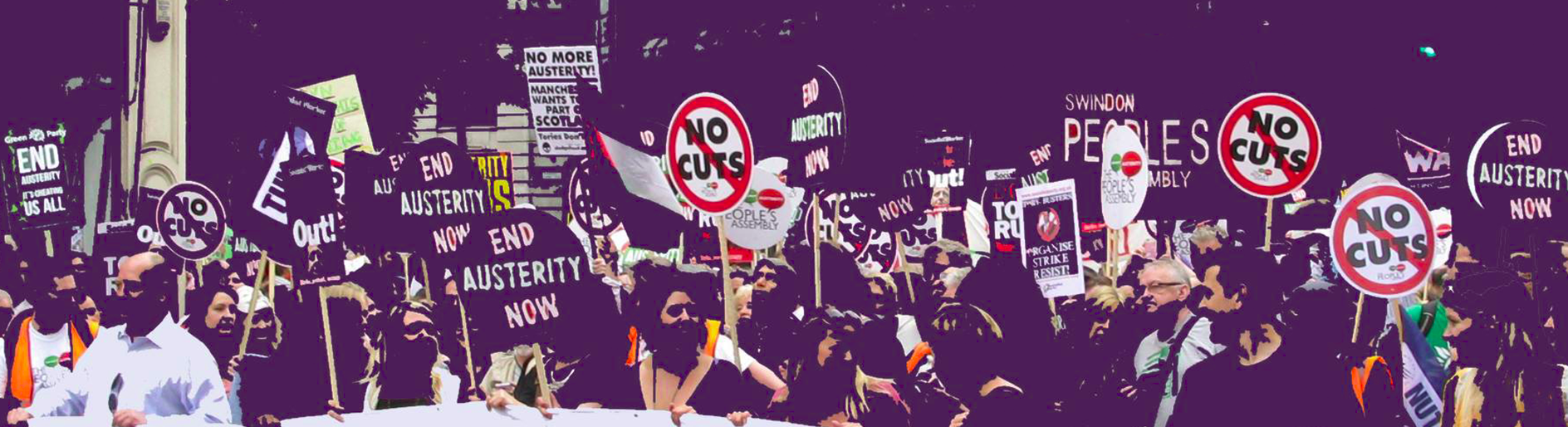

In today's Guardian, Will Straw argues that Labour must "pick what it thinks is the right size of the public sector." A wealth tax is one way to protect against cuts.

Alongside a group of “leading leftwing thinkers” including a number of Left Foot Forward contributors, I have a short piece in today’s Guardian outlining where I think “the Labour party should go from here”. I argue:
“The Labour party has to pick what it thinks is the right size of the public sector. Since 1997, public spending has gone up from 36% of national income to 48%. (Before the recession, it was at 42%.) But tax revenues have always been at around 38%, and during the recession fell to around 35%. The reason we’ve got a structural deficit is because Gordon Brown won the argument for investment in public services, but never took on the argument for increasing taxes to pay for it.”
The point is perhaps best made by this graph from the Institute for Fiscal Studies. Where the black and green lines end up is key to what the future of Britain will look like. The Lib-Cons with their series of tax cutting proposals want a smaller state, less redistribution, and a pared down welfare state. If Labour gets its act together, it can limit this scaling back.

This week’s Economist sets out the key strategic challenge facing the Labour party:
“For nothing will make or break the next leader of the opposition like his response to the government’s austerity programme. Oppose it all, and Labour will look incredible. Back it in grown-up fashion, and the coalition will have an easy ride. The tempting third way—supporting “good” cuts but not “bad” ones—will work only if Labour agrees on which bits of spending should go. Underlying this tactical dilemma is the more strategic question of what the left is for when there is no money to spend. Labour’s narrative was once devastatingly clear: the revenues from a buoyant economy should correct the historic underspend on public services. What is it now?”
The Social Market Foundation are on the right track today with a new report titled, “Axing and Taxing” covered in today’s FT. They recommend reducing the deficit with £39.0 billion of spending cuts and £25.3 billion of tax increases. This protects more public spending than under Labour’s plans to reduce the deficit with a 2:1 ratio of spending to tax. Indeed, if one removes from the SMF baseline the Lib-Con measures such as the £6.2 billion cuts to pay for scrapping the £6 billion employer NICs rise, their proposals would mean £32.8 billion in cuts and £31.3 billion of tax increases – close to the 1:1 ratio used by Ken Clarke and Norman Lamont in the early 1990s.
No doubt the SMF’s proposals to means-test child benefit and raise VAT will concern many on the left. But if not these we have to pick something else instead or say how taxes would go up further. In which spirit, instead of the VAT rise, which would be deeply regressive, I would instead pick a wealth tax. As the Political Climate blog points out, “recent data from the ONS show that the top 10% of households own more wealth than the rest put together”. Right-wing blogger Tim Worstall kindly points out the risks of capital flight. One way around this is to target the tax at land, which is hard to move. In an article for Prospect earlier this year, Philippe Legrain called it the “only efficient and fair way to bring Britain’s finances back into line”. After all, 0.3 per cent of Britain’s population owns 69 per cent of its land.
UPDATE 14.06
Alex Barker at FT Westminster picks out an intriguing graph from the SMF report to argue that a modest rise in VAT would actually be progressive if measure on an expenditure basis. It is certainly true that many in the bottom income decile are not the poorest in society since they are students, those on sabbatical, or self-employed people suffering from a bad year who are able to smooth their expenditure by borrowing or using savings. But there are arguably more people at the bottom of the income scale who bolster their expenditure by borrowing beyond their means. Expenditure rankings also say nothing about miserly Mr Scrooges at the top of the income scale. The SMF graph which caught Alex Barker’s eye is actually from an IFS report. They are careful to say only that the expenditure analysis gives a “different picture” rather than a better one.
And while we’re on the subject, this graph from the IFS shows that whichever way you cut it, removing exemptions to VAT – another SMF idea – would be regressive.

Left Foot Forward doesn't have the backing of big business or billionaires. We rely on the kind and generous support of ordinary people like you.
You can support hard-hitting journalism that holds the right to account, provides a forum for debate among progressives, and covers the stories the rest of the media ignore. Donate today.
48 Responses to “To defend the cuts, Labour must be clear about the size of government”
John77
Will,
You KNOW that VAT is NOT deeply regressive. I have already pointed out that the ONS data contradicts previous absurd LFF claims that were less extreme.
There are sensible ways to increase taxes fairly – such as increasing the individual tax threshold to 40 times the hourly minimum wage and increasing the basic rate of tax to the level at which Ken Clarke left it so reducing the tax burden on the poor and lower/middle income while increasing it on the well-off, limiting the tax breaks on ISAs and pension contributions to the basic rate of tax. One might even abolish all the tax breaks introduced for the benefit of the rich and put the tax consultancy industry out of business – I remember that there were few tears shed for them when Geoffrey Howe “decimated”* their business three decades ago. Alternatively you could align the effective tax rate for those being paid over £.25m pa with those with children on working tax credit by raising the former and reducing the latter. Under Blair/Brown a low/mid-income guy with one kid at university had a marginal tax rate of 81% while the Duke of Westminster paid 40%.
Simplifying the tax system might mean firstly that HMRC staff actually understood it (and did not send out tax return forms with instructions to the taxpayer that were just plain wrong) and so did the taxpayer so reducing the number of innocent errors so that inspectors could spend more time chasing deliberate cheats and secondly that there was less opportunity for tax advisers to “game” the system by converting taxable income to capital gains that were tax-exempt or taxable at a lower rate.
A wealth tax with a cut-off level below the price of an upper-quartile inner-London house would be horrendously and expensive to administer – the same applies to a land tax above the difference between the house price and the building cost. One with a higher threshold level would either bring in relatively little income or have rapidly diminishing returns (like Brown’s north sea oil tax)
*He reduced it by more than two-thirds not by 10% but most journalists don’t know the correct meaning of the word
them 30 years ago
To defend the cuts, Labour must be clear about the size of government « The best Labour blogs
[…] More… […]
Fat Bloke on Tour
John77 @ 10.36pm
Couple of interesting points, a schoolboy howler by me and a whole load of tripe by you. Your analysis is partial, limited and in the most just plain wrong.
Borrowing to invest has been part of the economics of government for generations. GB codified it and was applauded for doing so. Consequently your simplistic kitchen table conservative viewpoint is wrong.
If national debt runs to 60% of GDP then public sector investment of 3% can be supported using debt without ptting up the GDP value of the national debt year on year. If the debt goes to 80% then a 3% investment figure will actually reduce the national debt over time.
The public sector will always need investment, any attempt to cut investement will either mean reduced standards or a transfer of functions from the public to the private sector.
Your pay as you go attitude will only result in higher taxes or reduced provision. If we build today what is wrong with asking future generations to pay the interest on that investment if they are getting the benefit?
Your take on the Credit Crunch is interesting to say the least, at least you imply that as the Credit Crunch was generated in the private sector, then the private sector does not always get its investment decisions right. I admire your talent for understatement, when it is fully understood the Credit Crunch will be seen as a criminal game of Pass the Parcel where a magic circle generated worthless paper and used usefull idiots in the US to export the rubbish to under capitalised and under funded banks all around the world. Add in the herd instinct and the fear factor of the unknown and we had a Capitalist system undergoing a nervous breakdowm.
Sorry football beckons so just a couple of bullet points:
1) NS oil = 40 year old fields, the output is now 50% approx of the peak, no wonder the tax take is under pressure.
West of Shetland is an old wifes tale, how many dry wells do you need to take this onboard.
2) WW2 debt, figure for 39, figure for 45?
3) WW2 debt, we paid very little cash. 50 destroyers?
Lend Lease in 41, when did it begin? The answer is not Dec 7th.
4) Avoidance / Evasion, static — pull the other one.
The HMRC is 12 months behind the game, they need help. Simplify, publicise, target … any of these will do.
How much Corp Tax does NI / B”Sky”B / Torygraph pay?
How much profit / positive cashflow do they generate?
5) Thatch’s record, will come later.
Your howlers are too good to miss.
Fat Bloke on Tour
john77 Part 2
Thatch and the Falklands = Laugh a minute if it wasn’t for the loss of life.
Sunny Jim / 76 + 78 = Sorted out the junta big style.
Thatch / 81 = She wanted to be a cutter and not a warrior.
Just exactly did she do for the war effort in WW2?
Answer: The square root of very little is the polite response.
Sold the Invincible / dropped the LPD capability / got rid of the Endurance.
That was the plan announced to the world in the 81 budget.
Consequently she lost the Falklands, the forces won them back.
More troops were killed under her watch in the 80’s than were lost in the noughties.
Thatch and national debt / deficit.
She cut the national debt, that I do agree with.
But how did she do it?
Inflation / oil revenues / privitisation is the answer.
What was the average annual deficit in the 1980’s?
What was the average annual level of inflation in the 1980’s?
Consequently she was a snake oil saleswoman of the highest order.
Gap between rich and poor = You are having a laugh?
What figures are you using?
Decent wages for nurses?
I don’t think so, how come there were so may vacancies in 97?
Again, any info on this? Lets be having it.
1930’s re-armament — I talked about late 30’s Treasury interference.
You talked about early 30’s political trends.
Consequently you either don’t understand my original question or you do and are trying to obfuscate?
The Treasury has a long history of knowing the price of everything but the value of nothing.
John77
Fat Bloke on Tour
My analysis is limited because there are only 24 hours in a day and writing an economics dissertation takes longer. It is NOT, however, wrong. I don’t have 24 hours to spare so this will have to come in instalments.
Borrowing to invest has been the practice of *private companies* for generations – but they have to generate enough income from the investment to both pay interest on the debt and to repay it when it matures. It has not been the practice of governments which until Keynes’ ideas gained popularity were expected to balance their budgets except during major wars after which they were expected to repay their debts. [5% War Loan was due to be repaid in 1932 but some of it was rolled over into 3.5% War Loan]. Public sector accounting does not include depreciation – in fact until recently a lot of public sector accounts were purely cash flow statements that us poor taxpayers are not allowed to use when submitting tax returns (a few of us are allowed to use to a cash basis for payments but not for income). So Brown claimed to be prudent because he was “only” borrowing to fund gross capital expenditure rather that net capital investment. He did NOT codify existing practice – he changed it and pretended to be prudent when introducing a practice that would lead to escalating debt. Originally budgets were supposed to be balanced, then governments started to borrow during wars and repay debts after the war ended, then Keynes introduced the idea of running a deficit at/near the bottom of an economic cycle which he expected to be balanced by a budget surplus at/near the top which would repay the borrowings which could be interpreted as a fiscal balance over an economic cycle. Brown introduced the idea of a fiscal balance – excluding GROSS investment – over an economic cycle. If you cannot see the difference between Keynes and Brown, then you are economically illiterate.