Woke-Bashing of the Week: Trump’s war on ‘woke’ art escalates
This brand of patriotism looks less like celebrating American greatness and more like deciding whose art, identities and stories deserve to represent the country.
The Trump administration’s campaign against ‘woke’ art has taken another turn, with the US State Department reportedly seeking to sell a painting by Kehinde Wiley, the celebrated artist behind Barack Obama’s official presidential portrait.
Wiley is known for his large-scale paintings celebrating Black identity, often placing Black subjects in compositions inspired by traditional European portraiture. His portrait of Obama was unveiled in 2018 and now hangs in the Smithsonian’s National Portrait Gallery.
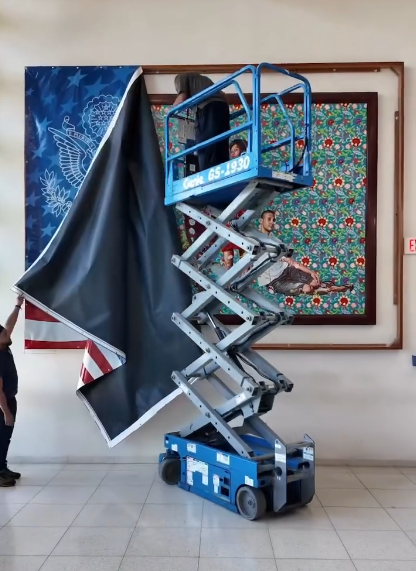
But the artist’s work has become a target of the Trump administration’s cultural purge. In August, a painting Wiley created for the US State Department in 2013 was removed from the US Embassy in Santo Domingo, Dominican Republic, on ideological grounds.
Young Artists After Siamesas 1960 depicts four Dominican models against an elaborate floral backdrop. Before its removal, the painting was hidden behind a tarp emblazoned with an image of the American flag.
Announcing the move on social media, US ambassador to the Dominican Republic Leah Campos said: “In the Trump Administration and under my leadership we are turning away from globalist and woke ideologies and instead embracing American patriotism and the beauty of our great country!”
Yet neither Campos nor Erin Scavino, director of the State Department’s Art in Embassies programme, has clearly explained what makes Wiley’s painting objectionable. As the New York Times has reported, the criticism has instead focused on the artist himself and his association with Obama.
Scavino took over the programme at the beginning of Trump’s second term. She has emphasised acquiring and displaying art featuring patriotic imagery. Her previous experience includes working as an attorney and appearing as a contestant on Trump’s reality television show the Apprentice. She is also married to White House deputy chief of staff Dan Scavino.
This summer, she organised an exhibition in Washington titled Passport to Patriotism: 250 Years of Diplomacy, featuring 56 works incorporating 68 representations of the American flag.
Established in 1963, Art in Embassies was designed to advance cross-cultural dialogue and strengthen international relationships through art. Wiley’s painting formed part of the embassy’s permanent collection, and in 2015 the state department awarded him its Medal of Arts in recognition of his contributions to the programme.
Now, according to the New York Times, the department wants to sell the very work it commissioned.
Virginia Shore, who commissioned the painting and served as the programme’s director of acquisitions and chief curator between 2000 and 2017, said the work was nonpartisan. She also noted that there was no precedent for selling embassy artworks.
“Calling this woke is difficult for me to understand,” she said. “This is a program validated and financially backed under Bush.
“There is a science of building trust and empathy across borders.”
Her comments highlight what is at stake. A programme intended to build relationships between the US and the wider world risks being repurposed to promote a narrow, politically approved vision of American identity.
Wiley has previously attracted criticism from conservative commentators over his 2012 painting Judith and Holofernes, which depicts a Black woman holding the severed head of a white woman. Wiley described the work as a play on the “kill whitey thing”.
He also faced scrutiny in 2024 over allegations of sexual assault, which he denies.
In an executive order issued in March, Trump directed the Smithsonian to remove what he called “improper ideology” and “divisive narratives,” while placing greater emphasis on what he described as American greatness. That same month, his administration reduced the federal workforce responsible for preserving a collection of 26,000 publicly owned artworks.
Ultimately, this brand of patriotism looks less like celebrating American greatness and more like deciding whose art, identities and stories deserve to represent the country.
Left Foot Forward doesn't have the backing of big business or billionaires. We rely on the kind and generous support of ordinary people like you.
You can support hard-hitting journalism that holds the right to account, provides a forum for debate among progressives, and covers the stories the rest of the media ignore. Donate today.
Donate today