Sharon Graham: A just transition could be as transformational as the 1945 Labour government
LFF interviewed Unite general secretary Sharon Graham at TUC Congress in Brighton
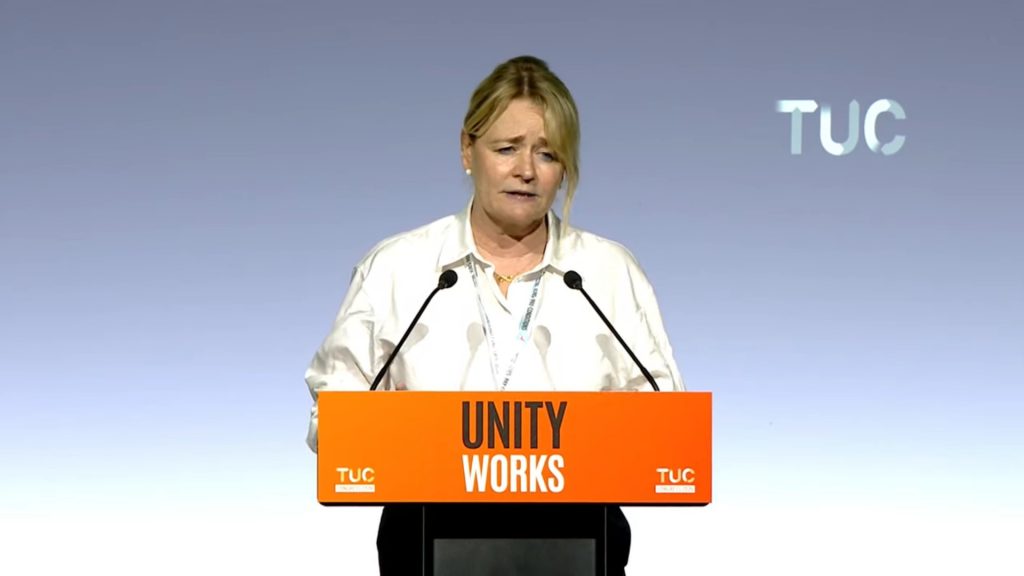
Unite is one of the UK’s largest trade unions, representing over 1 million workers in a range of sectors. Its general secretary – Sharon Graham – is one of the most prominent figures in the labour movement, having first been elected in 2021 and comfortably re-elected this summer.
Under her leadership, Unite has sought to assert its influence on the political scene in order to deliver policy change for its members, while maintaining a relentless focus on workplace organising over issues of pay, terms and conditions.
During her time in office, she’s butted heads with governments of various flavours. With Andy Burnham now in Number 10 and leading a new-ish administration, LFF spoke to Graham at this year’s TUC Congress about what she makes of his early days in government and what her union wants him to deliver for workers.
“At the moment the working class feel that their best days are behind them”, Graham told LFF, adding: “They don’t believe their children will have better jobs. They don’t believe their children are going to be able to buy a home. And actually they feel that everything that was there is almost in the past, not the present.”
She went on to say that Burnham needs to “crack the code” to ensure that “the working class could feel that their better days are ahead of them”. She said his “analysis has been good”, but that there needed to be “meat on the bones”.
What would this look like? Graham’s initial answer comes with a proposed contrast to the early days of the Keir Starmer government. Within months of coming to office, Starmer and his chancellor Rachel Reeves proposed major cuts to the Winter Fuel Allowance, a move vociferously opposed by many in the trade union movement.
Graham told LFF that Burnham needs to deliver a “Winter Fuel in reverse”, arguing that “he has to something positive and clear”, and that this should be “immediate”.
With the budget coming up in October, the government has an opportunity to deliver this. For Graham, there are some clear policies it could adopt that would improve the lives of workers and begin to rebalance the economy.
First up is tax thresholds, which Graham argues should be un-frozen. “It’s one of these hidden things that’s happening that most people don’t even realise”, Graham told LFF. She added that in: “2022, they were frozen by the Tories, continued on by Labour. But if that had not happened, the £12,500 band would be £16,000, and the 40% tax threshold at £50,000 would be £66,000. We’ve got low paid members and pensioners going in too early on the 20%, and you’ve also then got tanker drivers, nurses, teachers coming in at the 40% bracket when they shouldn’t be in at the 40% bracket at all.”
Graham continued: “So even though that’s something that in a way is really hidden, I think the signal it would give is: work pays.”
Alongside this, Graham has called for the government to use the budget to ‘ease’ the pressure on people around energy costs.
But Graham and Unite are looking for a more extensive set of economic changes than this. At this year’s TUC Congress, delegates backed a Unite motion which called for an “ambitious industrial strategy to deliver good well-paid jobs and reindustrialise Britain”, an end to public sector austerity through taxing wealth, and a loosening of the government’s ‘fiscal rules’ to allow more direct investment in jobs.
Graham told LFF that “since the 2008 crash and Covid, it’s been workers and communities that have paid the price for the entirety of it”, and called for the government to say that “workers and communities aren’t going to pay anymore”, arguing that they should instead be “going to the exceedingly rich” and the “banks who we bailed out” to fund the economy.
Alongside this, Graham said she wants to see a substantial “package of investment in British industry”, the “reindustrialisation” of the UK, and for the government to begin taking energy into public ownership. She told LFF: “In an average house bill of £1,700, £500 pound is profit. It’s a bit of a no-brainer. At some point we need to take this back into public hands.”
Graham acknowledged that “we might not get everything”, but argued that “if the package shows this is a Labour government fighting for the working class and making sure that everyday people are not paying the price – they’ve done that since 2008 – I think he [Burnham] will get a good hearing.”
On that economic package, how the government addresses the climate emergency and decarbonises the economy is a central interest for trade unions. How that transition is managed is a key area of debate within the trade union movement.
Unlike some within the movement and the wider left, Unite does not oppose the expansion of oil and gas extraction in the North Sea.
Graham told LFF that Unite’s support for continued drilling in the North Sea is in order to buy time to deliver a fair and just transition for workers into a net-zero economy.
“Everyone I speak to wants net-zero”, Graham said, adding: “But you cannot have one part of the equation, which is the target, if you don’t have the other part of the equation, which is how the jobs are going to be replaced and what those industries are”. She went on to say that continuing to extract oil and gas from the North Sea “just buys time for us to be able to hopefully convince a government that they have to invest in these new industries”, arguing that “The problem we’ve got at the moment – there isn’t any transition”.
For Graham, the transition to a decarbonised economy is a massive opportunity for the country and for workers, but one that is not currently being taken. “We led the first industrial revolution. We’re nowhere as far as this is concerned with the fourth industrial revolution”, Graham told LFF.
Later in the interview, she went on to say that this transition could be ‘transformational’ for the country. She said: “It could be something transformational on par with the 1945 Labour government if they got it right. I mean, imagine if there was a plan to nationalise our energy at the same time that we were building new industries in Britain for the first time. It’s an unbelievable package.
Chris Jarvis is head of strategy and development at Left Foot Forward
Left Foot Forward doesn't have the backing of big business or billionaires. We rely on the kind and generous support of ordinary people like you.
You can support hard-hitting journalism that holds the right to account, provides a forum for debate among progressives, and covers the stories the rest of the media ignore. Donate today.
Donate today