Woke-Bashing of the Week: The Spectator has a problem with Lewes, apparently even its trees are woke
The Spectator decided that the trees of Lewes are yet another front in the culture war.
Trees are rather useful things. They help cool towns and cities, support wildlife, protect soil and water, store carbon and can make agriculture more resilient.
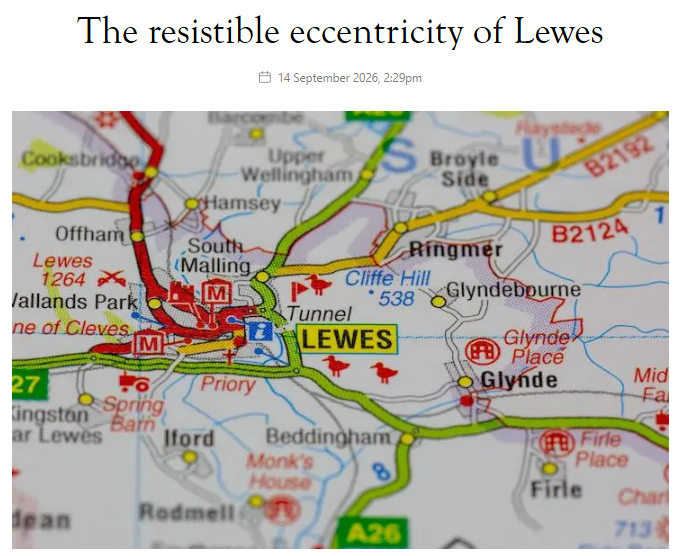
So, when Lewes Town Council passed a Tree Charter on September 10, recognising the rights of trees to flourish and maintain their natural life cycles, ecological functions and evolutionary processes, you might imagine this would be considered a fairly uncontroversial attempt to protect the natural environment.
Not so, apparently.
The Spectator decided that the trees of Lewes are yet another front in the culture war.
Alexander Larman, the magazine’s US books editor, devoted an entire column to the supposed decline of the East Sussex town, which has become, in his opinion, a rather tiresome haven for wealthy, self-satisfied lefties.
Larman, who lived in Lewes for nearly five years between 2014 and 2019, describes its “well-heeled denizens” and recalls being regarded with scorn as a “DFL,” Down From London. He portrays the town as having transformed from a beautiful, largely unspoilt place into a “tiresome and self-regarding hotbed of all things hard-left”.
Naturally, the familiar Spectator rollcall follows: £5 oat-milk lattes, wealthy lefties, Jeremy Corbyn, Palestine activism, the burning of Donald Trump in effigy at Lewes Bonfire, and the inevitable swipe at climate politics.
This is, after all, a magazine whose wider output has repeatedly attacked environmental policies and climate politics, with Spectator TV producing videos about “climate alarmism,” “Labour’s net zero madness” and net zero “leading the world to ruin.”
Lewes’s tree charter therefore provides another opportunity to turn environmentalism into another episode of the same culture-war drama.
But there’s a problem with this narrative.
Lewes’s reputation as a home for unconventional, creative and politically-independent people did not begin when affluent Londoners discovered it.
The town and its surrounding area have a much deeper cultural history. Thomas Paine, one of the great political radicals of the 18th century, was born nearby. Virginia Woolf and the Bloomsbury set had strong connections with the area, which remains known for its artistic and cultural life. The local tourism body still describes Lewes as having a thriving contemporary arts scene alongside its Bloomsbury heritage.
And the connection with creative outsiders continued long after Bloomsbury. Rolling Stones drummer Charlie Watts moved to Lewes in the 1960s. In fact, my mum went to college there with the music legend, a small personal connection, perhaps, but one that rather neatly illustrates how Lewes’s creative history long predates the modern culture-war portrait.
The story is not therefore that Lewes magically manufactures left-wing geniuses. Nor is it that everyone who lives there is some wealthy progressive stereotype.
It is that the town has repeatedly provided fertile ground for people who are independent-minded, artistic, unconventional or prepared to challenge the status quo. A history of dissent, a strong cultural life, a tolerance of eccentricity and its connections to London and Brighton have helped create an environment in which unconventional people can flourish.
That makes Lewes’s reputation as a home for creative “lefties” rather less of a fashionable lifestyle affectation than Larman would have us believe. It looks much more like the latest chapter in a considerably older tradition.
Left Foot Forward doesn't have the backing of big business or billionaires. We rely on the kind and generous support of ordinary people like you.
You can support hard-hitting journalism that holds the right to account, provides a forum for debate among progressives, and covers the stories the rest of the media ignore. Donate today.
Donate today