The Edinburgh attacks and the question of ‘two-tier journalism’
“Indeed, we don’t have a two tier policing problem, we have a two tier media problem.”
Five people were injured in a series of violent attacks in Edinburgh last weekend. Footage circulating online appeared to show a bare-chested man carrying a large weapon through the streets, while another clip showed a man repeatedly battering the door of a local pizzeria. The incident reportedly began at Broomhouse Mosque, and police have since charged a man in connection with the attacks.
The violence prompted reaction from politicians and Muslim organisations, many of whom argued that the attack appeared to be motivated by anti-Muslim hatred. Keir Starmer condemned what he described as “anti-Muslim hatred,” while Muslim Engagement and Development (MEND) urged authorities to “treat this as what the evidence indicates: Islamophobic, far-right terror.”
“Whipping up this type of vigilantism and emboldening far-right terror is [the] whole point of this poisonous narrative,” the group said.
The government-funded British Muslim Trust likewise said it was “deeply concerned by the shocking attacks.”
Yet despite the severity of the incident, the story received relatively little prominence across the UK national press, an omission that did not go unnoticed.
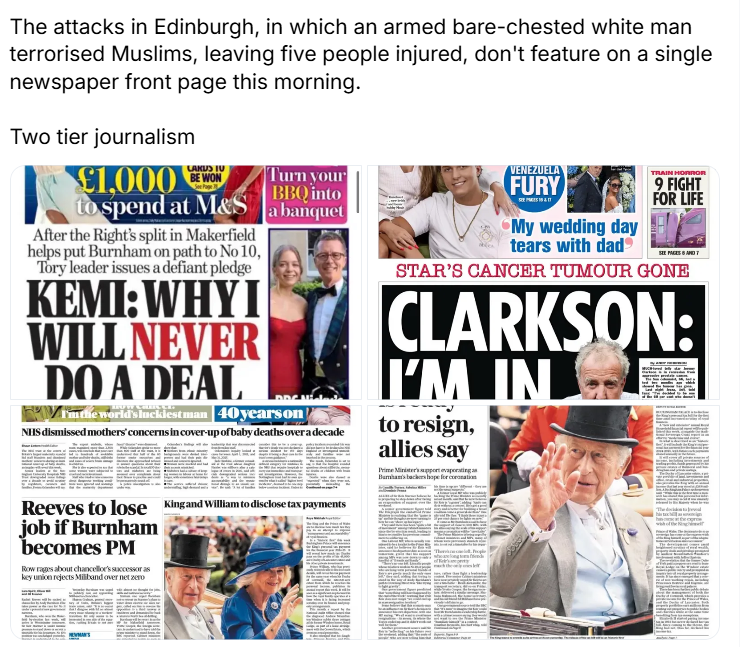
Posting on Bluesky alongside an image of the morning newspaper front pages, journalist Adam Bienkov wrote:
“The attacks in Edinburgh, in which an armed bare-chested white man terrorised Muslims, leaving five people injured, don’t feature on a single newspaper front page this morning. Two tier journalism.”
Bienkov contrasted the muted coverage with the intense media attention given to violence in Belfast earlier this month. Following the stabbing of a man by a Sudanese refugee, graphic footage spread rapidly across social media. Tommy Robinson, posting from Moscow, shared the video with his two million followers on X within hours, claiming it showed an “invader trying to behead a man.” Elon Musk subsequently called on people to protest.
Anti-immigration activists in Northern Ireland quickly seized on the incident, circulating protest locations and, in some cases, sharing alleged “hit lists” of migrants’ homes and hostels. The following day, images from the Belfast attack featured prominently on the front pages of the nationals. The Daily Mail went as far as to warn Britain has a “gaping back door” and raised what it described as “grave questions” about immigration policy. Its leader column urged the government to confront what it called “the migrant threat.”
The disparity in coverage certainly raises uncomfortable questions. If an attack on a minority community that leaves five people injured and is widely described as potentially motivated by anti-Muslim hatred fails to command national attention, while incidents involving migrants dominate front pages and political debate, accusations of “two-tier journalism” become harder to dismiss.
As Bienkov acknowledged, the Edinburgh story did receive coverage in parts of the Scottish press. But unlike the events in Belfast, it was not judged significant enough to lead the national news agenda, a contrast that speaks to broader concerns about how violence, extremism and minority communities are covered in Britain’s media.
An onlookers seemed to agree.
“Indeed, we don’t have a two tier policing problem, we have a two tier media problem,” wrote one BlueSky user.
Left Foot Forward doesn't have the backing of big business or billionaires. We rely on the kind and generous support of ordinary people like you.
You can support hard-hitting journalism that holds the right to account, provides a forum for debate among progressives, and covers the stories the rest of the media ignore. Donate today.
Donate today