Here’s some of the ways a US-UK trade deal could harm our health service
“Despite Donald Trump’s desperate attempt to row back his comments, the cat is well and truly out of the bag. The NHS would be on the table in any future US-UK trade talks."
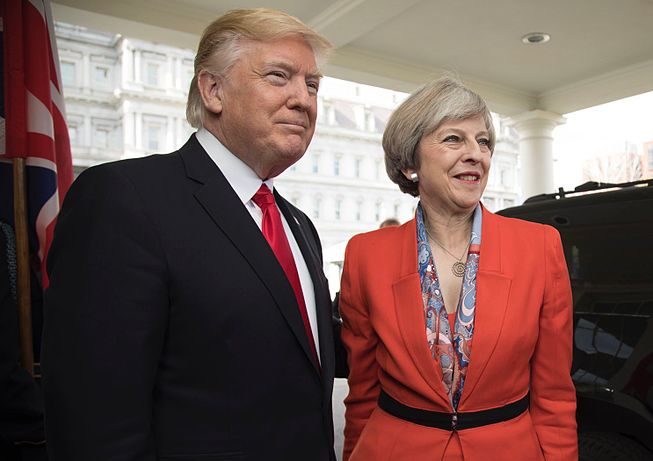
Donald Trump flip-flopped on using a trade deal to break up and fragment the NHS yesterday, first telling a press conference “everything will be on the table — the NHS, everything,” before, in the face of a massive backlash, telling Piers Morgan: “I don’t see it being on the table…that’s not trade.”
But whatever the shameless demagogue of ‘post-truth’ politics claims now, a new briefing by the People’s Vote campaign has made clear just how exposed the UK’s health care system would be in a US-UK trade deal.
US trade negotiators and lobbyists in Washington DC, have long seen breaking the NHS as key to their conquest of Europe.
But short of the NHS being open to full-scale privatisation, what would US negotiators demand? Here we share analysis by the People’s Vote campaign.
Medicine prices
Pharmaceutical companies insist that the NHS should pay more for its drugs (currently, prices in the UK are regulated by NICE). They spend hundreds of millions world-wide opposing any and all measures to limit drug prices and the great success of the NHS’s NICE regime is a prime target.
This is why, when Barack Obama proposed a highly limited health reform in the US, pharma lobbyists and their allies invented tales of “death panels” sitting in Britain to decide who lived or died – this is the political culture that feeds their desire to break our NHS.
The price of drugs is an important political issue in the United States. Donald Trump has blamed foreign ‘socialized’ healthcare providers like the NHS, saying that they do not pay enough for American made drugs. It is therefore very likely that in any trade negotiations, the US will attempt to force the NHS to pay higher prices for its drugs and medical devices.
A dodgy deal could lead to the NHS having to pay for ineffective and overpriced drugs. The Pharmaceutical Research and Manufacturers of America called the UK’s system for evaluating drugs a: “blunt cost containment tool” and went on to say, “narrow approaches to HTA [health technology assessments], such as rigid cost-effectiveness methodologies, should not be the principle framework for assessing value.” The message is clear: they want us to pay more even if the drugs don’t work.
The US’s official trade negotiation proposal states that negotiators will “Seek standards to ensure that government regulatory reimbursement regimes are transparent, provide procedural fairness, are non-discriminatory, and provide full market access for U.S. products” in the chapter for pharmaceuticals and medical devices.
And mega-lobbyists in the US Chamber of Commerce want to force the NHS to pay more for drugs – even if they don’t work as claimed. They want drug prices to be based on research and development costs – rather than effectiveness: “Sector-specific Regulatory Priorities [should] work to ensure pricing and reimbursement systems accurately and fairly reflect the value of R&D processes.” (US Chamber of Commerce, link) In other words, the public should bear the risk of high research costs, regardless of the effectiveness of the treatments.
Given that Donald Trump has in the past accused the NHS of ‘freeloading’ because it pays less for drugs than private hospitals in America, it should be clear that a ‘fair’ reimbursement regime in US eyes is one in which the health service pays much more for its drugs.
Last year Alex Azar, the US Health and Human Services Secretary, said: “On the foreign side, we need to, through our trade negotiations and agreements, pressure them. And so we pay less, they pay more. It shouldn’t be a one-way ratchet. We all have some skin in this game.”
US pharmaceutical lobbyists are among the most powerful and highest spending in Washington DC. They have been trying for years to break the NHS’ power to set the global price of medicines and they now see their chance.
Private healthcare firms running NHS Services
It is no secret that increasing portions of the NHS are run by private healthcare firms on behalf of the government. US healthcare firms have bid on and won contracts in the past, though on a small scale, and they would like to see more NHS services opened up to private American providers.
In the chapter titled “Government Procurement” US negotiators state that they will aim to “Increase opportunities for U.S. firms to sell U.S. products and services to the UK” and to “Ensure reciprocity in market access opportunities for U.S. goods, services, and suppliers in the UK.”
It is clear that any potential US-UK trade deal would mean opening up the NHS to potentially unscrupulous and inefficient American healthcare providers.
Paying more for medical equipment
Lobbyists at the US Advanced Medical Technology Association want President Trump to force the NHS to pay more for US-made equipment:
“The TPA states that one of the principal negotiating objectives of the United States shall be “to achieve elimination of government measures such as price controls and reference pricing which deny full market access for United States products.”
America First means putting the NHS last. A demand that could affect the NHS’ ability to acquire medical devices for patients at a reasonable cost.
Patient safety at risk
In the US, medical devices do not have to be tested if they are judged to be “substantially similar” to already tested devices.
But cases have already come to light where such untested devices been shown to be dangerous. It is a growing scandal: “Drugs must undergo two clinical trials before hitting the market, but fewer than half a percent of high-risk medical devices have undergone that standard. In 2015, the Food and Drug Administration received 16,000 reports of deaths associated with medical devices; one analysis estimated that only 1 percent of device-related deaths are reported to the FDA.”
The US Chamber of Commerce would like the UK to be similarly irresponsible: “[We should] promote greater cooperation between relevant U.S. and UK regulators to reduce unnecessary duplication of testing, spur innovation, and provide greater access to the best available medical devices.”
As Dr Rosena Allin-Khan, Labour MP and A&E Doctor says: “Despite Donald Trump’s desperate attempt to row back his comments, the cat is well and truly out of the bag. The NHS would be on the table in any future US-UK trade talks.
“A No Deal crash out Brexit is the biggest and best weapon the enemies of the NHS could ever hope to get their hands on.”
Josiah Mortimer is Editor of Left Foot Forward. Follow him on Twitter.
Left Foot Forward doesn't have the backing of big business or billionaires. We rely on the kind and generous support of ordinary people like you.
You can support hard-hitting journalism that holds the right to account, provides a forum for debate among progressives, and covers the stories the rest of the media ignore. Donate today.
Donate today