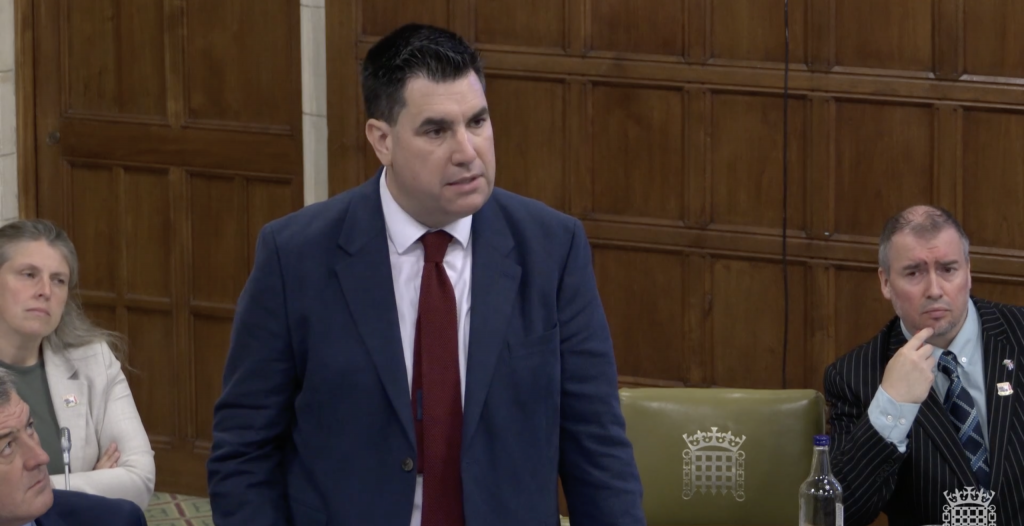
Richard Burgon MP: Tax Bank Super Profits to Tackle the Cost of Living Crisis
We go into the Autumn Budget with millions of people still being hammered by what feels like a never-ending cost-of-living […]
We go into the Autumn Budget with millions of people still being hammered by what feels like a never-ending cost-of-living crisis.
But while ordinary people struggle to cover the cost of life’s essentials, and with the fallout from Trump’s war on Iran set to push costs even higher, Britain’s biggest banks are doing very well indeed.
The so-called Big Four banks have been making tens of billions in additional profits from the very same interest rate rises that have left people facing mortgage misery and higher rents.
That is why I am campaigning for the Government to use the Budget to introduce a windfall tax on bank super-profits similar to that applied to oil and gas companies when their profits soared.
The funds raised could be used to bail out ordinary people, through an emergency cost-of-living package of support.
The scale of the banks’ windfall gains makes the case for action hard to ignore.
The four biggest banks in the UK made £46 billion in pre-tax profits in both 2024 and 2025, according to analysis from Positive Money.
That’s up nearly 80% on their average annual profits of £26 billion from 2018–2021, before interest rates began rising.
That trend is continuing. In the first six months of 2026 alone, the Big Four’s profits were 21% higher than in the same period last year.
We should be clear. These huge additional profits are not the result of improved services or some great innovation on their part.
They are windfall gains from economic circumstances that the banks themselves did not create.
One key way banks have boosted their profits is through the growing gap between what they charge borrowers and what they pay out to savers.
It’s literally easy money.
And what have they done with those profits?
TUC analysis shows that bankers’ bonuses reached their highest level since the 2008 financial crisis earlier this year.
Shareholders have also benefited handsomely. Between 2022 and 2024, the Big Four handed out £74 billion through dividend payments and share buybacks.
There is something deeply wrong with an economy when the same rate rises that hammer ordinary people lead to higher banking profits and bankers’ bonuses.
There is simply no good reason why the banks should be allowed to pocket all of those gains.
If extraordinary economic circumstances deliver huge gains to major corporations, it is only fair that some of that windfall is returned to the public.
When oil and gas companies made extraordinary profits as energy prices surged, a windfall tax was introduced.
The same principle should apply to banks benefiting from higher interest rates.
It is not even a radical policy. In 1981, Margaret Thatcher’s Conservative government imposed a one-off windfall levy on banks after they had benefited significantly from high interest rates.
TUC analysis suggests that a tax on bank super-profits similar to that on the oil and gas firms could raise around £15 billion a year.
That is a vast sum that could be used to ease pressure on living standards and help rebuild our public services.
We are constantly told there is not enough money for that.
But it’s clear the money is there.
The banks will, of course, warn that taxing them will somehow damage the economy.
Similar warnings are made whenever powerful interests are asked to contribute more, yet they rarely withstand scrutiny.
Even with an extra tax on windfall profits, banks would still have strong commercial incentives to lend and make a profit, as they did before higher rates led to these windfalls.
And as one ex-City banker quipped: “Banks can’t be too big to fail and too big to tax.”
There is also strong public support for taxing these bank windfalls. A TUC poll found that 66% supported a windfall tax on banks and other financial institutions.
I have put down a parliamentary motion calling for a windfall tax and, ahead of the Budget, I will be presenting a petition to Parliament backed by thousands of people calling for such a tax on bank super-profits.
Andy Burnham has rightly talked about ending 40 years of neoliberalism.
Taxing bank windfall profits to support households and rebuild our public services would be one way to start.
- You can sign Richard Burgon’s online petition here:
https://www.change.org/p/tax-bank-super-profits-at-the-budget
Left Foot Forward doesn't have the backing of big business or billionaires. We rely on the kind and generous support of ordinary people like you.
You can support hard-hitting journalism that holds the right to account, provides a forum for debate among progressives, and covers the stories the rest of the media ignore. Donate today.
Donate today