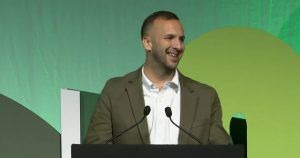
Jamie Driscoll interview: How the UK can make the economy work for everyone
LFF spoke to Jamie Driscoll at the Green Party's conference
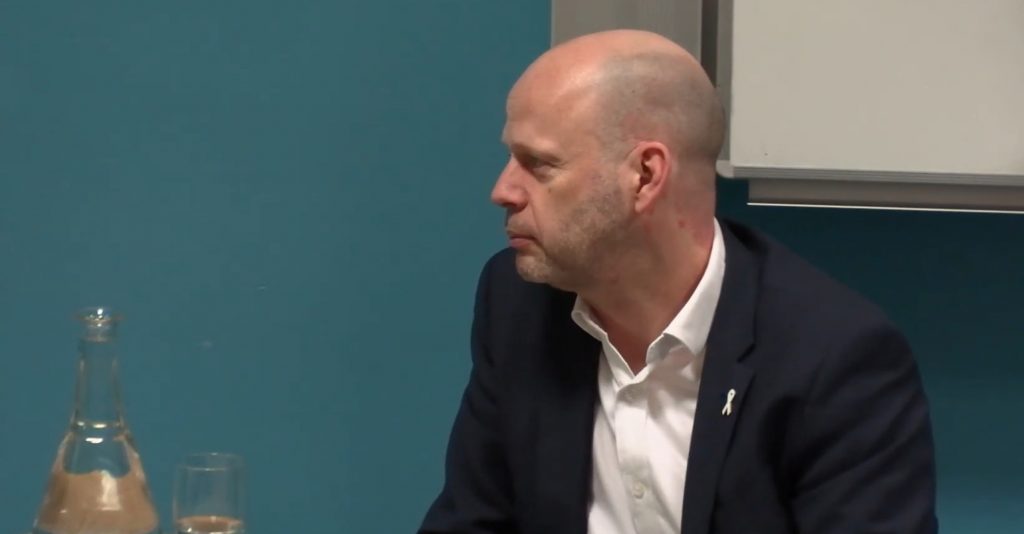
Jamie Driscoll served as Labour mayor of the North of Tyne from 2019 to 2024. Since then, he’s joined the Green Party and serves as a councillor on Newcastle City Council.
Since his election as a Green councillor, he’s been pushing for the Greens to up their game on economic policy. Part of this has been the release of a detailed new report – Hostage Nation – which seeks to make the case for a new approach to the economy.
LFF spoke to Driscoll at the Green Party’s autumn conference in Brighton about that report and his wider views on how Greens in local government can deliver transformative agendas in the context of more than a decade of austerity.
At the beginning of our conversation, Driscoll explained the underpinning issues the report seeks to address. He told LFF: “Pretty much everyone with any kind of social conscience knows we have serious problems with poverty – we have a housing crisis. Anyone who’s scientific literature knows that we are in a serious era of climate change.
“Yet we keep being told we haven’t got any money to build council houses, we’re going to have to wait for the market to sort us out on clean energy, we can’t build youth clubs or swimming pools anymore. So any idea of public luxury is out.
“And that’s told to us as if it’s scientific fact as if it’s a law of nature. The reality is we’ve got loads of money.”
He went on to argue that the UK government should be able to utilise the wealth that exists in the country to invest in public services and take the measures needed to address the climate emergency. Driscoll said: “There’s £70 billion a year goes in cash ISAs. We’ve got a pension pool of over two trillion in occupational pensions. Only 5 per cent of that is invested in British companies, and yet you get tax relief on it.
“So why don’t we just change it so that you can’t have tax relief for investing in silicon valley or fossil fuel exploration in the Middle East? If you want tax relief from British taxpayers, that money has to be invested in something socially useful for Britain – which is the building of council houses, retrofitting every home.”
He continued: “So if you went street by street and retrofitted every home in Britain, every pound you spend would get 40p back in tax immediately. And you can’t outsource this stuff. A crew of people working down Cedar Avenue in Leeds – that can’t be outsourced to a factory in China. So you crank the jobs, and if you crank the jobs, you’ve lowered the welfare bill.”
Some of the rhetoric that Driscoll uses is similar to that being used by the prime minister Andy Burnham. Burnham has spoken about ending neoliberalism, about bringing more control into the economy, and about not being ‘in hock’ to the bond markets.
What does Driscoll think of the early days of the Burnham government and its direction on the economy? He started his response by questioning the veracity of Labour leaders’ public rhetoric and pledges.
Driscoll told LFF: “I thought Keir Starmer’s 10 pledges were very good. I still think they’re good pledges. My opinion of Keir Starmer is somewhat different”.
He then continued: “How can you say we’ve got to get past this thing of being in hock to the bond markets and then say we will follow the fiscal rules?” before adding: “These are a political fiction not for managing the economy but for managing public opinion. If they’re going to lock themselves in a room and pretend they’re hostages then they’re not getting rid of neoliberalism.”
What should the Green Party do in light of Driscoll’s view that Burnham’s rhetoric doesn’t match reality?
Driscoll told LFF: “We should call it out. But you don’t call it out by saying that’s not ending neoliberalism because then the public will say ‘I don’t know what neoliberalism means’.
“So this is why you say look Andy, are you actually going to build 100,000 council houses every year? Are you going to make sure that everybody is on a living wage not a minimum wage? Anyone who’s serious about reducing the welfare budget has to get serious about structural wealth inequality.”
For the Greens, questions of national economic policy are – for now at least – a question of what concessions they can secure from the government, what they want to offer the electorate, and possibly what they would seek to deliver in the event they end up a partner in government after the next election.
But economic policy on a local level is a different matter entirely. The Greens are in sole or joint administration in dozens of councils across the country. In the context of more than a decade of austerity, rising costs of social care and temporary accommodation, and the reduction of economic levers at their disposal, delivering the kind of radical agenda Driscoll supports is a challenge.
He nonetheless thinks there are opportunities to utilise local government to improve people’s lives.
Driscoll told LFF: “The climate they’re operating in is extremely difficult, because not only is the financial effect of austerity on their services, on their staff extremely difficult, we’ve also stored up a huge amount of problems there. There are more people with mental ill health. There are more people who have been in financial distress for a much longer period of time. So the pressures are greater.”
He went on to say: “So you’ve got to be realistic. You are not going to build a people’s republic anywhere under the current financial system.
“That said, there are things you can do about engaging communities directly. There are things you can do about leaving money in. And there are still substantial budgets that are not procured in a way that either create the best possible jobs, the best environmental outcomes, or the best social outcomes”.
Driscoll would later add: “So it is about coming up with a manifesto and looking at the things that don’t cost a lot of money that at least signal that you’re doing the right things and will make people’s lives better. So it may be that there’s a park where the cafe’s been closed for ages – we’ll find a way to give that lease for peanuts to a local charity and get something out.”
Driscoll then argued that councils should be looking to bring public services back in house. He told LFF: “Perhaps you should be looking at a different procurement framework – if you are one of these councils that’s previously outsourced to Capita and the contract’s coming to an end, how are we actually going to not just roll that over again, how are we going to do some decent insourcing? Those are the kinds of things you can do.”
Chris Jarvis is head of strategy and development at Left Foot Forward
Left Foot Forward doesn't have the backing of big business or billionaires. We rely on the kind and generous support of ordinary people like you.
You can support hard-hitting journalism that holds the right to account, provides a forum for debate among progressives, and covers the stories the rest of the media ignore. Donate today.
Donate today